Why Organizations Cannot Change Fast and How they can

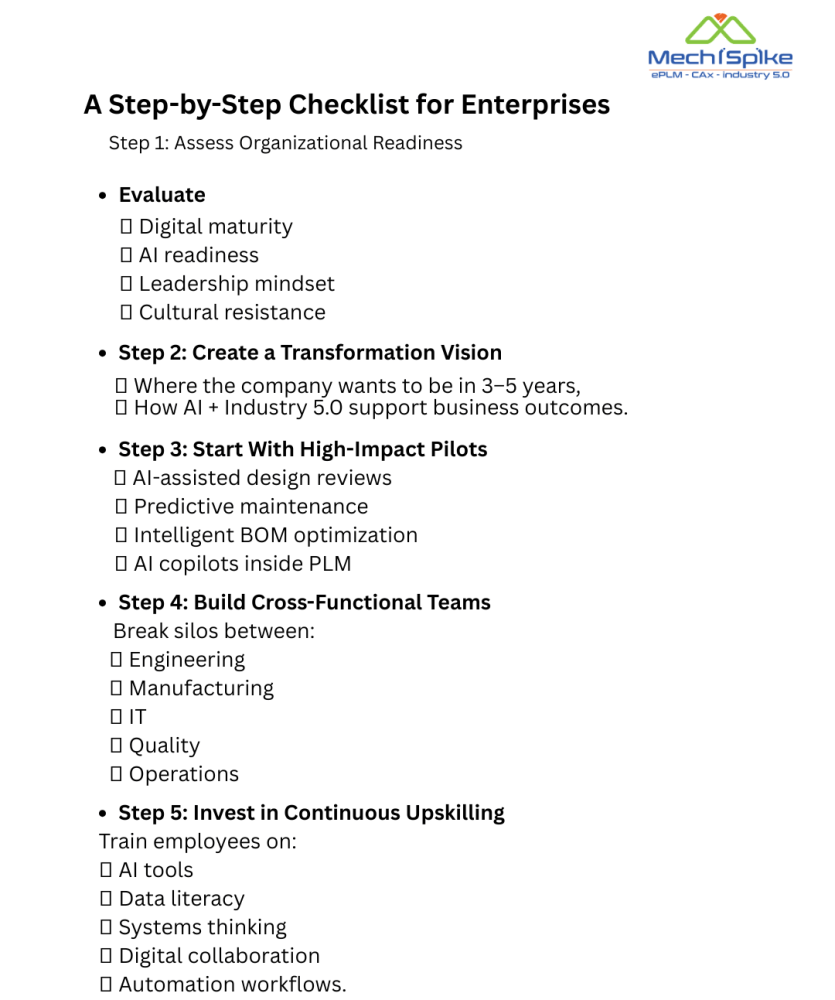
In this article, let’s explore why organizations cannot change fast and how they can with a checklist which can help enterprises and leaders.
Why Organizations Cannot Change Fast and How they can
For years, product manufacturers blamed slow transformation on legacy systems.
Old ERP systems.
Rigid PLM platforms.
Disconnected MES environments.
Outdated engineering workflows.
While these are certainly challenges, they are no longer the biggest obstacle.
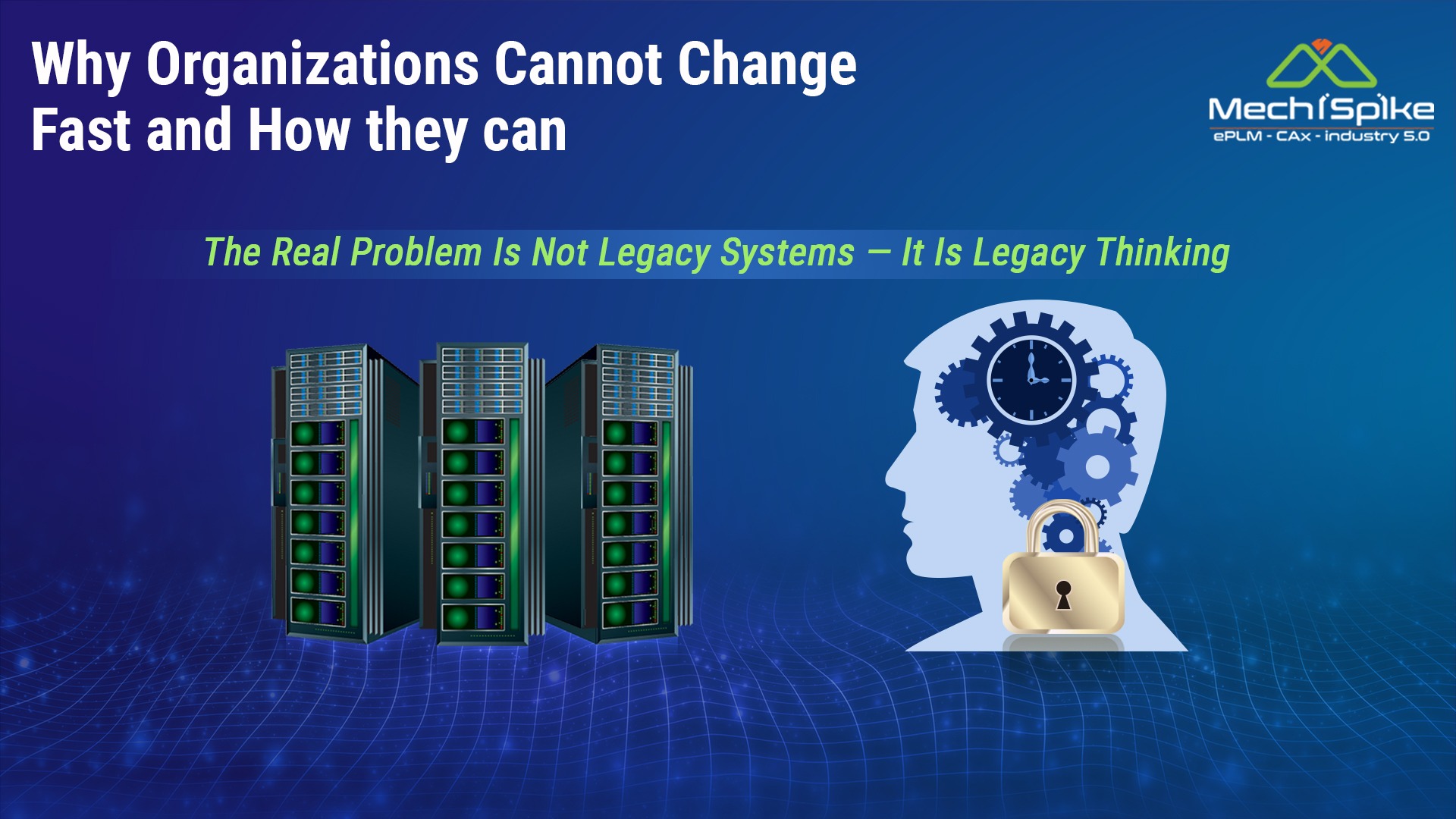
The Real Problem Is Not Legacy Systems — It Is Legacy Thinking
Today, manufacturing enterprises are entering an era shaped by AI, Industry 5.0, autonomous engineering, intelligent factories, and connected digital ecosystems. The companies that will struggle the most are not necessarily the ones with old technology stacks. They are the ones with old mindsets.
Because technology can be upgraded.
Thinking patterns are much harder to replace.
And that is precisely why organizational change is so difficult.
Why Organizations Cannot Change Fast
Most organizations are designed for stability, not transformation.
Over decades, enterprises create:
- Processes,
- Hierarchies,
- Approval systems,
- Reporting structures,
- Departmental silos,
- Operational habits
that optimize predictability and risk reduction.
This works well in stable environments.
But AI and Industry 5.0 are not stable shifts. They are disruptive shifts.
The challenge is that organizations continue responding to exponential change using linear thinking.
For example:
- AI evolves every few months.
- Product development cycles are shrinking dramatically.
- Customers expect personalization.
- Supply chains are becoming volatile.
- Engineering decisions increasingly depend on data intelligence.
Yet many enterprises still operate with:
- Yearly transformation planning,
- Slow approval chains,
- Rigid governance,
- Disconnected departments,
- Resistance to experimentation.
The result? : Organizations become too slow for the market they operate in.
The “Elephants Can’t Dance” Problem
Large enterprises face a unique problem: scale creates inertia.
A startup with 20 people can change direction in a week.
A manufacturing enterprise with:
- 50,000 employees,
- Multiple plants,
- Global suppliers,
- Legacy workflows,
- Compliance requirements,
- Decades of institutional habits
cannot move that quickly.
This is often described as the “elephants can’t dance” philosophy.
The larger the organization:
- the more dependencies exist,
- the more politics emerge,
- the more fear of disruption grows,
- and the harder transformation becomes.
Ironically, large organizations often possess:
- more talent,
- more resources,
- more data,
- and more technology
than smaller competitors.
Yet they struggle because their operating mindset was built for a different era.
Legacy Thinking in Product Manufacturing
In product design and manufacturing organizations, legacy thinking appears in many forms.
1. “This Is How We Have Always Done It”
Perhaps the most dangerous sentence in transformation.
Examples:
- Engineering reviews done manually despite AI assistance availability.
- Engineers recreating designs instead of reusing knowledge.
- Change management processes taking weeks.
- Excessive dependency on emails and spreadsheets.
2. Department-Centric Thinking
Many organizations still operate in silos:
- Design
- Manufacturing
- Quality
- Procurement
- Service
However, Industry 5.0 requires connected intelligence across the lifecycle.
The future belongs to enterprises where:
- PLM,
- ERP,
- MES,
- IoT,
- AI systems,
- and digital twins
work together as a connected ecosystem.
3. Fear of Experimentation
Many leaders fear failure more than irrelevance.
So instead of experimenting with AI:
- Organizations delay,
- Overanalyze,
- Create endless committees,
- and wait for certainty.
But in AI transformation, speed of learning matters more than perfection.
Understanding Change Management
Change management is not merely about implementing new software. It is about helping humans adopt new ways of thinking and working.
Most transformations fail because organizations focus only on technology, while ignoring:
- Behavior,
- Culture,
- Incentives,
- Leadership alignment,
- and Communication.
Successful change management requires five things:
1. Clear Vision
Employees must understand:
- Why change is happening,
- What future the company is moving toward,
- Why urgency exists.
2. Leadership Alignment
If leadership teams themselves resist change, the organization will never transform.
Transformation starts at the top.
3. Small Wins
Large-scale transformation cannot happen overnight.
Organizations need:
- Pilot projects,
- Measurable wins,
- Success stories &
- Internal champions.
4. Continuous Upskilling
AI and Industry 5.0 require constant learning.
Static skillsets quickly become obsolete.
5. Cultural Reinforcement
Transformation must become part of daily work, not a side initiative.
How Product Manufacturers Should Handle Change
Product manufacturers must now rethink transformation at three levels:
Level 1: Technology Transformation
Examples:
- AI-assisted engineering
- Intelligent PLM
- Digital twins
- Predictive manufacturing
- Autonomous quality systems
But technology alone is insufficient.
Level 2: Process Transformation
Manufacturers must redesign workflows:
- Faster engineering approvals,
- Connected product data,
- Real-time collaboration,
- AI-assisted decision-making,
- Digital continuity.
Level 3: Mindset Transformation
This is the hardest part.
Organizations must move from:
- Control → Adaptability
- Hierarchy → Collaboration
- Documentation → Intelligence
- Experience-only decisions → Data-assisted decisions
- Rigid planning → Continuous learning
The Future Role of Leaders
In the Industry 5.0 era, leaders can no longer function only as administrators.
They must become:
- Transformation orchestrators,
- Learning facilitators,
- Cultural architects,
- Systems thinkers.
Future leaders will spend less time controlling execution and more time enabling adaptability.
The role of leaders will increasingly involve:
- Helping teams embrace AI,
- Reducing resistance,
- Encouraging experimentation,
- Connecting technology with business outcomes.
Leaders who fail to evolve may become bottlenecks themselves.
Daily Activities Leaders Should Practice
Daily Activities
1. Spend 30 Minutes Learning
Leaders should continuously study:
- AI trends,
- Industry 5.0 developments,
- Manufacturing innovation,
- Digital transformation case studies.
2. Encourage Cross-Functional Conversations
Create daily interactions across departments.
3. Ask Better Questions
Instead of:
“How do we maintain current processes?”
Ask:
“How should this process work if designed today?”
4. Identify Friction
Look for:
- Delays,
- Approval bottlenecks,
- Repetitive manual work,
- Disconnected systems.
5. Promote Experimentation
Reward learning, not just success.
Weekly Leadership Activities
Weekly Plan
Monday
Review transformation KPIs and pilot progress.
Tuesday
Meet cross-functional teams to identify operational friction.
Wednesday
Conduct AI and technology learning sessions.
Thursday
Review customer feedback and market shifts.
Friday
Evaluate:
- Lessons learned,
- Failed experiments,
- Next transformation opportunities.
Essential Upskilling Areas for Leaders
Future-ready leaders should develop:
- AI literacy
- Systems thinking
- Data interpretation
- Digital collaboration
- Change leadership
- Emotional intelligence
- Scenario planning
- Strategic adaptability
Equally important are behavioral changes:
- Becoming more curious,
- More collaborative,
- More open to experimentation,
- and less dependent on hierarchy-driven decision making.
Conclusion
The biggest challenge facing product manufacturers today is not technology adoption. It is organizational adaptability.
AI and Industry 5.0 are exposing a hard truth:
Companies designed for stability struggle in environments demanding continuous reinvention.
Legacy systems can eventually be replaced.
Legacy thinking is far more dangerous because it slows decisions, discourages experimentation, and prevents organizations from evolving at the speed of change.
The future will belong to organisations that:
- Learn faster,
- Adapt faster,
- Collaborate better &
- Continuously reinvent themselves.
Because in the age of AI and Industry 5.0, transformation is no longer a one-time initiative.
It becomes the operating system of the enterprise itself.
MechiSpike can be of great help here to take your organization to the future of Product Design as well as Manufacturing with our focus on AI & Industry 5.0 using our prowess in PLM, Engineering and IT Digital.
Click here to know more about us.
For Corporates :
MechiSpike can be of great help to your organization to help you improve your PLM ROI and 30% Savings, be it the hiring cost in staffing or setting up an ODC.
We do this with efficient planning, organizing and controlling Product Master data with seamless data exchange among Engineering, Manufacturing and Enterprise systems.
With our well established niche expertise in PLM, we are now serving more than 15 Global Clients. They are now looking at us as a ‘Go To’ partner for Engineering, IT and PLM. With this confidence, we are expanding our scope of services beyond PLM to Industry 5.0 Digital Transformation i.e. PLM, ERP, CAD, Cloud, AI and DevOps.
Why MechiSpike :

RightSourcing is ‘Better Outsourcing’, given to ‘NICHE EXPERTS’.

Click here to know how we can actually help you with our Proven Methodologies.
For PLM Careers :
Learn More | Earn More | Grow More
Interactive UI : Every Application will get a response with a recruiter contact details and the applicant will get a notification at each phase until the applicant is positioned well with our 15+ global clients in India, USA & Germany.
Candidate Referral Program : Refer a candidate and earn INR 25,000.
Mechispike Solutions Pvt Ltd is a PLM focused company, having all kinds of PLM projects to enable employee career growth and add value to clients. We can position you better with our 15+ global clients in India, USA & Germany.
We believe in “Grow Together” and “Employee First” culture.
Dream more than a Job. Grow your PLM Career to the Fullest with MechiSpike
Click Here to explore our Job Openings.
Subscribe Now :
Our mission : To equip you with the knowledge and tools you need to drive value, streamline operations, and maximize return on investment from your PLM initiatives.
PLM ROI Newsletter will guide you through a comprehensive roadmap to help you unlock the full potential of your PLM investment.
We are committed to be your trusted source of knowledge and support throughout your PLM journey. Our team of experts and thought leaders will bring you actionable insights, best practices, case studies, and the latest trends in PLM.
Subscribe Now to get this weekly series delivered into your Inbox directly, as and when we publish it.
To your PLM success!
Warm regards,
Visit Us: www.mechispike.com
For PLM Services : Click Here to Schedule a Call with us.