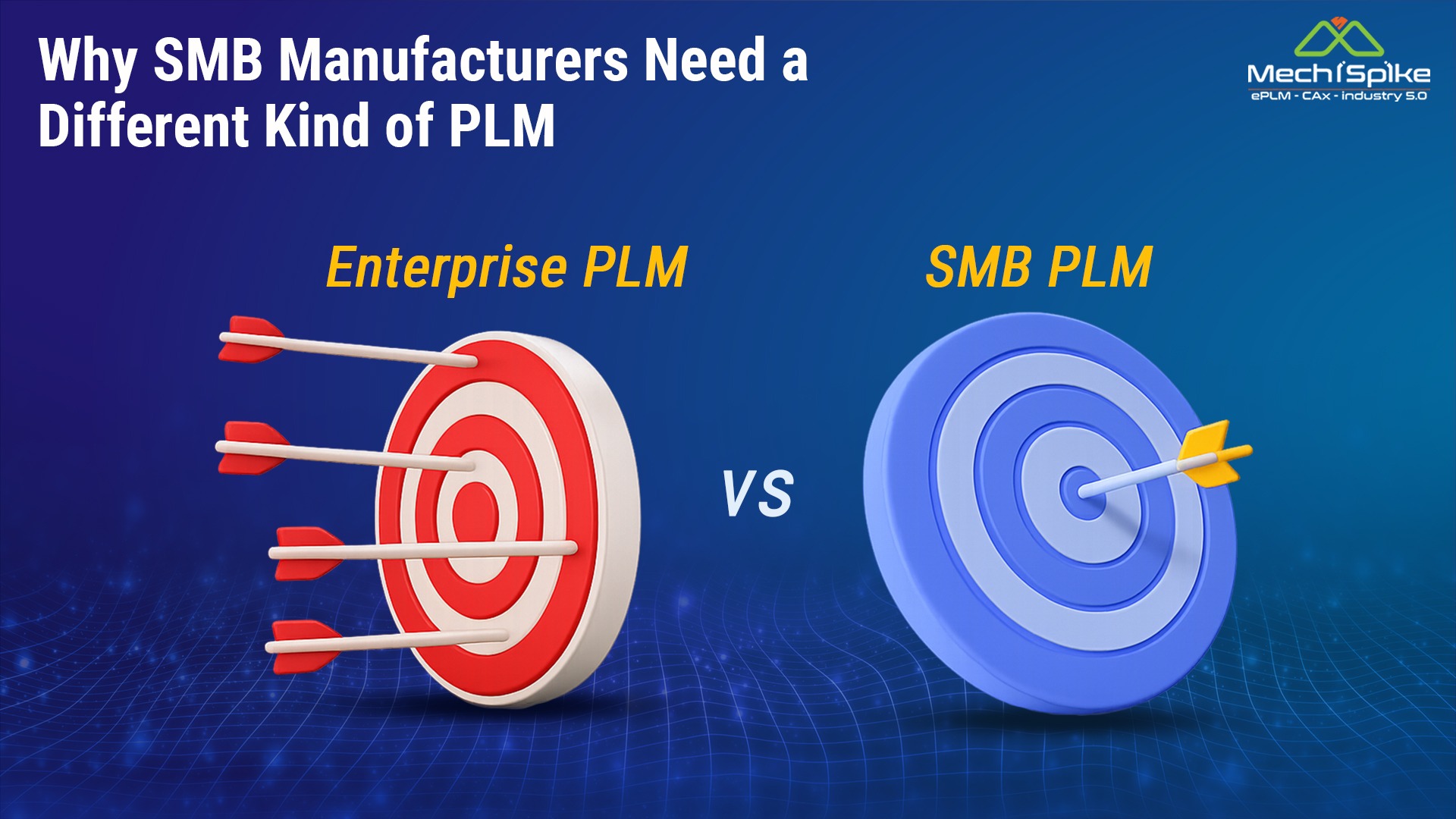
Why SMB Manufacturers Need a Different Kind of PLM : Enterprise PLM Vs SMB PLM

In this article, let’s explore one of the most underserved markets in Product Lifecycle Management – The SMBs. SMBs are not so simple that they can be managed using spreadsheets but are not that complex to need the bulky Enterprise PLM Software. They need something in the middle. Let’s understand why SMBs need a different kind of PLM, Features they need, a Decision Checklist whether they need SMB PLM or Enterprise PLM, Pros and Cons of SMB PLMs and how SMBs should select the right PLM software for their business.
Why SMB Manufacturers Need a Different Kind of PLM
For decades, Product Lifecycle Management (PLM) software has largely been designed for large enterprises.
Global automotive companies. Aerospace manufacturers. Industrial equipment giants. Electronics corporations operating across multiple countries.
These organizations manage enormous product complexity involving thousands of engineers, millions of parts, global suppliers, multiple manufacturing plants, and complicated regulatory requirements.
Naturally, PLM platforms evolved to manage this complexity.
The result?
Powerful enterprise PLM systems capable of managing almost every imaginable product lifecycle scenario.
But there is a problem.
They are often complex.
They can be bulky.
Implementation can take months or even years.
And they can be extremely expensive.
For a large global enterprise, this may be justified.
For a Small or Medium Business (SMB) manufacturing company, however, such a PLM implementation can easily become an overkill.
Yet the alternative is equally problematic.
Spreadsheets.
This has created what may be one of the most underserved markets in Product Lifecycle Management: The missing middle between spreadsheets and enterprise PLM.
And thousands of growing product manufacturers are stuck right in the middle.
SMB Manufacturers Are Not Simple Anymore
Consider a growing industrial equipment manufacturer.
Ten years ago, the company may have had:
- 20 products
- A small engineering team
- A handful of suppliers
- One manufacturing facility
Managing product information using spreadsheets, shared folders, and emails may have worked reasonably well.
Now imagine the same company after years of growth.
It may have:
- hundreds of product variants,
- thousands of parts,
- multiple suppliers,
- distributed engineering teams,
- growing compliance requirements,
- and increasingly complex customer configurations.
Suddenly, the spreadsheet starts becoming dangerous.
Which is the latest BOM?
Who changed the drawing?
Was the manufacturing team informed?
Has the supplier received the latest revision?
Which products use this component?
Why was this design changed three years ago?
The organization has outgrown informal product management.
But it may still not need the complexity of a massive enterprise PLM platform.
This is the PLM gap facing SMB manufacturers. They are too complex for spreadsheets, but not complex enough for enterprise PLM.
Why Enterprise PLM Can Become an Overkill for SMBs
Mainstream enterprise PLM systems are designed to solve enterprise-scale problems.
They may support:
- highly complex configuration management,
- multi-site product structures,
- global regulatory processes,
- advanced digital threads,
- sophisticated supplier ecosystems,
- and enterprise-wide integrations.
These are valuable capabilities.
But an SMB manufacturer may initially need something far simpler.
For example:
- Centralized product data
- Controlled BOM management
- Revision management
- Engineering Change Management
- Document control
- Basic CAD integration
- Approval workflows
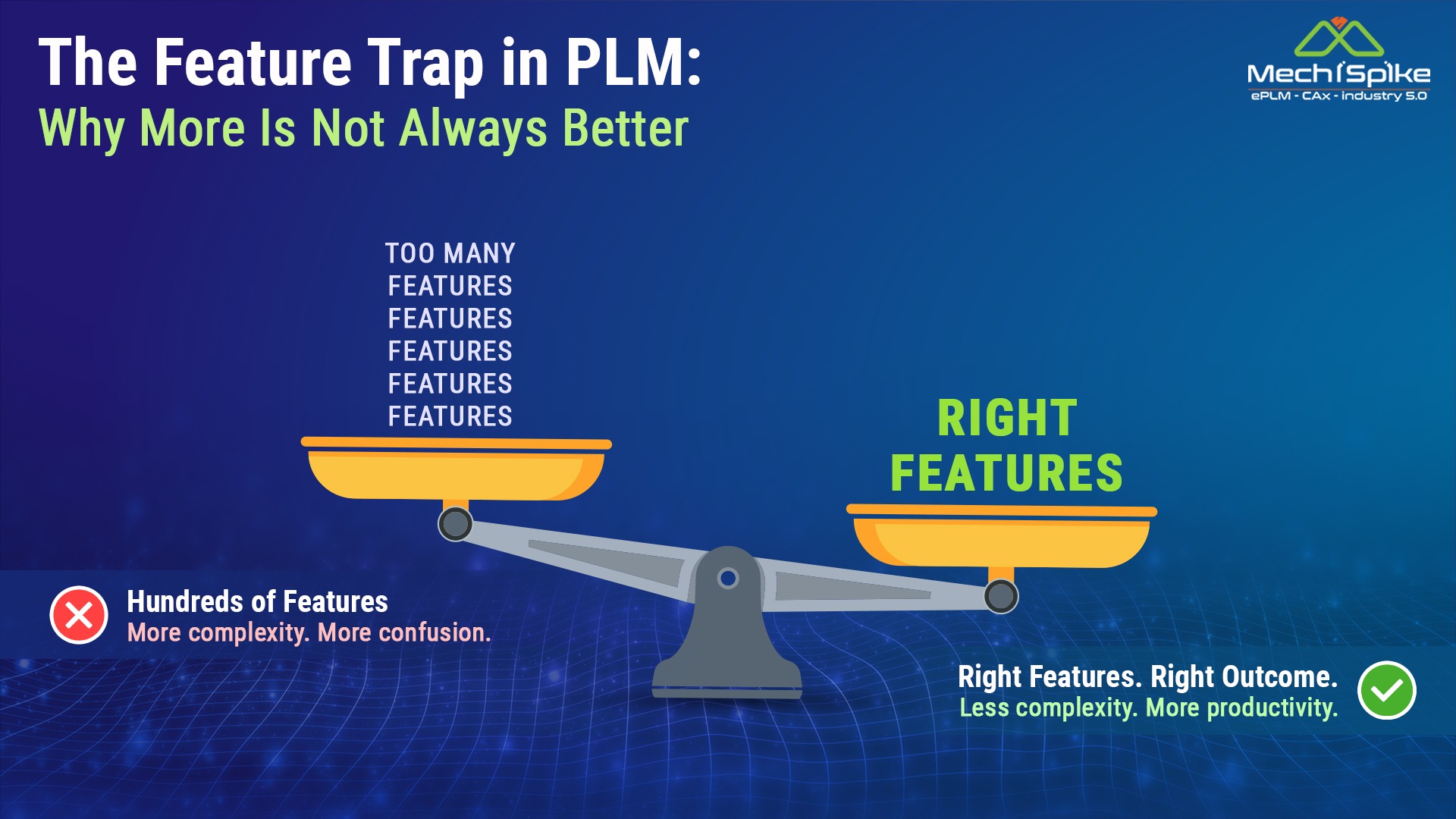
The problem occurs when an SMB purchases an enterprise platform containing hundreds of capabilities while actively using only a small percentage of them.
The company then pays not only for software licenses but also for:
- implementation,
- consulting,
- customization,
- infrastructure,
- integration,
- training,
- and ongoing administration.
The PLM system that was supposed to simplify engineering becomes another complicated system engineers struggle to use.
What SMB Manufacturers Actually Need
SMBs do not need a “smaller enterprise PLM.” They need a PLM platform designed around their operating reality.
The ideal SMB PLM should be:
Modern, flexible, accessible, scalable, and easy to adopt—while still providing real product governance.
This last point is important.
SMB PLM cannot simply be a glorified document management system.
It must provide genuine lifecycle control.
Essential Features of an SMB PLM
1. Centralized Product Data
There must be a single trusted location for:
- product information,
- drawings,
- specifications,
- and engineering documents.
Engineers should not search through email chains and shared folders.
2. BOM Management
The system should support:
- Product structures,
- BOM versions,
- Revisions,
- Component relationships.
For many SMB manufacturers, this alone can create significant value.
3. Revision and Version Control
Teams must clearly know:
- What changed,
- Who changed it,
- When it changed,
- Which version is approved.
4. Simple Engineering Change Management
SMBs need structured ECR and ECO processes.
But the workflows should be configurable without requiring months of consulting.
5. Document Control
Drawings, specifications, test reports, and certifications should remain linked to relevant products and parts.
6. CAD Connectivity
Basic integration with commonly used CAD environments can significantly improve engineering productivity.
7. ERP Integration
Product data should eventually flow into purchasing, inventory, and manufacturing systems.
8. Role and Rule-Based Governance
Traditional access controls remain important.
However, as AI agents become more common, PLM systems must increasingly support policy and rule-based access.
9. API-First Architecture
Modern PLM systems should integrate easily with:
- ERP,
- MES,
- AI platforms,
- Supplier systems,
- Automation tools.
10. AI Readiness
Future SMB PLM systems should support capabilities such as:
- Intelligent product search,
- BOM analysis,
- Duplicate part identification,
- Change impact analysis,
- Engineering knowledge retrieval.
AI should not be an after thought.
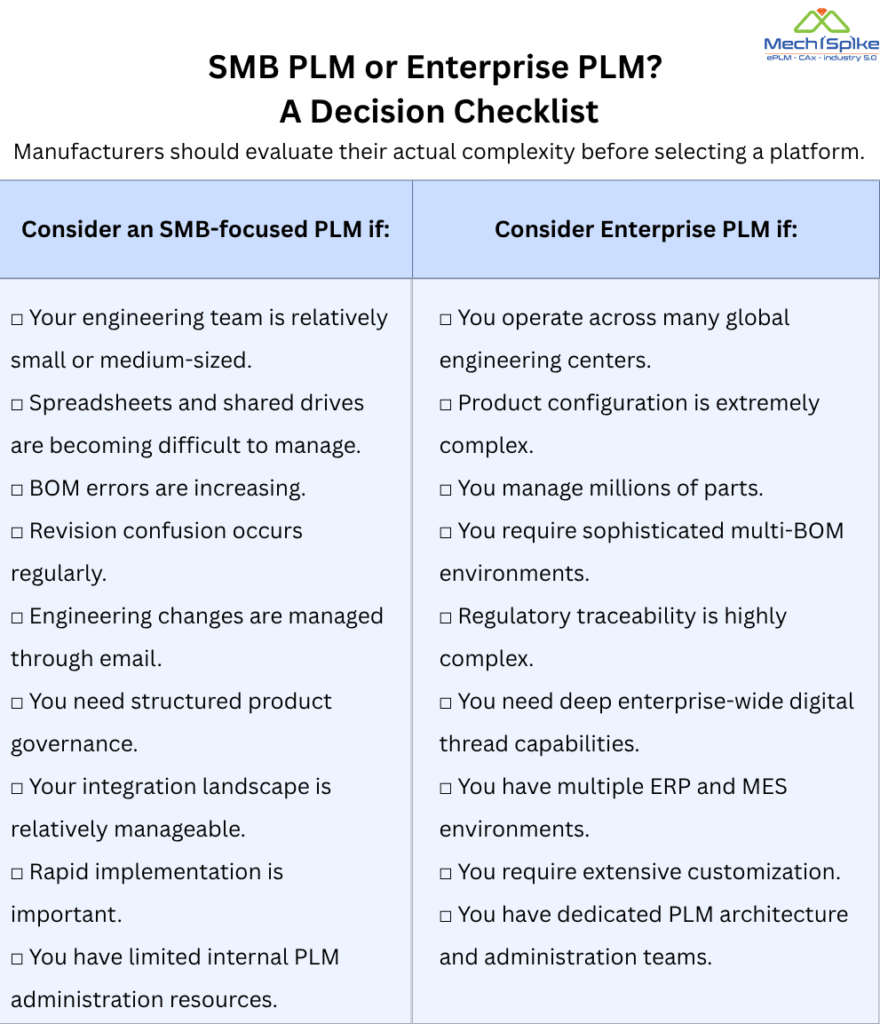
The important principle is simple: Buy PLM for the complexity you have—not the complexity a vendor says you may have someday.
The Pros of SMB PLM
Faster Implementation
Smaller platforms can often be deployed more quickly.
Lower Total Cost of Ownership
Licensing, implementation, and administration costs may be significantly lower.
Easier Adoption
Simpler user experiences encourage engineering participation.
Greater Flexibility
Modern platforms can adapt more easily to evolving processes.
Faster ROI
Organizations can begin solving immediate problems without waiting for a multi-year transformation.
The Cons and Risks of SMB PLM
SMB PLM is not automatically the correct answer.
Potential risks include:
Scalability Limitations
Rapid growth may eventually exceed platform capabilities.
Integration Constraints
Some platforms may lack mature enterprise connectors.
Vendor Maturity
Smaller PLM vendors may have limited global support.
Functional Gaps
Advanced configuration or regulatory capabilities may be missing.
Migration Risk
Organizations may eventually need to migrate to a larger platform.
This is why software selection matters enormously.
The Independent Consulting Problem
Unfortunately, selecting the right PLM platform is becoming increasingly difficult.
Many manufacturers rely heavily on software vendors and implementation partners for guidance.
Software vendors naturally understand their own platforms extremely well.
But they also have a commercial objective: Sell software.
A vendor is unlikely to say: “You probably do not need our enterprise PLM platform.”
Similarly, implementation partners may benefit from larger and more complex projects.
This does not mean vendors or partners provide bad advice.
But their commercial incentives must be understood.
On the other side, independent consulting has its own challenge.
Some independent consultants built their expertise around PLM technologies and architectures that dominated the market ten or fifteen years ago.
Today, the landscape is changing rapidly due to:
- Cloud PLM,
- SaaS platforms,
- AI,
- Agentic AI,
- API-first architectures,
- Composable enterprise systems.
Advice based entirely on yesterday’s PLM landscape may not prepare an SMB for tomorrow.
Use Independent Consultants Before Selecting the Software
Many businesses make a fundamental mistake. They first shortlist software. Then they hire consultants to help implement it.
Independent thinking should happen much earlier.
Before product demonstrations.
Before vendor negotiations.
Before issuing an RFP.
An independent PLM consultant should first help the business understand:
- Current product complexity,
- Engineering pain points,
- Future growth expectations,
- Integration requirements,
- Governance needs,
- AI readiness,
- Realistic budgets.
Only after this analysis should software options be evaluated.
The consultant’s first question should not be: “Which PLM software should we implement?”
It should be: “What PLM capability does this business actually need?”
That single change in approach can save years of frustration and significant investment.
A Better PLM Selection Approach for SMBs
A growing manufacturer can follow this simple sequence:
Step 1: Document current engineering problems.
Identify BOM, revision, change, and collaboration issues.
Step 2: Measure product complexity.
Understand parts, products, variants, users, and locations.
Step 3: Define the minimum PLM capability required.
Separate “must-have” features from “future possibilities.”
Step 4: Appoint an independent advisor.
Ensure the advisor has no commercial interest in a particular software sale.
Step 5: Evaluate modern architectures.
Consider cloud, SaaS, API readiness, and AI integration.
Step 6: Run a real-world pilot.
Use actual products, BOMs, and engineering changes.
Step 7: Measure user adoption.
If engineers avoid the system during the pilot, adding more features will not solve the problem.
Step 8: Evaluate five-year cost and scalability.
Consider licenses, implementation, integrations, administration, and migration risks.
The PLM Opportunity Nobody Should Ignore
The SMB manufacturing sector is enormous.
These organizations design:
- Industrial machinery,
- Automotive components,
- Electronics,
- Medical devices,
- Consumer products,
- Specialized equipment.
Their products are becoming more complex.
Their customers expect faster innovation.
Their supply chains are increasingly connected.
And AI will soon demand cleaner, better-structured product data.
Spreadsheets will not provide the product intelligence required for this future.
But neither should every manufacturer be forced into a massive enterprise PLM transformation.
There is a clear need for a new generation of PLM platforms built specifically for the SMBs.
Conclusion
PLM is no longer a requirement only for global manufacturing giants.
Growing SMB manufacturers increasingly need structured product data, BOM control, revision management, and Engineering Change Management.
However, the answer cannot always be a complex, bulky, and expensive enterprise PLM implementation.
SMBs occupy a critical middle ground.
They are too complex for spreadsheets—but often not complex enough for enterprise PLM.
The future opportunity lies in modern PLM platforms that combine simplicity with genuine product governance, flexibility with scalability, and affordability with AI readiness.
For manufacturers, the first step should not be selecting software. It should be independently understanding their actual product complexity and future requirements.
Because the best PLM system is not the one with the most features.It is the one that gives an organization exactly the product governance it needs—and allows it to grow intelligently from there.
MechiSpike can be of great help here to take your organization to the future of Design & Manufacturing with our focus on AI & Industry 5.0 using our prowess in PLM, Engineering and IT Digital.
Click here to know more about us.
For Corporates :
MechiSpike can be of great help to your organization to help you improve your PLM ROI and 30% Savings, be it the hiring cost in staffing or setting up an ODC.
We do this with efficient planning, organizing and controlling Product Master data with seamless data exchange among Engineering, Manufacturing and Enterprise systems.
With our well established niche expertise in PLM, we are now serving more than 15 Global Clients. They are now looking at us as a ‘Go To’ partner for Engineering, IT and PLM. With this confidence, we are expanding our scope of services beyond PLM to Industry 5.0 Digital Transformation i.e. PLM, ERP, CAD, Cloud, AI and DevOps.
Why MechiSpike :

RightSourcing is ‘Better Outsourcing’, given to ‘NICHE EXPERTS’.

Click here to know how we can actually help you with our Proven Methodologies.
For PLM Careers :
Learn More | Earn More | Grow More
Interactive UI : Every Application will get a response with a recruiter contact details and the applicant will get a notification at each phase until the applicant is positioned well with our 15+ global clients in India, USA & Germany.
Candidate Referral Program : Refer a candidate and earn INR 25,000.
Mechispike Solutions Pvt Ltd is a PLM focused company, having all kinds of PLM projects to enable employee career growth and add value to clients. We can position you better with our 15+ global clients in India, USA & Germany.
We believe in “Grow Together” and “Employee First” culture.
Dream more than a Job. Grow your PLM Career to the Fullest with MechiSpike
Click Here to explore our Job Openings.
Subscribe Now :
Our mission : To equip you with the knowledge and tools you need to drive value, streamline operations, and maximize return on investment from your PLM initiatives.
PLM ROI Newsletter will guide you through a comprehensive roadmap to help you unlock the full potential of your PLM investment.
We are committed to be your trusted source of knowledge and support throughout your PLM journey. Our team of experts and thought leaders will bring you actionable insights, best practices, case studies, and the latest trends in PLM.
Subscribe Now to get this weekly series delivered into your Inbox directly, as and when we publish it.
To your PLM success!
Warm regards,
Visit Us: www.mechispike.com
For PLM Services : Click Here to Schedule a Call with us.