
In this article, let’s explore the hidden problem with feature-rich PLM software and why more functionality does not always mean greater engineering productivity. Learn how cognitive load, poor adoption and complex workflows affect PLM ROI—and how AI can transform PLM from menu-driven software into an intent-driven engineering platform focused on Time-to-Engineering-Outcome.
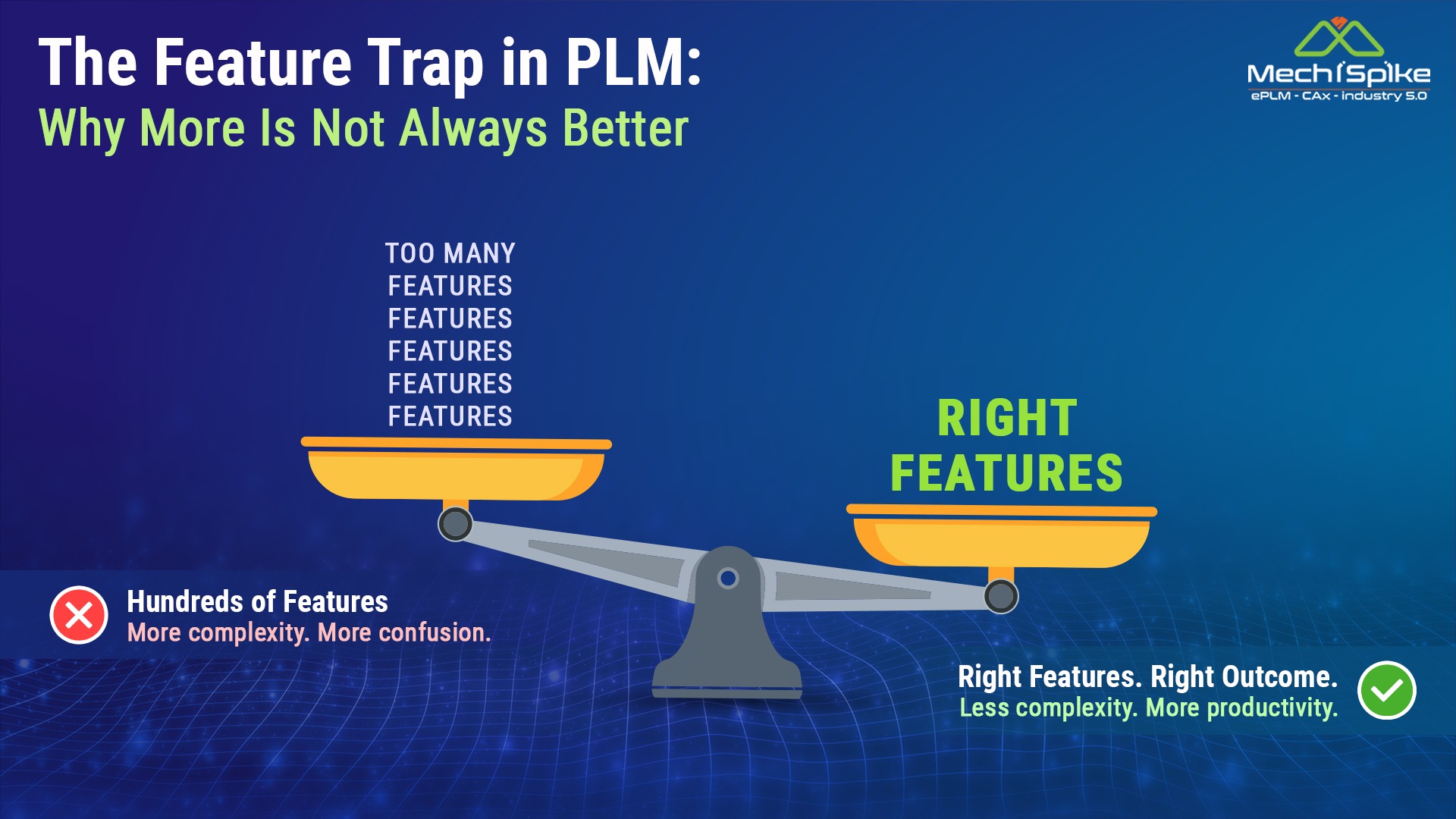
The Feature Trap in PLM: Why More Is Not Always Better
For decades, enterprise software has followed a seemingly logical principle:
More features = better software.
Product Lifecycle Management (PLM) has been no exception.
As manufacturing organizations became larger and products became more sophisticated, PLM platforms expanded to support almost every conceivable requirement:
- Product structures
- EBOM and MBOM management
- Engineering Change Management
- Requirements
- Configuration management
- Supplier collaboration
- Quality
- Compliance
- Project management
- Digital twins
- Manufacturing planning
- Service lifecycle management
The capability is impressive.
But somewhere along this journey, an uncomfortable question emerged:
Does adding more PLM functionality actually make engineers more productive? – Not necessarily.
In fact, PLM may occasionally suffer from the opposite problem.
The system becomes incredibly powerful—but increasingly difficult for ordinary engineers to use.
And in the AI and Industry 5.0 era, that deserves serious reconsideration.
Engineers Don’t Come to Work to “Use PLM”
This distinction is fundamental.
An engineer rarely starts Monday morning thinking: “Today I want to spend four hours using PLM.”
They have an engineering outcome to accomplish.
They want to:
- release a drawing,
- find the latest specification,
- modify a BOM,
- identify where a component is used,
- raise an engineering change,
- compare revisions,
- or obtain an approval.
PLM is simply the system enabling that outcome.
Therefore, perhaps the most important metric shouldn’t be:
How many features does our PLM have?
It should be:
How quickly and reliably can an engineer accomplish the intended outcome?
This changes the entire philosophy of PLM.
The Hidden Cost of PLM Complexity
Imagine a PLM screen containing:
- 15 tabs,
- 40 attributes,
- multiple menus,
- workflow options,
- relationship types,
- classification choices,
- configuration rules.
Every individual capability may have a perfectly valid business justification.
Collectively, however, they create cognitive load.
An engineer must constantly decide:
Which object should I create?
Which relationship should I use?
Which lifecycle state applies?
Which workflow should I select?
Which fields are mandatory?
Which revision rule is correct?
Each additional decision creates friction.
One decision is insignificant.
Hundreds of small decisions every week are not.
Multiply that across 5,000 engineers and PLM complexity becomes an organizational productivity issue.
When Feature Richness Creates “Silent Failure”
The dangerous part is that complicated PLM systems don’t necessarily fail technically.
The server works.
Workflows execute.
Data gets stored.
Integrations function.
Dashboards remain green.
Yet something else happens.
Engineers quietly develop workarounds.
Excel spreadsheets appear.
Files get downloaded locally.
Teams maintain unofficial trackers.
Approvals happen over email or chat before someone updates PLM later.
Experienced users ask PLM specialists to perform difficult transactions for them.
Nothing has technically failed. But adoption has. This is silent PLM failure.
And it can be more dangerous than an obvious system outage because management may believe the implementation is successful.
The PLM Expert’s Bias
There is another reason complexity accumulates.
PLM architects, administrators, consultants and software developers spend years understanding their systems.
They know:
- object models,
- workflows,
- relationships,
- configuration rules,
- navigation structures.
Something that appears straightforward to a PLM expert may feel completely unnatural to a design engineer who enters the system twice a week.
This creates an important bias.
The people designing PLM are frequently not the people experiencing PLM.
A PLM architect might admire the sophistication of a configurable workflow.
An engineer might simply wonder:
“Why does releasing this drawing require twelve clicks?”
Both perspectives matter.
But ultimately, PLM exists to enable the product-development organization—not the other way around.
Feature Utilization Should Matter More Than Feature Availability
Consider an enterprise PLM implementation containing 200 capabilities.
Suppose:
20 capabilities account for 80% of user activity.
Another 50 are occasionally used.
The remaining 130 are rarely touched.
Yet all 200 contribute in some way to:
- configuration complexity,
- testing,
- upgrades,
- documentation,
- training,
- administration,
- and possibly licensing costs.
This raises an interesting question:
Should PLM leaders measure feature availability—or feature utilization?
Organizations routinely monitor infrastructure utilization.
CPU utilization.
Cloud utilization.
Software license utilization.
Why not PLM functionality utilization?
Which capabilities are genuinely creating value?
Which are rarely used?
Which create more complexity than benefit?
From Feature Thinking to Journey Thinking
A better approach would be to design PLM around common engineering journeys.
For example:
Journey 1: Find a Part
Search → Identify → Verify Revision → Use.
Journey 2: Release a Drawing
Upload → Validate → Review → Approve → Release.
Journey 3: Change a Component
Identify → Where-Used → Impact Analysis → Approval → Implementation.
Instead of asking:
“What additional functionality should we implement?”
ask:
“Where does this engineering journey become unnecessarily difficult?”
That single question can completely change PLM improvement priorities.
Perhaps engineers don’t need another dashboard.
Perhaps they need better search.
Perhaps they don’t need another workflow feature.
Perhaps they need three approval steps removed.
AI Could Fundamentally Change This Equation
This becomes particularly interesting with Generative AI and Agentic AI.
Historically, sophisticated enterprise capabilities often required sophisticated interfaces.
AI potentially separates the two.
Imagine an engineer simply asking:
“Show me all released assemblies containing Part ABC-123.”
The AI navigates the underlying PLM relationships.
Or:
“Start a change request replacing Supplier A’s bearing with Supplier B’s equivalent and identify affected products.”
An AI agent could:
- Find the component.
- Perform where-used analysis.
- Identify affected BOMs.
- Retrieve previous similar changes.
- Prepare an impact assessment.
- Draft the ECR.
- Route it for appropriate human approval.
The underlying PLM may remain extremely sophisticated. But the engineer’s interaction becomes remarkably simple.
This could become one of AI’s greatest contributions to PLM:
AI may allow enterprises to retain backend complexity while dramatically reducing frontend complexity.
From Navigation to Intent
Traditional PLM asks users to understand the system.
Future PLM may increasingly ask the system to understand the user.
Today:
User → Menu → Object → Search → Workflow → Action
Tomorrow:
User → Intent → AI → PLM Action
That is a profound shift.
PLM could evolve from a system engineers must learn to navigate into an engineering intelligence layer they simply communicate with.

These questions may reveal more about PLM effectiveness than another feature comparison matrix.
A New PLM Metric: Time-to-Outcome
Perhaps PLM needs a new family of KPIs.
Instead of only measuring:
- uptime,
- transactions,
- workflows completed,
- objects created,
measure:
Time to Find
How quickly can an engineer locate trusted information?
Time to Change
How quickly can an engineering change move from identification to implementation?
Time to Release
How quickly can approved designs reach manufacturing?
Time to Understand
How quickly can someone understand why a product decision was made?
Collectively, these represent something more meaningful:
Time-to-Engineering-Outcome.
Simplicity Is Not the Opposite of Capability
There is an important misconception here.
Simplifying PLM does not mean removing enterprise capability.
Complex products require sophisticated governance.
Aerospace, automotive, medical-device and industrial manufacturers cannot simply eliminate configuration control, traceability or compliance.
The objective should therefore not be:
Make PLM simple by making PLM less capable.
It should be:
Make sophisticated PLM capabilities easier to consume.
That means better workflows.
Better search.
Better defaults.
Better interfaces.
Fewer unnecessary decisions.
And increasingly, AI-powered interaction.
Conclusion
PLM platforms have become extraordinarily powerful because the products and enterprises they manage are extraordinarily complex.
That capability remains essential.
But feature richness should never become the objective itself.
The true purpose of PLM is to help organizations design, manufacture, change and support better products.
In the Industry 5.0 era, PLM leaders therefore need to shift their thinking:
From features to outcomes.
From navigation to intent.
From system utilization to engineering productivity.
From adding functionality to removing friction.
And AI could accelerate this transformation dramatically by hiding unnecessary complexity while exposing intelligence exactly when engineers need it.
The PLM of the future may actually become more powerful underneath—and feel dramatically simpler on the surface.
That should be the goal.
Because the best PLM system is not the one where engineers can do the most things.
It is the one that helps engineers get the right things done—with the least possible friction.
MechiSpike can be of great help here to take your organization to the future of Design & Manufacturing with our focus on AI & Industry 5.0 using our prowess in PLM, Engineering and IT Digital.
Click here to know more about us.
For Corporates :
MechiSpike can be of great help to your organization to help you improve your PLM ROI and 30% Savings, be it the hiring cost in staffing or setting up an ODC.
We do this with efficient planning, organizing and controlling Product Master data with seamless data exchange among Engineering, Manufacturing and Enterprise systems.
With our well established niche expertise in PLM, we are now serving more than 15 Global Clients. They are now looking at us as a ‘Go To’ partner for Engineering, IT and PLM. With this confidence, we are expanding our scope of services beyond PLM to Industry 5.0 Digital Transformation i.e. PLM, ERP, CAD, Cloud, AI and DevOps.
Why MechiSpike :