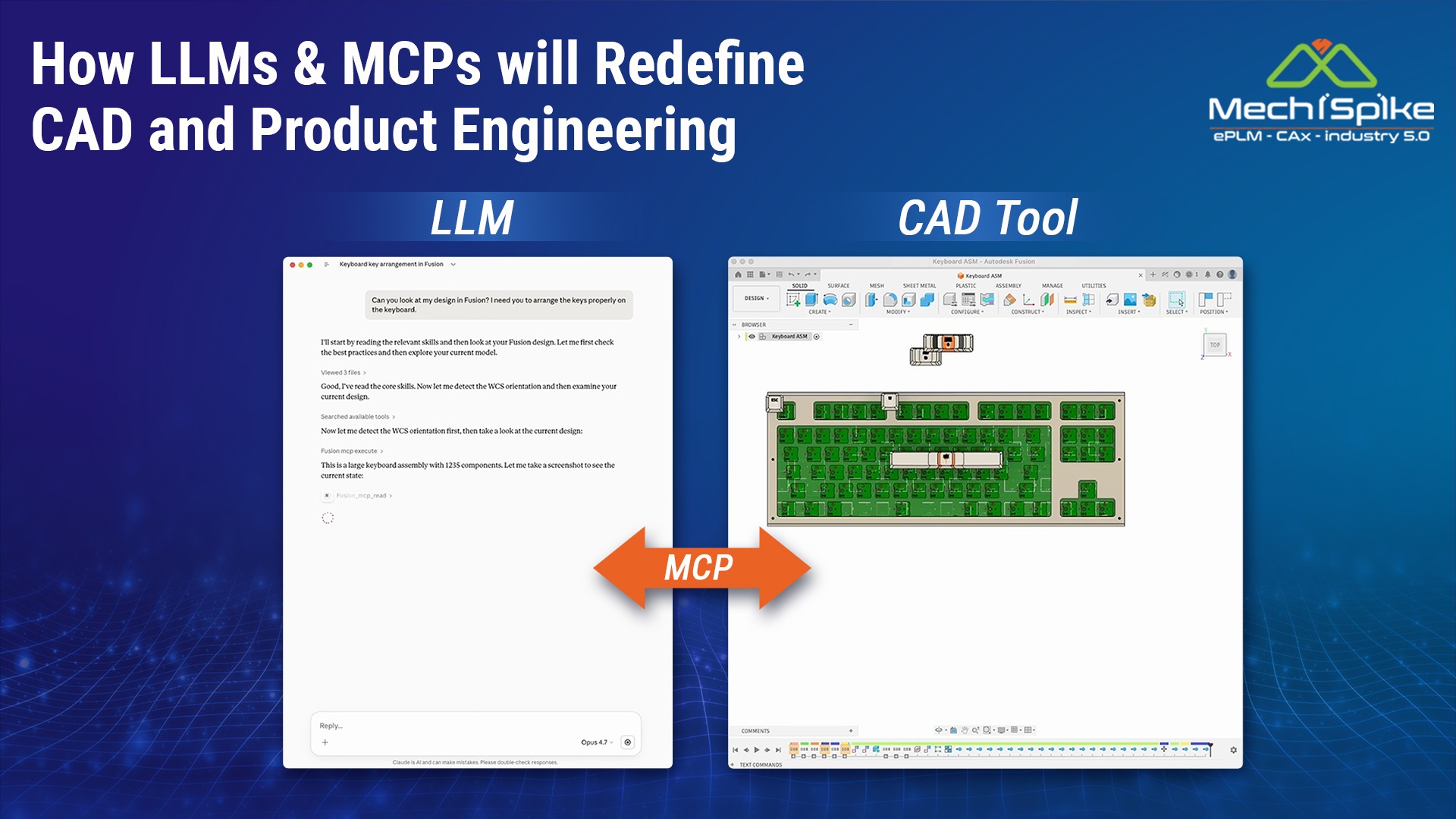

Let’s dive deeper into this. Let’s explore how CAD + LLM integration works with MCPs, the current landscape, how it will evolve, and what engineers and organizations must do to prepare.
What Is MCP and Why It Matters for CAD
A Model Context Protocol (MCP) is a structured interface that allows AI models to:
- Access application data
- Understand context (objects, relationships, constraints)
- Perform actions within defined permissions
In CAD systems, MCP acts as the translation layer between:
- Human intent (expressed in natural language)
- CAD system data (features, sketches, assemblies, constraints)
Without MCP:
- LLMs operate blindly on text
- No reliable access to geometry or parametric relationships
With MCP:
- LLMs can query model features
- Modify parameters
- Trigger operations
- Maintain design intent
Current Landscape: CAD Systems, MCPs, and LLMs
While still early, several patterns are emerging across the ecosystem.
CAD Platforms Moving Toward MCP-Like Integrations
Different CAD environments are enabling AI access through APIs, plugins, or structured context layers:
- Cloud-based CAD platforms are exposing rich APIs that can serve as MCP-like interfaces
- Desktop CAD tools are enabling plugin-based integrations
- Some platforms are experimenting with native AI copilots
These integrations allow AI models to:
- Read model structure
- Modify sketches and parameters
- Automate repetitive modeling tasks
LLMs Being Integrated
Common LLM categories used include:
- General-purpose LLMs (for language understanding and reasoning)
- Code-oriented models (for parametric scripting and automation)
- Domain-adapted models (trained on engineering data)
These models are increasingly capable of:
- Translating text into parametric operations
- Interpreting engineering constraints
- Generating structured outputs
MCP Variants Emerging
Although not standardized across the entire industry yet, MCP-like implementations include:
- API-based context layers
- Plugin-driven command execution frameworks
- Agent-based orchestration systems
- Retrieval-augmented systems linked to CAD/PLM data
Over time, these will likely converge into standardized protocols for engineering systems.
How LLM + MCP Integration Changes Product Design
The integration fundamentally changes how engineers interact with CAD systems.
1. From Command-Based to Intent-Based Design
Today:
- Engineers manually create sketches
- Apply constraints
- Build features step by step
With LLM + MCP:
- Engineers describe intent
- AI translates into parametric operations
- System generates initial geometry
Example: “Create a heat sink optimized for airflow and minimal material usage” → AI generates initial geometry → Engineer refines constraints
2. Faster Design Iteration
AI can:
- Generate multiple variants
- Evaluate trade-offs
- Suggest improvements
Engineers focus on selection and validation, not creation.
3. Embedded Engineering Intelligence
LLMs can:
- Suggest materials
- Check compliance rules
- Recommend manufacturable designs
This integrates knowledge directly into the design process.
4. Seamless PLM Integration
With MCP connected to PLM systems:
- Designs are automatically linked to BOMs
- Changes trigger impact analysis
- Version control is maintained
This creates a continuous digital thread.
Practical Use Cases
1. Concept Design Acceleration
Generate multiple concepts quickly from textual input.
2. Design Optimization
AI suggests geometry changes for:
- weight reduction
- strength improvement
- cost optimization
3. Automation of Repetitive Tasks
- Feature creation
- Pattern generation
- Constraint application
4. Design Validation
AI checks:
- manufacturability
- compliance
- tolerance constraints
5. Knowledge Reuse
AI retrieves past designs and suggests reuse.
How This Integration Will Evolve
Phase 1: AI Assistants Inside CAD
- Copilots help with commands
- Limited automation
Phase 2: Agent-Based Design Execution
- AI agents perform multi-step tasks
- Workflows become semi-autonomous
Phase 3: AI-Native Design Environments
- Engineers interact via intent
- Systems generate and validate designs
- UI becomes secondary
Phase 4: Autonomous Design Systems
- AI generates complete design options
- Engineers supervise and approve
Challenges to Overcome
1. Precision and Reliability
Engineering requires exactness—AI must meet strict tolerances.
2. Design Intent Preservation
Generated models must maintain clean parametric structures.
3. Integration Complexity
Connecting CAD, PLM, ERP, and AI systems is non-trivial.
4. Trust and Adoption
Engineers must trust AI outputs.
5. Data Security
Sensitive design data must be protected.

Organizational Changes Required
To implement LLM + MCP integration, organizations must:
1. Build Data Foundations
- Clean, structured CAD and PLM data
- Standardized models
2. Enable API-First Architecture
- Systems must be accessible to AI agents
- Integration layers must be robust
3. Redesign Workflows
Shift from:
- manual design steps to
- AI-assisted design validation
4. Update Governance Models
Define:
- AI permissions
- validation checkpoints
- audit mechanisms
5. Upskill Workforce
Train engineers in:
- AI collaboration
- decision-making
- advanced design thinking
6. Redefine KPIs
Measure:
- design cycle time reduction
- AI-assisted productivity
- rework reduction
- innovation rate
The Bigger Picture: From CAD Tools to Design Intelligence Platforms
CAD systems are evolving from:
Geometry creation tools
to
Intelligent design platforms
In this future:
- Data becomes the interface
- AI becomes the executor
- Humans become decision-makers
This aligns with the broader shift toward AI-native engineering systems.
Conclusion
The integration of LLMs with CAD systems through MCP-like frameworks represents a fundamental shift in product design. By enabling AI to understand and act on engineering context, these technologies promise faster innovation, better designs, and more efficient workflows.
However, success will depend on more than technology. Organizations must invest in data quality, redesign workflows, and upskill engineers to collaborate effectively with AI systems.
For engineers, the future is not about competing with AI—but about leveraging it to amplify creativity, insight, and decision-making.
The next generation of product design will not be driven by commands and clicks—but by intent, intelligence, and collaboration between humans and machines.
MechiSpike can be of great help here to take your organization to the future of Product Design as well as Manufacturing with our focus on AI & Industry 5.0 using our prowess in PLM, Engineering and IT Digital.
Click here to know more about us.
For Corporates :
MechiSpike can be of great help to your organization to help you improve your PLM ROI and 30% Savings, be it the hiring cost in staffing or setting up an ODC.
We do this with efficient planning, organizing and controlling Product Master data with seamless data exchange among Engineering, Manufacturing and Enterprise systems.
With our well established niche expertise in PLM, we are now serving more than 15 Global Clients. They are now looking at us as a ‘Go To’ partner for Engineering, IT and PLM. With this confidence, we are expanding our scope of services beyond PLM to Industry 5.0 Digital Transformation i.e. PLM, ERP, CAD, Cloud, AI and DevOps.
Why MechiSpike :