How PLM Careers Are Changing in AI & Industry 5.0 Era

In this article, let’s look at how PLM Careers Are Changing in AI & Industry 5.0 Era.
How PLM Careers Are Changing in AI & Industry 5.0 Era
For years, Product Lifecycle Management (PLM) careers followed a fairly predictable path.
A professional would begin with:
- Configuration,
- Support,
- BOM management,
- Workflows,
- Integrations,
- and gradually move toward architecture and leadership roles.
That path still exists. But AI and Industry 5.0 are changing the nature of PLM careers dramatically.
Today, the PLM professional is no longer just managing product data. They are increasingly becoming:
- Digital transformation enablers,
- AI workflow orchestrators,
- Digital thread architects,
- Enterprise integration specialists,
- and eventually strategic innovation leaders.
The future of PLM is no longer only about systems. It is about intelligence, connectivity, automation, and adaptability.
And that means the skills required at every stage of a PLM career are evolving rapidly.
Why PLM Careers Are Changing
Historically, PLM implementations focused heavily on:
- Process standardization,
- Document management,
- CAD integrations,
- Change management,
- Lifecycle governance.
But modern manufacturing enterprises are now entering the age of:
- AI copilots,
- Digital twins,
- Connected factories,
- Industry 5.0,
- Predictive intelligence &
- Agentic AI systems.
This is fundamentally changing enterprise expectations from PLM professionals. Companies no longer want PLM teams that only maintain systems.
They want professionals who can:
- Connect engineering ecosystems,
- Enable intelligent automation,
- Improve decision-making,
- Drive enterprise-wide transformation.
In many organizations, PLM is gradually becoming the “digital backbone” connecting:
- Engineering,
- Manufacturing,
- Supply chain,
- Quality,
- Service,
- and AI systems.
As a result, PLM careers are becoming broader, more strategic, and more interdisciplinary.
The New PLM Career Journey
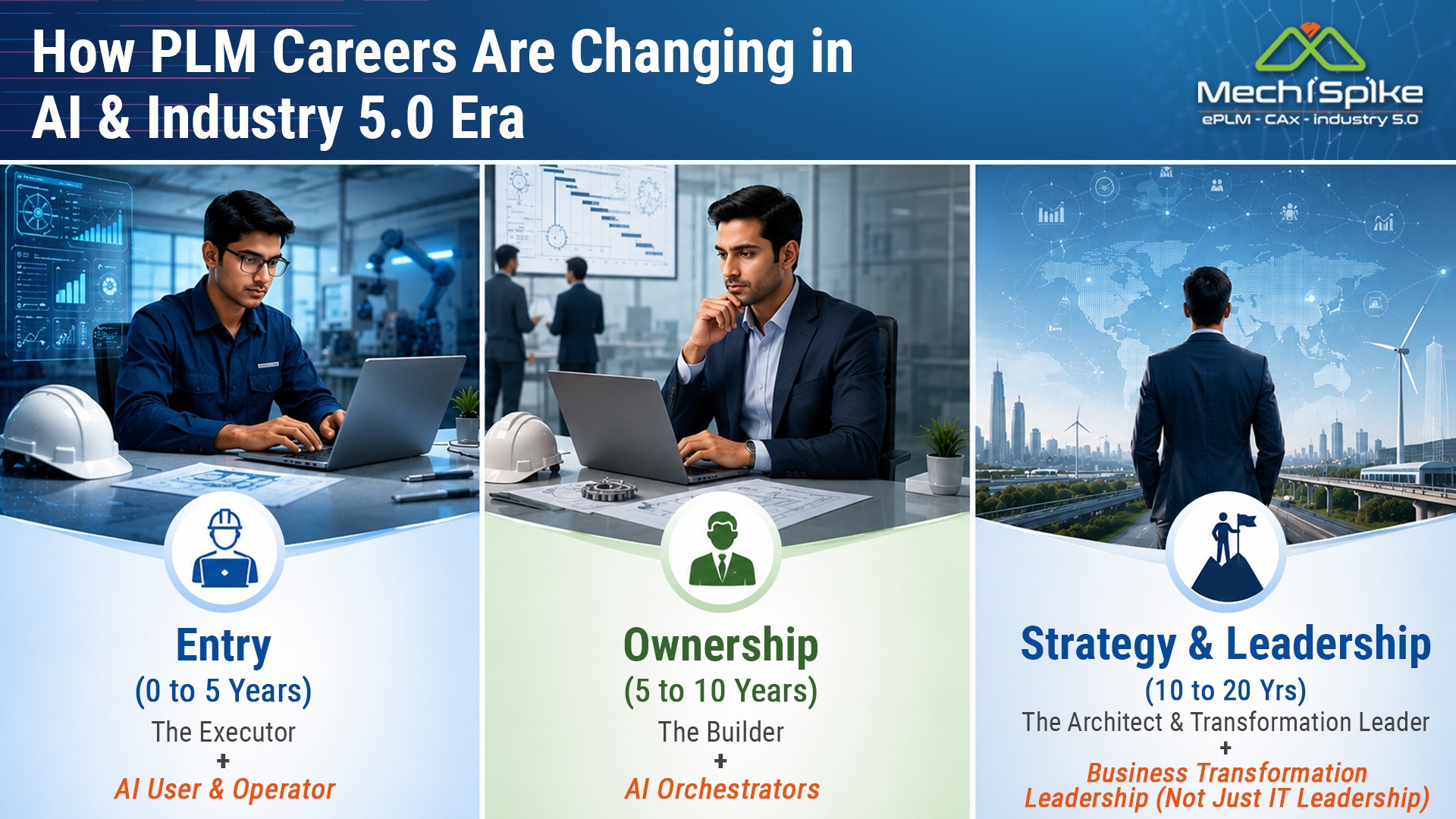
The traditional PLM career path can still be viewed in three broad phases:
- Entry
- Ownership
- Strategy & Leadership
However, AI and Industry 5.0 are now adding a fourth dimension: Intelligence Enablement.
Let us explore how each stage is evolving.
0–5 Years: Entry Phase
Traditional Focus
In the early years, PLM professionals typically work on:
- Teamcenter,
- Windchill,
- 3DEXPERIENCE,
- BOM structures,
- workflows,
- revisions,
- lifecycle states,
- and CAD integrations.
They learn:
- EBOM vs MBOM,
- ECR/ECO processes,
- ERP integrations,
- data governance,
- and engineering workflows.
At this stage, the professional acts as: The Executor.
The primary responsibility is ensuring systems work reliably and product data remains accurate.
How AI Is Changing the Entry Phase
Today, entry-level PLM professionals are increasingly expected to understand:
- AI-assisted workflows,
- Automation tools,
- Prompt engineering,
- Data intelligence,
- Low-code/no-code integrations.
For example:
- AI copilots may assist in creating workflows,
- Generating reports,
- Validating metadata,
- Analyzing engineering changes.
A junior PLM engineer who understands AI tools can become dramatically more productive than someone relying only on manual processes.
Emerging Skills in the First 5 Years
Technical Skills
- API integrations
- Data analytics basics
- AI-assisted configuration
- Prompt engineering
- Workflow automation
- Python scripting
- Understanding of digital threads
Industry 5.0 Skills
- Human-centric system thinking
- Cross-functional collaboration
- Digital literacy
- Systems thinking
Agentic AI Exposure
Early-career professionals may begin interacting with:
- AI assistants inside PLM,
- Automated validation agents,
- Document intelligence systems,
- AI-driven workflow recommendations.
At this stage, they are primarily: AI users and operators.
5–10 Years: Ownership Phase
This is where PLM professionals begin transitioning from executors to builders.
Traditional Responsibilities
Professionals at this stage typically work on:
- PLM architecture,
- Enterprise integrations,
- Workflow automation,
- Scalability,
- Digital thread enablement,
- Data modeling.
They become responsible for balancing:
- Governance,
- Flexibility,
- Scalability,
- Performance.
Their role evolves into: The Builder.
How Industry 5.0 Changes This Phase
Industry 5.0 requires deeper enterprise connectivity.
PLM professionals now need to think beyond the PLM tool itself.
They must understand:
- MES,
- ERP,
- IoT,
- Digital twins,
- AI platforms,
- Cloud ecosystems,
- Manufacturing intelligence systems.
The modern PLM professional becomes a: Connected Enterprise Architect.
The Rise of Agentic AI Skills
This is also the stage where Agentic AI becomes highly relevant.
Agentic AI refers to AI systems capable of:
- Autonomous task execution,
- Workflow orchestration,
- Contextual decision support,
- Multi-step reasoning.
For example: An Agentic AI system may:
- Identify engineering change impacts,
- Trigger workflow approvals,
- Notify stakeholders,
- Generate compliance documentation,
- Suggest risk mitigation steps automatically.
PLM professionals in this phase will increasingly manage and orchestrate such AI agents.
Important Mid-Career Skills
Technical Skills
- AI orchestration
- Enterprise integration
- API ecosystem design
- Cloud PLM
- Data architecture
- Automation frameworks
Business Skills
- ROI analysis
- Process optimization
- Change management
- Stakeholder communication
AI-Related Skills
- Prompt engineering
- AI governance
- AI workflow validation
- Agentic system supervision
- Human-AI collaboration design
At this stage, professionals evolve from: AI users → AI Orchestrators.
10–20 Years: Strategy & Leadership Phase
This is where PLM professionals move toward enterprise leadership.
Traditional Responsibilities
Senior professionals work on:
- PLM strategy,
- Enterprise transformation,
- Process standardization,
- Global governance,
- Digital transformation initiatives.
They become: Architects and Transformation Leaders.
The New Industry 5.0 Leadership Reality
Industry 5.0 is changing leadership expectations significantly.
Future PLM leaders will not only manage systems.
They will shape:
- Enterprise intelligence,
- AI governance,
- Digital innovation strategies,
- Organizational adaptability.
The role becomes less technical and more strategic.
The Future PLM Leader
The future PLM leader must understand:
- AI capabilities,
- Enterprise data intelligence,
- Human-machine collaboration,
- Organizational psychology,
- Transformation management.
They must answer questions like:
- How should AI interact with engineering workflows?
- How do we govern autonomous engineering systems?
- How do we protect IP while enabling AI innovation?
- How do we redesign processes for AI-native manufacturing?
This is no longer pure IT leadership. It becomes: Business Transformation Leadership.
Agentic AI at Leadership Level
At senior levels, PLM professionals may oversee:
- AI-enabled engineering ecosystems,
- Autonomous workflow agents,
- Digital decision systems,
- Intelligent digital twins,
- Enterprise-wide AI governance frameworks.
For example: A future PLM organization may include:
- Design optimization agents,
- Compliance verification agents,
- Supplier intelligence agents,
- Predictive maintenance agents
working collaboratively across the product lifecycle.
PLM leaders will increasingly become: Orchestrators of Intelligent Enterprise Ecosystems.
The Biggest Career Shift: From Tool Expertise to Systems Thinking
One of the biggest career changes happening in PLM is this:
Earlier: “How well do you know the PLM tool?”
Now: “How well do you understand the enterprise?”
The future belongs to professionals who can connect:
- Engineering,
- Manufacturing,
- AI,
- Business strategy,
- Human collaboration.
Pure technical specialization alone may no longer be enough.
Habits Future PLM Professionals Should Develop
1. Continuous Learning
AI and Industry 5.0 evolve rapidly.
Static knowledge becomes obsolete quickly.
2. Cross-Functional Thinking
Understand:
- Manufacturing,
- Quality,
- Supply chain,
- Service operations.
3. AI Experimentation
Actively explore:
- AI copilots,
- Automation tools,
- Agentic workflows.
4. Systems Thinking
Learn how enterprise systems interact together.
5. Communication Skills
Future PLM professionals must explain technical complexity in business language.
Upskilling Areas for the Future
PLM professionals should invest in:
- AI fundamentals
- Prompt engineering
- Cloud platforms
- Enterprise architecture
- Data analytics
- Automation frameworks
- Digital thread concepts
- Change management
- Business strategy
- Cybersecurity awareness
- Agentic AI orchestration
Equally important are soft skills:
- Adaptability,
- Leadership,
- Collaboration,
- Strategic thinking.
Conclusion
PLM careers are no longer evolving in a straight line.
They are evolving in layers.
The traditional progression: Executor → Builder → Architect is now expanding further into: Intelligence Orchestrator → Transformation Leader.
In the Industry 5.0 era, PLM professionals are no longer just system experts.
They are becoming:
- Enterprise connectors,
- AI collaborators,
- Digital transformation enablers,
- Strategic innovation leaders.
The professionals who grow fastest will not necessarily be the ones who only master tools.
They will be the ones who:
- Understand systems,
- Embrace AI,
- Adapt continuously,
- Learn how to combine technology with business transformation.
Because the future of PLM is no longer only about managing product lifecycle data. It is about managing intelligent product ecosystems.
Mechispike can be a great place to work for your PLM career growth. Being a PLM focused company, MechiSpike has all kinds of PLM projects to enable employee career growth and add value to clients. We can position you better with our 12+ global clients in India, USA & Germany.
Dream more than a Job. Grow your PLM Career to the Fullest,
Click Here to explore our Job Openings.
For PLM Careers :
Learn More | Earn More | Grow More
Interactive UI : Every Application will get a response with a recruiter contact details and the applicant will get a notification at each phase until the applicant is positioned well with our 15+ global clients in India, USA & Germany.
Candidate Referral Program : Refer a candidate and earn INR 25,000.
Mechispike Solutions Pvt Ltd is a PLM focused company, having all kinds of PLM projects to enable employee career growth and add value to clients. We can position you better with our 15+ global clients in India, USA & Germany.
We believe in “Grow Together” and “Employee First” culture.
Dream more than a Job. Grow your PLM Career to the Fullest with MechiSpike
Click Here to explore our Job Openings.
For Corporates :
MechiSpike can be of great help to your organization to help you improve your PLM ROI and 30% Savings, be it the hiring cost in staffing or setting up an ODC.
We do this with efficient planning, organizing and controlling Product Master data with seamless data exchange among Engineering, Manufacturing and Enterprise systems.
With our well established niche expertise in PLM, we are now serving more than 15 Global Clients. They are now looking at us as a ‘Go To’ partner for Engineering, IT and PLM. With this confidence, we are expanding our scope of services beyond PLM to Industry 5.0 Digital Transformation i.e. PLM, ERP, CAD, Cloud, AI and DevOps.
Why MechiSpike :

RightSourcing is ‘Better Outsourcing’, given to ‘NICHE EXPERTS’.

Click here to know how we can actually help you with our Proven Methodologies.
Subscribe Now :
Our mission : To equip you with the knowledge and tools you need to drive value, streamline operations, and maximize return on investment from your PLM initiatives.
PLM ROI Newsletter will guide you through a comprehensive roadmap to help you unlock the full potential of your PLM investment.
We are committed to be your trusted source of knowledge and support throughout your PLM journey. Our team of experts and thought leaders will bring you actionable insights, best practices, case studies, and the latest trends in PLM.
Subscribe Now to get this weekly series delivered into your Inbox directly, as and when we publish it.
To your PLM success!
Warm regards,
Visit Us: www.mechispike.com
For PLM Services : Click Here to Schedule a Call with us.