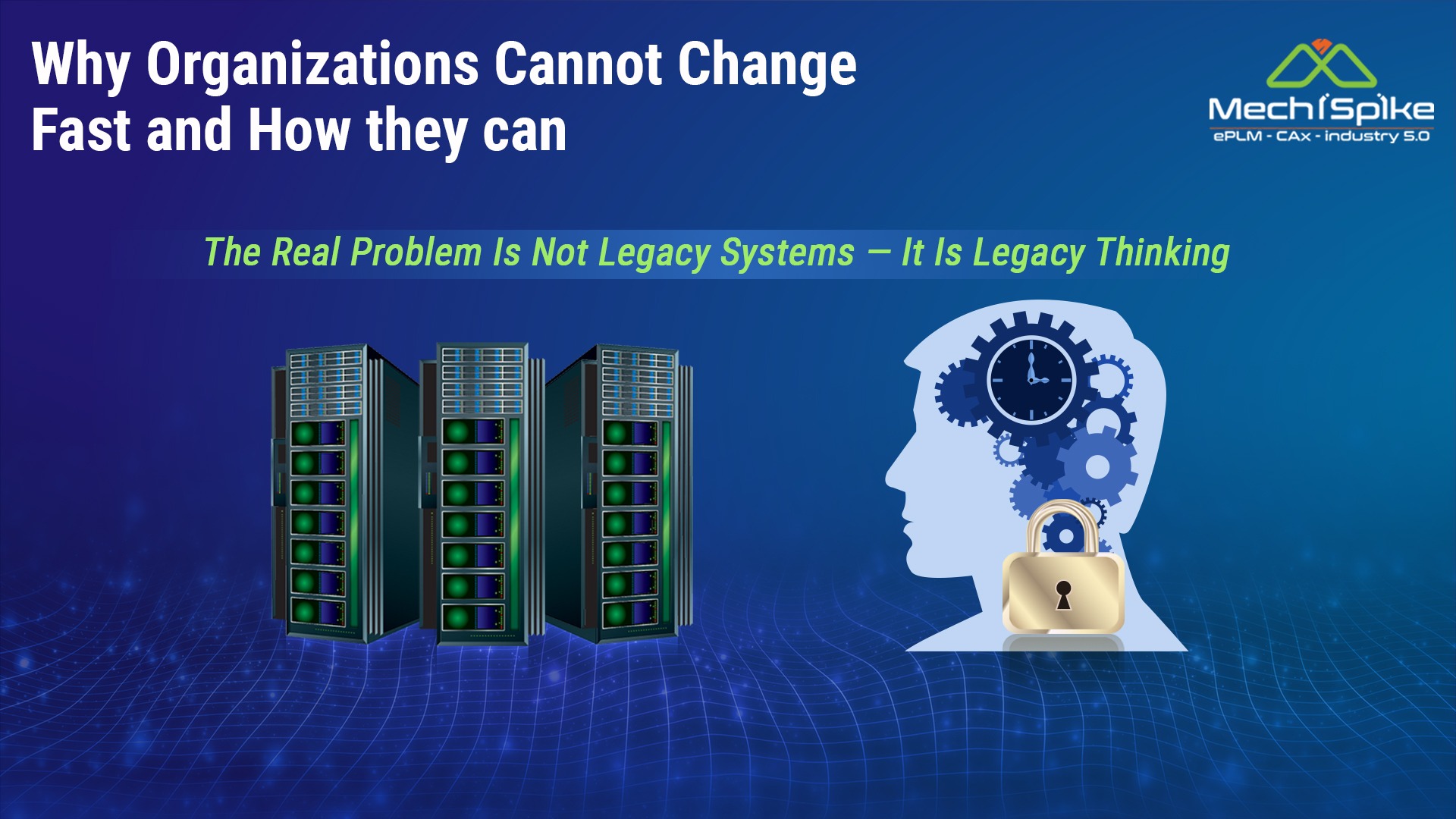
Why Organizations Cannot Change Fast and How they can

In this article, let’s explore Prompt Engineering: The New Core Skill for Product Design and Manufacturing Teams.
- Comparison tables,
- Engineering checklist,
- FMEA format,
- Structured workflow.
Prompt Engineering Guide: Basics, Tips and Template for Product Design & Manufacturing Teams
Artificial Intelligence is rapidly entering the world of product design and manufacturing.
Engineers are now using AI for:
- Design ideation,
- Requirement analysis,
- Code generation,
- CAD assistance,
- Documentation,
- Simulation support,
- Root cause analysis,
- Manufacturing optimization.
However, many organizations are discovering an important reality:
The quality of AI output depends heavily on the quality of the input.
This is where Prompt Engineering becomes important.
In simple terms, prompt engineering is the ability to communicate effectively with AI systems to get useful, accurate, and context-aware results.
In the Industry 5.0 era, prompt engineering is gradually becoming a critical skill for:
- Engineers,
- Designers,
- Manufacturing teams,
- PLM consultants,
- Quality teams,
- and even Leadership.
Because AI is no longer just a tool. It is becoming a collaborative working partner.
What Is Prompt Engineering?
A prompt is simply the instruction or input given to an AI system.
Prompt engineering is the process of designing that instruction in a structured and intelligent way so the AI generates:
- Better responses,
- Better designs,
- Better recommendations &
- Better insights.
For example:
A weak prompt: “Suggest a product design.”
A stronger prompt: “Suggest three lightweight aluminum enclosure design concepts for an industrial IoT device operating in high-temperature manufacturing environments. Prioritize thermal efficiency, manufacturability, and ease of assembly.”
The second prompt provides:
- Context,
- Constraints,
- Priorities &
- Objectives.
This dramatically improves output quality.
Why Prompt Engineering Matters
AI systems are extremely powerful, but they are not mind readers.
Poor prompts create:
- Vague outputs,
- Hallucinations,
- Irrelevant recommendations &
- Inconsistent results.
Good prompts improve:
- Productivity,
- Engineering quality,
- Creativity,
- Decision-making &
- Speed.
In product manufacturing, where accuracy and context are critical, prompt quality becomes even more important.
What a Good Prompt Should Have
A high-quality prompt generally contains six key elements.
1. Context
Provide background information.
Example:
- Industry,
- Product type,
- Manufacturing environment,
- Customer segment,
- Standards,
- Engineering domain.
2. Objective
Clearly state the expected outcome.
Example:
- Generate concepts,
- Optimize weight,
- Improve manufacturability,
- Reduce cost
- Identify risks.
3. Constraints
Engineering work always involves constraints.
Examples:
- Material limitations,
- Tolerance requirements,
- Budget,
- Sustainability targets,
- Regulatory compliance,
- Manufacturing methods.
4. Output Format
Specify how results should be presented.
Examples:
- Bullet points,
5. Role Definition
Assigning a role improves contextual output.
Example: “Act as a senior automotive design engineer.” or “Act as a PLM transformation consultant.”
6. Iterative Refinement
Good prompting is rarely one-shot.
Users should refine prompts continuously based on:
- Output quality,
- Missing details or
- Changing objectives.
What a Prompt Should NOT Have
1. Vagueness
Poor: “Improve this product.”
Better: “Suggest ways to reduce product weight while maintaining structural strength.”
2. Missing Context
AI without context produces generic responses.
3. Contradictory Instructions
Avoid conflicting objectives without prioritization.
Example: “Make it cheaper, premium-looking, ultra-lightweight, and highly durable.”
Tradeoffs must be clarified.
4. Overloading the Prompt
Very long prompts with unrelated requirements can confuse AI systems.
Break large tasks into smaller prompts.
5. Blind Trust
AI outputs should never replace:
- Engineering validation,
- Simulations,
- Compliance checks,
- Human judgment.
Especially in manufacturing environments.
Prompt Engineering for Product Design and Manufacturing
Prompt engineering in manufacturing differs significantly from general AI usage because engineering work depends heavily on:
- Precision,
- Domain knowledge,
- Standards,
- Workflows &
- Lifecycle context.
A casual consumer-style prompt is insufficient for industrial use cases.
Best Practices for Engineering Prompts
1. Define the Engineering Domain
Specify:
- Automotive,
- Aerospace,
- Electronics,
- Industrial equipment,
- Consumer products,
- Medical devices.
This changes output relevance significantly.
2. Include Lifecycle Context
AI recommendations should consider:
- Design,
- Manufacturing,
- Assembly,
- Serviceability,
- Maintenance,
- Sustainability.
Example: “Suggest a housing design optimized for injection molding and field maintenance.”
3. Mention Manufacturing Constraints
Examples:
- CNC machining,
- Additive manufacturing,
- Casting,
- Welding,
- Sheet metal fabrication or
- Injection molding.
Manufacturing-aware prompts improve realism.
4. Specify Standards and Compliance
Example:
- ISO standards,
- GD&T,
- DFMEA,
- Safety requirements,
- FDA compliance,
- Automotive standards.
5. Ask for Tradeoff Analysis
Excellent engineering prompts ask AI to evaluate tradeoffs.
Example: “Compare aluminum and carbon fiber for this application considering cost, manufacturability, durability, and thermal performance.”
Examples of Engineering Prompts
Example 1: Product Design
“Act as a senior consumer electronics product designer. Suggest three ergonomic smartwatch housing concepts for elderly users. Prioritize ease of use, lightweight materials, manufacturability, and battery accessibility.”
Example 2: Manufacturing Optimization
“Analyze potential bottlenecks in an automotive assembly line producing 20,000 units per month. Suggest AI-assisted improvements for reducing cycle time and improving quality consistency.”
Example 3: PLM Transformation
“Act as a PLM consultant. Suggest a roadmap for migrating from document-centric engineering workflows to a digital thread-based PLM environment.”
Pros of Prompt Engineering in Manufacturing
1. Faster Ideation
AI accelerates concept generation significantly.
2. Improved Productivity
Engineers spend less time on repetitive tasks:
- Documentation,
- Summaries,
- Initial analysis,
- Report generation.
3. Better Knowledge Accessibility
Junior engineers can quickly access domain insights.
4. Enhanced Cross-Functional Collaboration
AI helps bridge communication gaps between:
- Design,
- Manufacturing,
- Quality,
- Operations teams.
5. Faster Decision Support
AI can rapidly compare alternatives and summarize tradeoffs.
Cons and Risks of Prompt Engineering
1. Hallucinations
AI may generate technically incorrect outputs.
This is dangerous in manufacturing contexts.
2. Overdependence
Teams may stop applying critical engineering thinking.
3. IP and Data Security Risks
Sensitive product information should not be exposed carelessly to external AI systems.
4. Generic Recommendations
Poor prompts create shallow outputs.
5. Lack of Real-World Validation
AI cannot replace:
- Testing,
- Prototyping,
- Simulations or
- Physical verification.
A Prompt Template for Product Design & Manufacturing Teams
Here is a simple reusable framework.
Engineering Prompt Checklist
1. Define Role
Who should the AI behave as?
Example:
- Design engineer,
- Manufacturing engineer,
- PLM architect,
- Quality expert.
2. Define Context
What industry/product/environment?
3. Define Objective
What exactly should AI help achieve?
4. Define Constraints
Include:
- Cost,
- Material,
- Manufacturing process,
- Standards,
- Timelines,
- Sustainability.
5. Define Output Format
Examples:
- Table,
- Report,
- Checklist,
- Roadmap,
- Comparison matrix.
6. Ask for Risks & Tradeoffs
This improves engineering realism.
Upskilling Activities for Prompt Engineering
Organizations should actively train teams on AI communication skills.
Key upskilling areas:
- AI fundamentals
- Systems thinking
- Engineering data interpretation
- Structured problem-solving
- Workflow thinking
- Digital collaboration
- PLM awareness
- Manufacturing processes
- Design thinking
Habits to Develop
1. Think Structurally
Good prompt engineers think clearly and systematically.
2. Break Problems Into Smaller Parts
Complex engineering tasks should be decomposed.
3. Validate Everything
Never assume AI output is automatically correct.
4. Continuously Refine Prompts
Prompt engineering improves through iteration.
5. Build Domain Context
Strong engineering knowledge improves prompt quality dramatically.
6. Learn Through Experimentation
The best prompt engineers constantly test:
- Wording,
- Context depth,
- Constraints,
- Output formats.
The Future of Prompt Engineering
Prompt engineering is likely to evolve from a niche AI skill into a standard professional capability.
In Industry 5.0 environments, future engineers may routinely collaborate with:
- AI copilots,
- Design assistants,
- Simulation agents,
- Manufacturing intelligence systems,
- Autonomous engineering workflows.
This means communication with AI systems will become as important as communication with human teams.
The organizations that master this collaboration early may gain substantial advantages in:
- Innovation speed,
- Engineering productivity,
- Decision-making,
- Operational efficiency.
Conclusion
Prompt engineering is not simply about asking better questions to AI.
It is about thinking more clearly, structurally, and contextually.
For product design and manufacturing organizations, prompt engineering can unlock:
- Faster innovation,
- Better collaboration,
- Improved productivity,
- Smarter engineering decisions.
However, prompts are not magic.
AI still requires:
- Human judgment,
- Engineering validation,
- Domain expertise,
- Responsible usage.
The future will belong to organizations where engineers do not compete with AI — but learn how to collaborate with it effectively.
Because in the Industry 5.0 era, the quality of human thinking may increasingly determine the quality of AI outcomes.
MechiSpike can be of great help here to take your organization to the future of Product Design as well as Manufacturing with our focus on AI & Industry 5.0 using our prowess in PLM, Engineering and IT Digital.
Click here to know more about us.
____________________________________________________________________________
For Corporates :
MechiSpike can be of great help to your organization to help you improve your PLM ROI and 30% Savings, be it the hiring cost in staffing or setting up an ODC.
We do this with efficient planning, organizing and controlling Product Master data with seamless data exchange among Engineering, Manufacturing and Enterprise systems.
With our well established niche expertise in PLM, we are now serving more than 15 Global Clients. They are now looking at us as a ‘Go To’ partner for Engineering, IT and PLM. With this confidence, we are expanding our scope of services beyond PLM to Industry 5.0 Digital Transformation i.e. PLM, ERP, CAD, Cloud, AI and DevOps.
Why MechiSpike :
<Pranoti – This is from our booklet. Pl copy paste a high resolution image here. Replace below image with your image>
RightSourcing is ‘Better Outsourcing’, given to ‘NICHE EXPERTS’.
Click here to know how we can actually help you with our Proven Methodologies.
__________________________________________________________________________________
For PLM Careers :
Learn More | Earn More | Grow More
Interactive UI : Every Application will get a response with a recruiter contact details and the applicant will get a notification at each phase until the applicant is positioned well with our 15+ global clients in India, USA & Germany.
Candidate Referral Program : Refer a candidate and earn INR 25,000.
Mechispike Solutions Pvt Ltd is a PLM focused company, having all kinds of PLM projects to enable employee career growth and add value to clients. We can position you better with our 15+ global clients in India, USA & Germany.
We believe in “Grow Together” and “Employee First” culture.
Dream more than a Job. Grow your PLM Career to the Fullest with MechiSpike
Click Here to explore our Job Openings.
___
Subscribe Now :
Our mission : To equip you with the knowledge and tools you need to drive value, streamline operations, and maximize return on investment from your PLM initiatives.
PLM ROI Newsletter will guide you through a comprehensive roadmap to help you unlock the full potential of your PLM investment.
We are committed to be your trusted source of knowledge and support throughout your PLM journey. Our team of experts and thought leaders will bring you actionable insights, best practices, case studies, and the latest trends in PLM.
Subscribe Now to get this weekly series delivered into your Inbox directly, as and when we publish it.
The Future Role of Leaders
In the Industry 5.0 era, leaders can no longer function only as administrators.
They must become:
- Transformation orchestrators,
- Learning facilitators,
- Cultural architects,
- Systems thinkers.
Future leaders will spend less time controlling execution and more time enabling adaptability.
The role of leaders will increasingly involve:
- Helping teams embrace AI,
- Reducing resistance,
- Encouraging experimentation,
- Connecting technology with business outcomes.
Leaders who fail to evolve may become bottlenecks themselves.
Daily Activities Leaders Should Practice
Daily Activities
1. Spend 30 Minutes Learning
Leaders should continuously study:
- AI trends,
- Industry 5.0 developments,
- Manufacturing innovation,
- Digital transformation case studies.
2. Encourage Cross-Functional Conversations
Create daily interactions across departments.
3. Ask Better Questions
Instead of:
“How do we maintain current processes?”
Ask:
“How should this process work if designed today?”
4. Identify Friction
Look for:
- Delays,
- Approval bottlenecks,
- Repetitive manual work,
- Disconnected systems.
5. Promote Experimentation
Reward learning, not just success.
Weekly Leadership Activities
Weekly Plan
Monday
Review transformation KPIs and pilot progress.
Tuesday
Meet cross-functional teams to identify operational friction.
Wednesday
Conduct AI and technology learning sessions.
Thursday
Review customer feedback and market shifts.
Friday
Evaluate:
- Lessons learned,
- Failed experiments,
- Next transformation opportunities.
Essential Upskilling Areas for Leaders
Future-ready leaders should develop:
- AI literacy
- Systems thinking
- Data interpretation
- Digital collaboration
- Change leadership
- Emotional intelligence
- Scenario planning
- Strategic adaptability
Equally important are behavioral changes:
- Becoming more curious,
- More collaborative,
- More open to experimentation,
- and less dependent on hierarchy-driven decision making.
Conclusion
The biggest challenge facing product manufacturers today is not technology adoption. It is organizational adaptability.
AI and Industry 5.0 are exposing a hard truth:
Companies designed for stability struggle in environments demanding continuous reinvention.
Legacy systems can eventually be replaced.
Legacy thinking is far more dangerous because it slows decisions, discourages experimentation, and prevents organizations from evolving at the speed of change.
The future will belong to organisations that:
- Learn faster,
- Adapt faster,
- Collaborate better &
- Continuously reinvent themselves.
Because in the age of AI and Industry 5.0, transformation is no longer a one-time initiative.
It becomes the operating system of the enterprise itself.
MechiSpike can be of great help here to take your organization to the future of Product Design as well as Manufacturing with our focus on AI & Industry 5.0 using our prowess in PLM, Engineering and IT Digital.
Click here to know more about us.
For Corporates :
MechiSpike can be of great help to your organization to help you improve your PLM ROI and 30% Savings, be it the hiring cost in staffing or setting up an ODC.
We do this with efficient planning, organizing and controlling Product Master data with seamless data exchange among Engineering, Manufacturing and Enterprise systems.
With our well established niche expertise in PLM, we are now serving more than 15 Global Clients. They are now looking at us as a ‘Go To’ partner for Engineering, IT and PLM. With this confidence, we are expanding our scope of services beyond PLM to Industry 5.0 Digital Transformation i.e. PLM, ERP, CAD, Cloud, AI and DevOps.
Why MechiSpike :

RightSourcing is ‘Better Outsourcing’, given to ‘NICHE EXPERTS’.

Click here to know how we can actually help you with our Proven Methodologies.
For PLM Careers :
Learn More | Earn More | Grow More
Interactive UI : Every Application will get a response with a recruiter contact details and the applicant will get a notification at each phase until the applicant is positioned well with our 15+ global clients in India, USA & Germany.
Candidate Referral Program : Refer a candidate and earn INR 25,000.
Mechispike Solutions Pvt Ltd is a PLM focused company, having all kinds of PLM projects to enable employee career growth and add value to clients. We can position you better with our 15+ global clients in India, USA & Germany.
We believe in “Grow Together” and “Employee First” culture.
Dream more than a Job. Grow your PLM Career to the Fullest with MechiSpike
Click Here to explore our Job Openings.
Subscribe Now :
Our mission : To equip you with the knowledge and tools you need to drive value, streamline operations, and maximize return on investment from your PLM initiatives.
PLM ROI Newsletter will guide you through a comprehensive roadmap to help you unlock the full potential of your PLM investment.
We are committed to be your trusted source of knowledge and support throughout your PLM journey. Our team of experts and thought leaders will bring you actionable insights, best practices, case studies, and the latest trends in PLM.
Subscribe Now to get this weekly series delivered into your Inbox directly, as and when we publish it.
To your PLM success!
Warm regards,
Visit Us: www.mechispike.com
For PLM Services : Click Here to Schedule a Call with us.