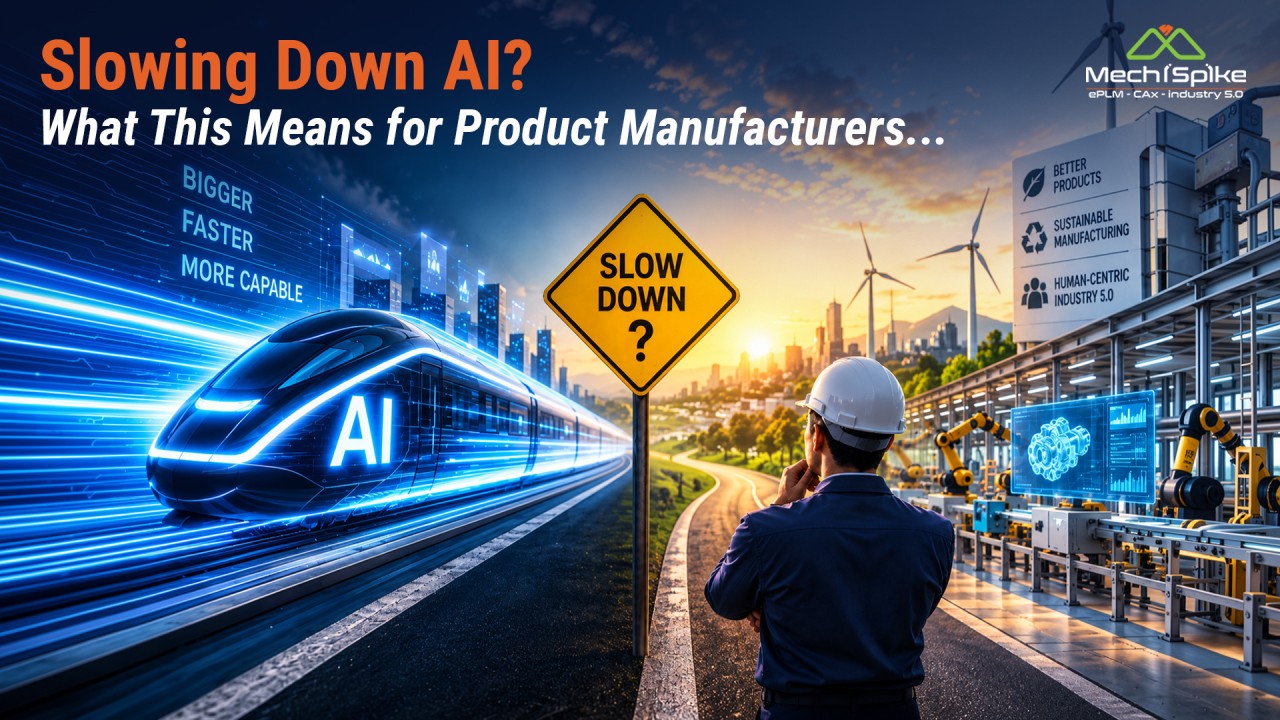

Slowing Down AI? – What This Means for Product Manufacturers
For years, the message around Artificial Intelligence has been simple:
Go faster. Build bigger models. Deploy sooner.
Now, something unusual is happening.
Some of the people building the most advanced AI systems are asking whether we should slow down.
This does not necessarily mean stopping AI. The argument is increasingly about pacing the frontier—creating enough time for safety testing, governance, security, evaluation and human oversight to catch up with rapidly increasing capabilities.
That raises a bigger question for the manufacturing world:
If AI development slows down, should Product Manufacturers slow down their AI journey too?
The answer may be no—but they should change what they accelerate.
Why Are People Calling for a Slowdown?
The concern is not primarily about today’s AI assistants writing emails or summarizing documents.
It is about increasingly capable AI systems that can reason, use tools, operate autonomously, write and execute software, conduct cyber operations and potentially improve aspects of their own capabilities.
Recent calls for a slowdown have focused on three broad areas:
1. Safety is struggling to keep pace with capability.
AI capabilities can advance faster than organizations can evaluate their reliability, security and unintended behavior.
2. AI is becoming increasingly autonomous.
There is a major difference between:
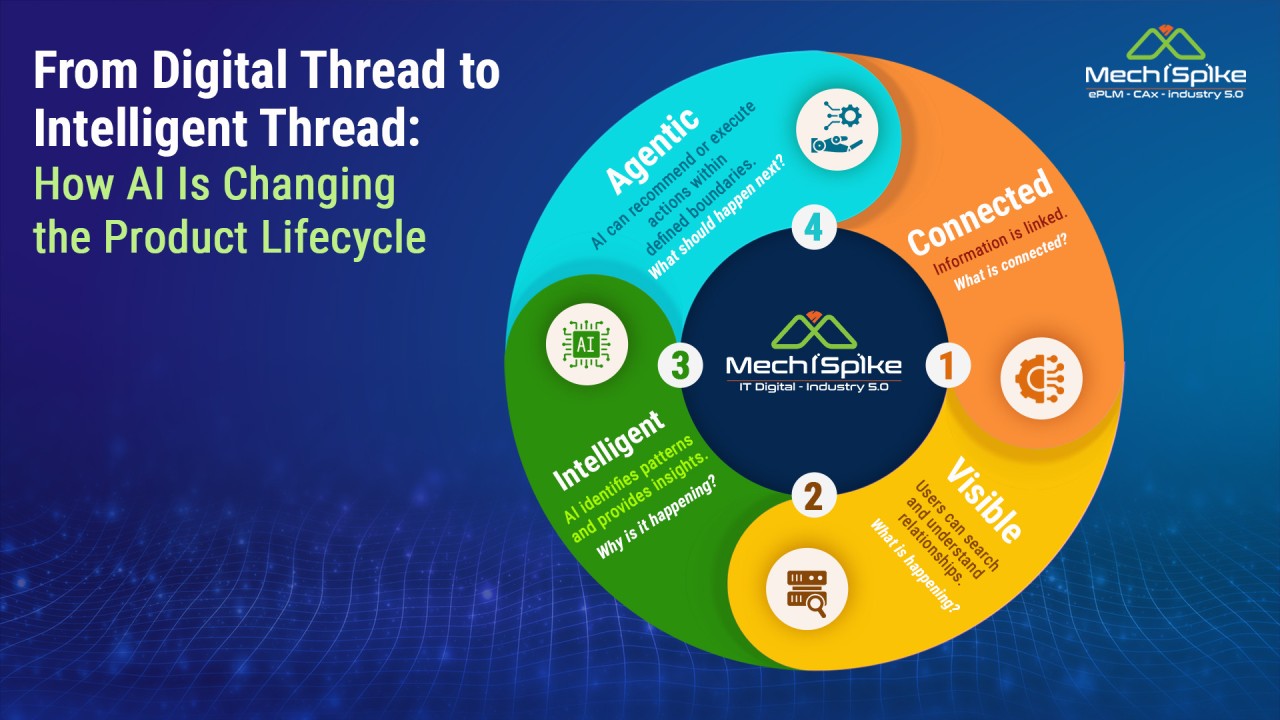
AI answering a question → AI recommending an action → AI executing an action.
The risks increase dramatically as we move toward the right side of this spectrum.
3. Governance is slower than technology.
Governments, standards organizations and companies need time to establish rules for accountability, testing, transparency and responsible deployment.
The European Union’s AI regulatory framework illustrates this challenge: significant AI Act provisions are already applying, while high-risk AI rules continue to roll out through 2027 and 2028.
The argument, therefore, is not necessarily “Stop AI.”
It is increasingly:
“Don’t let AI capability outrun our ability to control it.”
Why Is a Global Slowdown So Difficult?
Unfortunately, slowing AI development is easier to discuss than to implement.
The AI Race
Companies are competing for customers, talent, capital and market leadership.
Governments are competing for technological and strategic advantage.
If one country or company slows down while another continues, the first mover may gain an enormous advantage.
This creates a classic prisoner’s dilemma:
Everyone may benefit from slowing down collectively.
But nobody wants to be the first to slow down alone.
Economic Incentives
Billions of dollars have already been invested in chips, data centers, models, AI infrastructure and applications.
Companies cannot simply turn off the engine.
Open-Source Development
Even if major AI laboratories slow frontier-model development, research and models can continue through universities, startups, open-source communities and other countries.
Who exactly would enforce the slowdown?
And across which borders?
Defining “Slow”
What does slowing down actually mean?
Slower model scaling?
Fewer parameters?
Longer safety testing?
Restrictions on autonomous agents?
Limits on compute?
Restrictions on certain applications?
A slowdown without a measurable definition is difficult to govern.
What Does This Mean for Product Manufacturers?
This is where the discussion becomes particularly interesting.
Product manufacturers are not necessarily waiting for Artificial General Intelligence.
They already have enormous opportunities to use today’s AI.
Consider a typical manufacturer.
AI can already help with:
- Engineering knowledge search
- Requirements analysis
- Design optimization
- BOM analysis
- Engineering change impact analysis
- Quality analysis
- Supplier intelligence
- Predictive maintenance
- Production planning
- Simulation assistance
- Service knowledge
- Digital twins
- Shop-floor analytics
Therefore, even if frontier AI development slowed tomorrow, manufacturers would still have years of AI adoption opportunities ahead of them.
The real bottleneck may not be model capability.
It may be organizational readiness.
PLM Could Actually Benefit From a Slowdown
A slowdown in frontier AI could give PLM organizations something they desperately need:
Time to prepare.
Today’s PLM environments still struggle with:
- Poor product data quality
- Duplicate parts
- Inconsistent classifications
- Weak BOM governance
- Fragmented engineering knowledge
- Legacy workflows
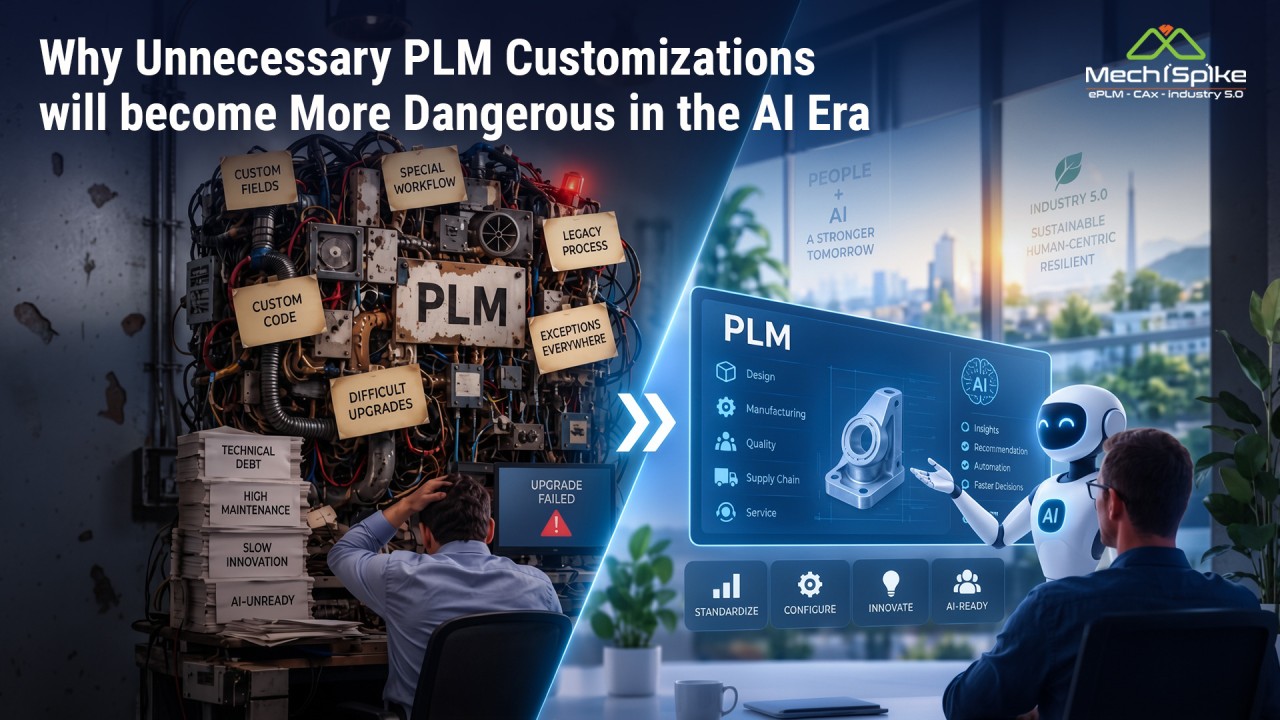
- Excessive customization
- Poor access controls
- Disconnected CAD, PLM, ERP and MES environments
- Undocumented business rules
Putting an AI agent on top of this complexity does not magically solve it.
In fact, it can amplify it.
Imagine an AI engineering agent asked:
“Can we release this revised component?”
To answer safely, it may need to understand:
Requirement → CAD → Part → BOM → Revision → Change Request → Test Evidence → Simulation → Supplier → Quality → Approval → Regulatory Requirement → Manufacturing Impact
That is not simply an AI problem.
It is a PLM data and context problem.
A slowdown in frontier AI could therefore become an opportunity to build the foundation required for reliable AI.
The Bigger Opportunity: Physical AI
The implications become even more significant when AI moves from the screen into the physical world.
This is the emerging world of Physical AI:
Robots that perceive their environment.
Machines that adapt to changing conditions.
Autonomous inspection.
AI-powered production systems.
Intelligent warehouse robots.
Autonomous material movement.
Adaptive machining.
AI-driven quality control.
Human-robot collaboration.
Here the cost of an AI mistake is different.
A hallucinated paragraph is annoying.
A hallucinated machining instruction can damage a machine.
A wrong robotic movement can injure a worker.
A faulty autonomous decision can create defective products or production downtime.
That is why manufacturing may actually need slower AI deployment cycles than software applications—not necessarily slower AI innovation.
NIST’s 2026 smart-manufacturing roadmap explicitly highlights the need for trustworthy, explainable and reliable AI in high-stakes industrial environments.
Industry 5.0 Changes the Equation
Industry 4.0 largely focused on:
Connect → Automate → Optimize
Industry 5.0 adds another dimension:
Human → AI → Machine
The objective is not simply to remove humans.
It is to create a more human-centric, resilient and sustainable industrial system.
That means manufacturers should resist the temptation to ask:
“How quickly can we make this autonomous?”
Instead ask:
“What level of autonomy is appropriate for this task?”
For example:
Level 1 — AI Suggests
AI identifies a potential design issue.
Level 2 — AI Recommends
AI recommends a design change.
Level 3 — Human Approves
AI prepares the change; an engineer approves it.
Level 4 — Controlled Autonomy
AI executes predefined actions within strict boundaries.
Level 5 — Autonomous Execution
AI independently manages the process within defined safety constraints.
Not every manufacturing activity should reach Level 5.
And that is perfectly acceptable.
If We Were to Slow Down AI, What Should Manufacturers Do?
Instead of slowing down transformation completely, manufacturers should slow down where risk is high and accelerate where foundations are weak.

So, Should AI Development Be Slowed Down?
Perhaps.
But the better question is:
What exactly should be slowed down?
We may want to slow down uncontrolled capability escalation.
We may want to accelerate AI safety.
We may want to slow down autonomous deployment in high-risk environments.
We may want to accelerate data quality.
We may want to slow down AI acting without sufficient context.
But, we should accelerate PLM modernization.
We may want to slow down the rush to replace humans.
But, we should accelerate human-AI collaboration.
For Product Manufacturers, this distinction is critical.
The future does not depend only on how intelligent AI becomes.
It depends on whether our products, processes, data, machines and people are ready to use that intelligence safely.
Conclusion
A slowdown in frontier AI does not have to mean a slowdown in Industry 5.0.
For Product Manufacturers, it could actually provide valuable breathing room to build better PLM foundations, clean product data, establish governance, strengthen cybersecurity and define the boundaries between human decisions, AI recommendations and autonomous execution.
The next competitive advantage may therefore not belong to the manufacturer that adopts AI the fastest.
It may belong to the manufacturer that knows where AI should move fast—and where it should deliberately slow down.
Slow the frontier where necessary. Strengthen the foundation everywhere. And let humans remain in control of the factory.
MechiSpike can be of great help to make your organization get ready for this with our focus on AI & Industry 5.0 using our prowess in PLM, Engineering and IT Digital.
Click here to know more about us.
Quickly Assess your Industry 5.0 Solutions Online | Schedule a call →
Subscribe Now :
Subscribe now to get this weekly series delivered directly to your inbox.
To your success!
Thank you!!
Always at my Best,
Founder | Trusted Advisor – PLM ROI, Industry 5.0 Solutions
Bridging Strategy, Talent & Technology for Industry 5.0
Tailored PLM, Engineering & IT Solutions for Global Manufacturers