
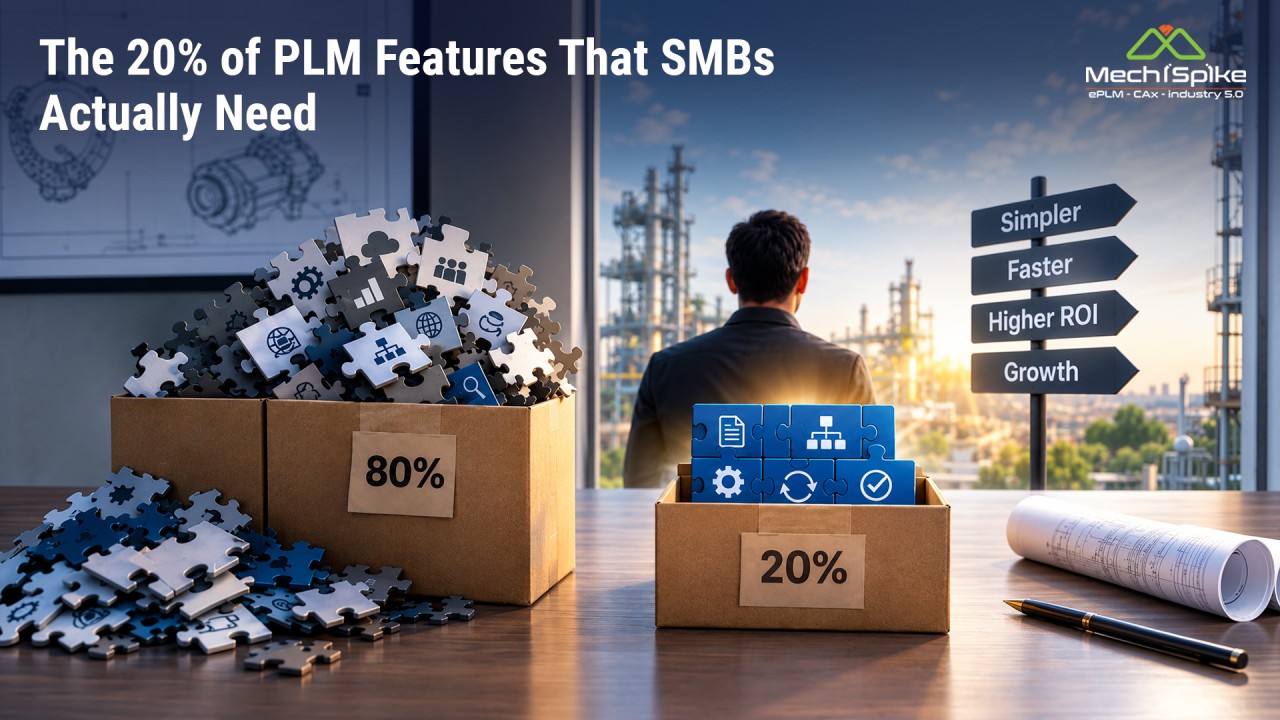

The 20% of PLM Features That SMBs Actually Need
Most SMB manufacturers don’t need more PLM. They need the right 20% of it.
For a large OEM, a PLM platform may need to manage thousands of users, complex product structures, global engineering teams, supplier ecosystems, regulatory requirements and highly customized workflows.
But should a 100- or 500-person manufacturer implement the same level of complexity?
Probably not.
For many SMB manufacturers, the real challenge is not a lack of software features. It is that the few capabilities that matter most are often surrounded by hundreds of features they may never use.
The result?
Higher licence costs. More configuration. More customization. Longer implementations. More training. And, eventually, engineers returning to spreadsheets because the system became harder to use than the problem it was supposed to solve.
The smarter question is therefore not:
“Which PLM platform has the most features?”
It is:
“Which PLM capabilities solve our most expensive problems?”
PLM Is Not About Having Every Feature
PLM, or Product Lifecycle Management, is fundamentally about creating a reliable way to manage product information and product changes throughout the lifecycle.
For an SMB manufacturer, that could mean something surprisingly simple:
- One trusted location for parts and drawings
- Controlled versions and revisions
- A reliable BOM
- A structured engineering change process
- Clear approvals
- Traceability
- A connection between engineering and ERP
- And eventually, a digital thread extending toward manufacturing
That’s already a significant transformation.
The mistake is assuming that implementing PLM means implementing everything the platform can do.
In reality, the best PLM system for an SMB may be the one that solves fewer problems—but solves them extremely well.
So, What Is the “20%”?
The “20%” is not a mathematical rule or a universal feature list. It is a practical way of thinking about prioritization.
For many SMB manufacturers, five capability areas deserve attention first.
1. Product Data Management
Start with the basics.
Where are your:
- Parts?
- Drawings?
- Specifications?
- CAD files?
- Documents?
- Revisions?
If the answer is “somewhere in SharePoint, someone’s laptop, an ERP system and a few Excel files,” you have already identified a PLM opportunity.
A PLM system should establish a trusted source for product information.
The objective isn’t simply to store more files.
It is to make sure that engineers, purchasing, manufacturing and quality are working from the same approved information.
2. BOM Management
The Bill of Materials may be one of the most important pieces of information in your manufacturing business.
Yet many SMBs still maintain different versions of BOM information across engineering, purchasing and production.
Engineering has one BOM.
ERP has another.
Production has a spreadsheet.
And someone is manually comparing them.
That’s not just an IT problem.
It creates the possibility of:
- Incorrect purchasing
- Production errors
- Rework
- Delays
- Costing inaccuracies
- And difficulty tracing what actually went into a product
A right-sized PLM implementation should establish one trusted product structure and make the flow of that information to downstream systems predictable.
3. Revision & Change Management
Products change.
Parts change. Drawings change. Materials change. Suppliers change.
The question is not whether change happens.
The question is: Can everyone see what changed, why it changed, who approved it and which version should now be used?
A basic engineering change process can deliver enormous value.
Instead of an engineer sending an email saying:
“Please use the attached revised drawing.”
you have a controlled process that records the change and its approval.
This becomes particularly important as an SMB grows, adds customers, increases product variants or faces greater traceability requirements.
4. Engineering-to-ERP Integration
PLM should not become another isolated island.
One of the most valuable steps for an SMB is connecting engineering information with the business system.
Consider a simple flow:
CAD → PLM → ERP → Purchasing / Production
When these systems communicate properly, engineering doesn’t need to repeatedly re-enter the same information.
Part numbers, BOMs and approved product information can flow through the organization in a controlled manner.
This is where PLM starts moving from being an engineering repository to becoming part of a broader digital thread.
5. Adoption & Usability
This may actually be the most important feature of all.
People using the system.
A technically excellent PLM system that engineers avoid is not delivering value.
The pitch for SMB manufacturers is often framed around functionality:
“Does the software have this feature?”
A better question is:
“Will our engineers actually use it?”
If the workflow is unnecessarily complicated, requires excessive data entry or doesn’t match how people actually work, users will create workarounds.
And once spreadsheets become the workaround, the digital transformation starts moving backwards.
The objective should therefore be simple workflows that people can follow consistently.
What About the Other 80%?
This doesn’t mean the remaining features are useless.
They may be extremely valuable for a large OEM or a highly complex manufacturer.
The point is different:
You shouldn’t pay for, implement and maintain complexity before you have established the basics.
For example, an SMB may eventually benefit from:
- Advanced supplier collaboration
- Complex workflow orchestration
- Advanced manufacturing integration
- Digital twins
- Model-based systems engineering
- Advanced analytics
- AI-powered engineering assistance
- Sophisticated configuration management
But the sequence matters.
If your BOM data is inconsistent, adding AI doesn’t solve the problem.
If engineering changes are still communicated through email, building an advanced digital twin may not be the first priority.
If engineers don’t trust the PLM system, adding another module won’t increase adoption.
The Bigger Principle: Configure Before You Customize
There is another important reason SMBs should focus on the essential 20% : Customization creates a long-term obligation.
A custom workflow may look perfect when the system goes live.
But every customization can potentially create additional work during:
- Upgrades
- Testing
- Migration
- Validation
- Maintenance
- User support
That’s why a useful SMB principle is:
Configure where possible. Customize only when the business case is clear.
The simpler the implementation, the easier it generally becomes to maintain and upgrade.
A Simple SMB PLM Checklist
Before selecting or expanding a PLM system, ask these seven questions:

If you cannot answer several of these questions, adding more PLM functionality may not be the answer.
Simplify what you already have.
The SMB PLM Mindset
PLM shouldn’t be treated as a competition to see who can implement the most features.
For an SMB manufacturer, the objective should be much simpler:
Get the right product information to the right person at the right timewith as little manual effort and ambiguity as possible.
Start with parts.
Then BOMs.
Then revisions and changes.
Then connect engineering with ERP.
Then improve adoption.
Then automate.
And once the underlying data and processes are reliable, start asking where AI can create the next level of value.
That’s a much more practical path toward Industry 5.0 than simply buying more technology.
The question isn’t whether your PLM has 1,000 features.
The question is whether the 20 features you actually need are delivering measurable value.
Start small. Prove the return. Then scale.
About MechiSpike Solutions
MechiSpike Solutions works with SMB manufacturers on PLM, MES, ERP, AI, engineering and Industry 5.0 initiatives—with an emphasis on right-sized technology, practical adoption and measurable business outcomes. The company’s approach is to understand the requirement first, then configure only what the industry and users actually need.
MechiSpike can be of great help to make your organization get ready for this and more with our focus on AI & Industry 5.0 using our prowess in PLM, Engineering and IT Digital.
Click here to know more about us.
Quickly Assess your Industry 5.0 Solutions Online | Schedule a call
Subscribe Now :
Subscribe now to get this weekly series delivered directly to your inbox.
To your success!
Thank you!!
Always at my Best,
Founder | Trusted Advisor – PLM ROI, Industry 5.0 Solutions
Bridging Strategy, Talent & Technology for Industry 5.0
Tailored PLM, Engineering & IT Solutions for Global Manufacturers
