
Every PLM implementation usually begins with a familiar promise:
“We will leverage the Out-of-the-Box capabilities as much as possible.”
Then the requests start coming and each team member adds a small customization which leads to a lot of new custom requests.
In short, PLM customization rarely happens in one big decision. It happens through hundreds of small decisions.
Over a period of time, the PLM platform becomes heavily customized, difficult to upgrade, expensive to maintain—and understood by only a handful of people.
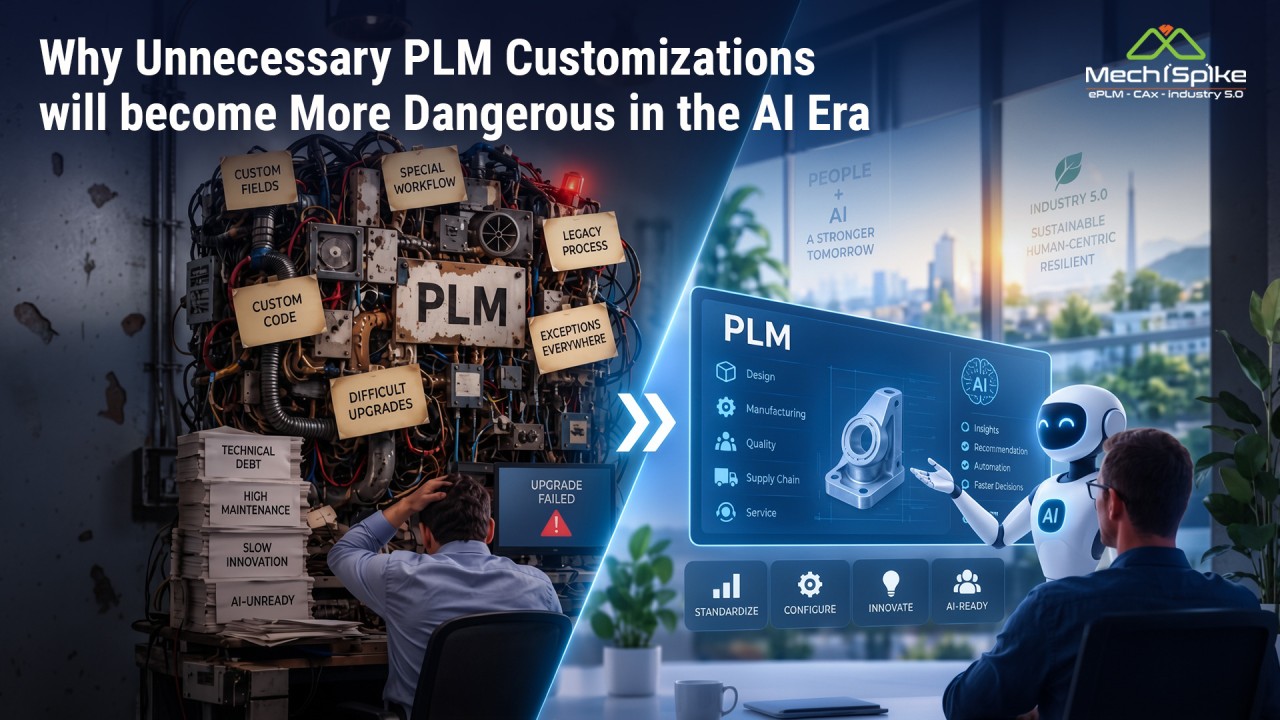
In the age of AI-powered PLM, copilots and agentic engineering, there is an additional problem: Unnecessary customization can now become an AI-readiness problem.
Maximum Configuration. Minimum Customization.
The fundamental principle has not changed:
Configure wherever possible. Customize only where the business value clearly justifies it.
Modern PLM platforms already incorporate years of industry knowledge, process patterns, workflow capabilities, data models and best practices.
Organizations should first understand what the platform can already do before deciding what it must be changed to do.
Customization is not inherently bad.
A differentiated product-development process, regulatory requirement, safety-critical workflow or genuinely competitive capability may absolutely justify an extension.
The problem is customization without discipline.
The question should not be:“Can the PLM system be customized to work exactly like our current process?”. It should be: “Should our future process work this way in the first place?”
That distinction is critical.
Why Unnecessary Customization Becomes More Dangerous in the AI Era
Traditional customization created technical debt. AI can amplify the consequences.
Modern PLM is increasingly moving toward AI-assisted search, engineering copilots, intelligent recommendations, automated classification, predictive analytics and eventually agentic workflows. Major PLM platforms are already introducing AI and agentic capabilities directly into product-lifecycle processes.
These capabilities depend on the PLM environment having consistent data, predictable processes, understandable relationships and accessible system logic.
Consider two organizations.
Company A
It uses mostly standard PLM capabilities with clearly defined:
- Part and document structures
- BOM relationships
- Change processes
- Approval rules
- Roles and responsibilities
- Classification
- Lifecycle states
Company B
It has implemented years of custom workflows, custom objects, special exceptions, bespoke integrations and undocumented business rules.
Both may technically have “PLM.”
But Company A is likely to have a much easier path toward AI adoption.
Why?
Because AI needs more than data. AI needs context, relationships, rules and predictable processes.
If the logic of the business is buried inside custom code, undocumented scripts and special exceptions, AI has a much harder environment to understand, reason over and safely act upon.
Customization Creates an AI “Black Box”
Imagine an engineering change process.
In a standard environment, an AI assistant may be able to understand:
Change Request → Impact Analysis → Review → Approval → Implementation → Release
Now imagine that the same process has been customized over ten years.
One product line follows Workflow A.
Another follows Workflow B.
A special customer uses Workflow C.
Certain parts bypass approval under an undocumented rule.
Another approval is triggered by a custom script.
A particular engineering group has a special exception known only to two administrators.
Humans who have worked in the organization for years may understand this complexity.
Can an AI agent safely understand it?
More importantly: Can you confidently allow an AI agent to execute within it?
This is where customization moves from being an IT concern to becoming an AI governance concern.
The Hidden Cost of “Just One More Customization”
The danger is cumulative complexity.
One custom field rarely destroys a PLM implementation.
One custom workflow usually doesn’t either.
But multiply this by hundreds of decisions over several years and the result can become:
Customization → Complexity → Technical Debt → Upgrade Difficulty → Higher Cost → Slower Innovation
And now add AI:
Customization → Fragmented Process Logic → Poor Context → Lower AI Reliability → More Human Intervention → Lower AI ROI
This is particularly important as manufacturers move toward Industry 5.0, where technology is expected to augment human expertise rather than simply automate tasks. Industry 5.0 emphasizes human-centricity, sustainability and resilience—not technology for technology’s sake.
A highly customized PLM that is difficult for humans to understand is unlikely to become an effective foundation for human-AI collaboration.
The New PLM Customization Decision Framework
Before approving a customization, ask seven questions:
1. Is it a genuine business requirement?
Or is someone simply asking for the system to behave like the legacy system?
2. Can configuration solve the requirement?
Always explore OOTB capabilities and configuration before custom development.
3. Does the customization create competitive differentiation?
If every competitor could use the same capability, why build and maintain it yourself?
4. What happens during the next upgrade?
A customization that saves 10 hours today but creates 500 hours of upgrade effort later is not necessarily a good investment.
5. Who owns it?
Every customization needs a business owner and a technical owner.
“Someone in IT will handle it” is not governance.
6. Will AI be able to understand and use it?
Can AI interpret the data, relationships, rules and workflow created by the customization?
And if an AI agent eventually needs to act on it, can that action be governed safely?
7. Is the long-term value greater than the technical debt?
Every customization should have a business-value case—not merely a technical feasibility case.
From Customization Governance to AI-Ready PLM Governance
Organizations should now introduce an AI impact assessment into their PLM customization governance.
For every proposed customization, evaluate:
Business Value
- Does it create measurable business value?
- Is it strategically differentiated?
Process Impact
- Does it simplify or complicate the process?
- Does it eliminate waste or merely reproduce existing habits?
Data Impact
- Does it create new data structures?
- Does it fragment existing information?
AI Impact
- Can AI understand the resulting process?
- Can AI retrieve the necessary context?
- Can an AI agent safely execute within the workflow?
Lifecycle Impact
- What happens during future upgrades?
- How difficult will migration become?
- Can the customization eventually be retired?
This turns customization from an emotional “business wants it” decision into a strategic architecture decision.
The Future: Configure the Platform, Customize the Experience
The future of PLM will not necessarily mean zero customization.
Instead, customization will increasingly move upward in the stack.
Rather than modifying the core PLM data model and process engine extensively, organizations may use:
- Configuration
- APIs
- Extensions
- Low-code capabilities
- External services
- AI interfaces
- Role-based experiences
- Agent orchestration
This creates a more upgrade-friendly architecture while still allowing organizations to differentiate where differentiation matters.
The objective should be:
Standardize the foundation. Differentiate where it creates value.
That philosophy becomes even more important as PLM evolves from a system of record into a system of intelligence and action.
A Practical PLM Customization Checklist
Before saying YES to a customization, ask:

If several answers are unclear, pause before building.
Conclusion:
The classic PLM lesson remains: Maximum Configurations. Minimum Customizations.
But the reason has evolved.
Yesterday, unnecessary customization created maintenance problems and made upgrades difficult. Today, it can also create data fragmentation, process complexity and AI-readiness challenges.
The future PLM environment will increasingly combine humans, AI copilots, intelligent recommendations and autonomous agents.
Industry 5.0 reinforces the need for these technologies to empower people while creating resilient and sustainable industrial systems.
Therefore, every customization decision should be evaluated not only for what it solves today—but for what it enables or prevents tomorrow.
Because in the AI era, the most valuable PLM may not be the one with the most custom code. It may be the one with the least unnecessary complexity.
MechiSpike can be of great help to make your organization get ready for the next era with our focus on AI & Industry 5.0 using our prowess in PLM, Engineering and IT Digital.
Click here to know more about us.
Quickly Assess your Industry 5.0 Solutions Online | Schedule a call →
Subscribe Now :
Subscribe now to get this weekly series delivered directly to your inbox.
To your success!
Thank you!!
Always at my Best,
Founder | Trusted Advisor – PLM ROI, Industry 5.0 Solutions
Bridging Strategy, Talent & Technology for Industry 5.0
Tailored PLM, Engineering & IT Solutions for Global Manufacturers