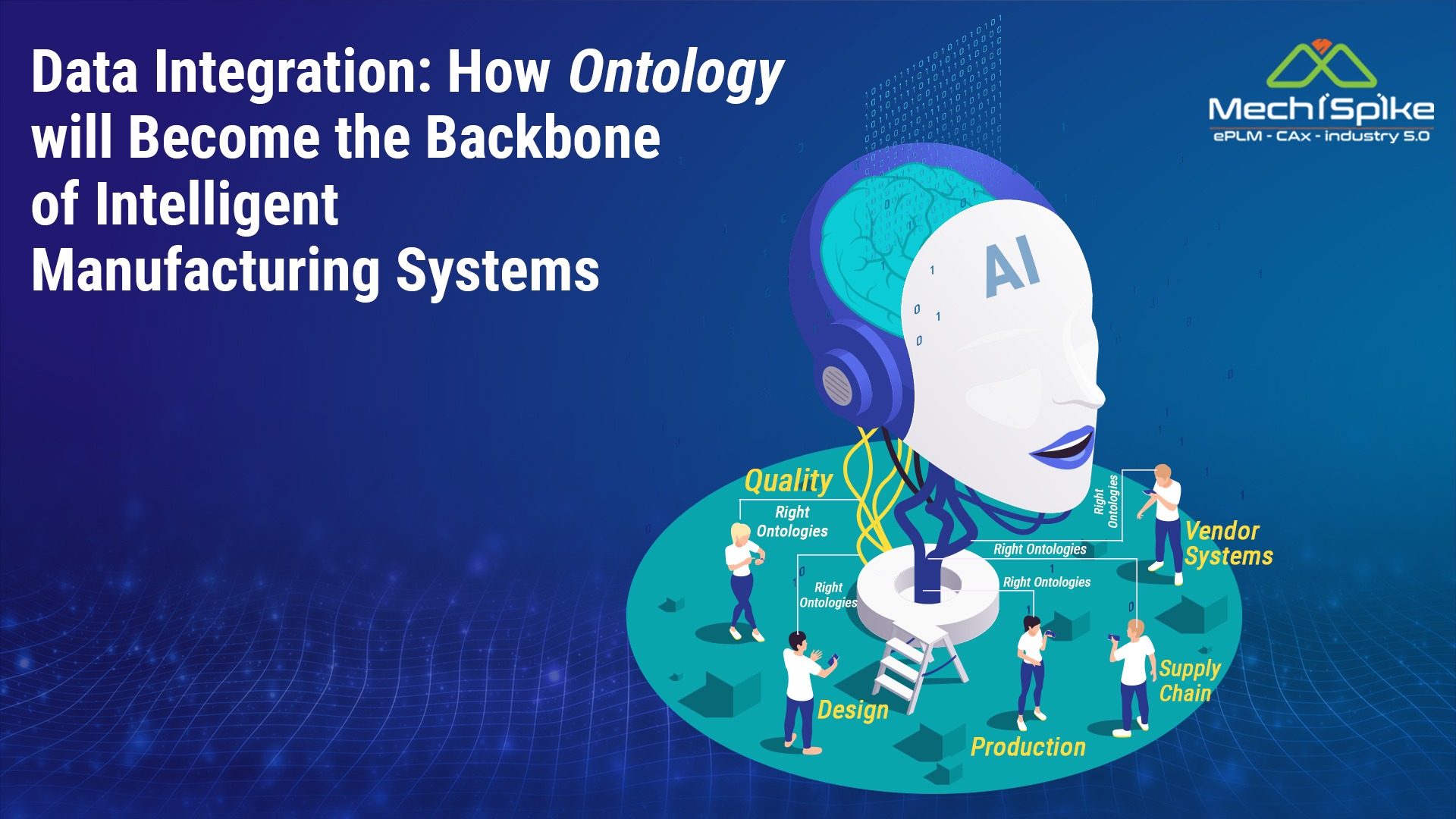
Data Integration: How Ontology Will Become the Backbone of Intelligent Manufacturing Systems

In this article, let’s explore what is happening in the world of Data Integration and how it is poised for a BIG change with Ontology.
While it is still in early phases for the PLM/ERP World, it is worth understanding : What is Ontology, how it helps in Data Integration, Its Benefits, Pros & Cons and how to adopt the same.
Data Integration: How Ontology Will Become the Backbone of Intelligent Manufacturing Systems
For decades, product manufacturers have invested heavily in enterprise systems—PLM for product data, ERP for business operations, MES for manufacturing execution, and various supplier and vendor systems. Yet, despite these investments, one challenge persists:
True integration remains elusive.
Systems may be connected through APIs, middleware, or data pipelines, but they often fail to understand each other. Data flows, but meaning does not.
This is where Ontology enters the picture.
In the emerging AI-driven world, ontology is not just a technical concept—it is becoming a strategic foundation for intelligent, connected, and autonomous enterprise systems.
In practice, this approach has been demonstrated by platforms like Palantir (at a very large scale), which are poised to operate as an integration and intelligence layer above established PLM ISVs.
Rather than replacing these systems, they extend them by enabling AI-driven insights across engineering, manufacturing, and supply chain workflows—pointing toward a future where PLM systems are augmented by intelligent, data-centric orchestration layers.
What Is Ontology?
In the context of business and technology, an ontology is a structured way of defining:
- Entities (e.g., parts, suppliers, processes)
- Relationships (e.g., “part is used in assembly”, “supplier provides material”)
- Attributes (e.g., material type, cost, tolerance)
- Rules and constraints
In simple terms:
Ontology defines the meaning of data, not just the data itself.
Why Traditional Integration Falls Short
Most enterprise integrations today are:
- Schema-based (field-to-field mapping)
- System-specific
- Hardcoded
For example:
- PLM stores a “Part”
- ERP stores an “Item”
- MES references a “Component”
Even if these represent the same thing, systems treat them differently.
This creates:
- Data duplication
- Misalignment
- Manual reconciliation
- Integration complexity
How Ontology Solves This Problem
Ontology provides a shared understanding layer across systems.
Instead of mapping fields, ontology defines:
- What a “Part” means
- How it relates to other entities
- How different systems interpret it
This allows systems to:
- Understand each other semantically
- Interoperate more effectively
- Enable AI to reason across data
Ontology in the Context of PLM, ERP, and Vendor Integration
In a manufacturing environment, ontology connects:
- PLM → Product definitions, BOMs, design data
- ERP → Costing, procurement, financials
- MES → Production execution
- Vendor systems → Supplier data, material specifications
Example: Material Change Scenario
Without ontology:
- PLM updates material specification
- ERP may not reflect cost implications immediately
- Supplier data may remain outdated
With ontology:
- The system understands:
- AI can automatically evaluate:
This creates end-to-end visibility and intelligence.
Why Ontology Is Critical in the AI Era
AI systems—especially LLMs and AI agents—depend on:
- Context
- Relationships
- Structured understanding
Without ontology:
- AI may misinterpret data
- Insights may be incomplete
- Decisions may lack context
With ontology:
- AI can reason across systems
- Understand dependencies
- Provide accurate recommendations
In essence:
Ontology is the bridge between raw data and intelligent decision-making.
Key Benefits of Ontology for Product Manufacturers
1. Seamless Integration Across Systems
Ontology eliminates the need for complex point-to-point integrations.
2. Improved Data Consistency
A shared semantic model ensures alignment across PLM, ERP, and other systems.
3. Enhanced AI Capabilities
AI agents can operate more effectively with structured relationships.
4. Faster Decision-Making
Cross-functional insights become readily available.
5. Better Vendor Integration
Suppliers can align with a common data model, reducing friction.
6. Scalability
New systems can be integrated more easily without redefining data mappings.
Real-World Use Cases
1. Engineering Change Management
Ontology helps track impact across:
- Design
- Manufacturing
- Supply chain
AI can evaluate change implications holistically.
2. Supply Chain Optimization
Ontology connects:
- Materials
- Suppliers
- Logistics
Enabling AI to optimize sourcing decisions.
3. Compliance Management
Regulatory requirements can be linked directly to product attributes.
4. Digital Twins and Virtual Twins
Ontology enables consistent representation across physical and digital models.
Pros of Using Ontology
✅ Unified Understanding Across Systems
Eliminates semantic gaps between PLM, ERP, MES.
✅ Enables AI-Driven Insights
Supports advanced analytics and decision-making.
✅ Reduces Integration Complexity
Minimizes need for custom mappings.
✅ Improves Data Quality
Encourages structured and consistent data definitions.
✅ Future-Proof Architecture
Supports scalability and adaptability.
Cons and Challenges
❌ High Initial Effort
Building an ontology requires deep domain expertise.
❌ Organizational Alignment Needed
Different departments must agree on definitions.
❌ Complexity in Design
Ontology modeling can be complex and time-consuming.
❌ Maintenance Overhead
Ontology must evolve with business and product changes.
❌ Tooling and Skill Gaps
Requires specialized tools and knowledge.
How Manufacturers Should Adopt Ontology
1. Start with Core Domains
Focus on:
- Parts
- BOMs
- Materials
- Suppliers
2. Build a Unified Data Model
Define:
- Entities
- Relationships
- Attributes
3. Integrate with Existing Systems
Map ontology to:
- PLM
- ERP
- MES
- Vendor systems
4. Enable AI Integration
Use ontology to:
- Train AI models
- Support AI agents
5. Establish Governance
Define:
- Ownership
- Update processes
- Validation mechanisms
6. Scale Gradually
Expand ontology to cover:
- Manufacturing processes
- Service lifecycle
- Sustainability metrics
Organizational Changes Required
To successfully implement ontology, organizations must:
1. Shift to Data-Centric Thinking
Move from system-centric to data-centric architecture.
2. Break Down Silos
Encourage collaboration across departments.
3. Invest in Data Governance
Ensure consistency and quality.
4. Build New Skills
Train teams in:
- data modeling
- semantic technologies
- AI integration
5. Align Leadership
Ensure top-down support for standardization.
The Future: Ontology as the Operating Layer
In the future, ontology will act as the semantic backbone of enterprise systems.
Instead of:
- Navigating multiple systems
- Reconciling data manually
Organizations will operate on:
- Unified data models
- AI-driven insights
- Seamless integration
PLM, ERP, and other systems will become applications on top of a shared knowledge layer.
Conclusion
Ontology represents a fundamental shift in how organizations manage and interpret data. By defining not just data but its meaning and relationships, ontology enables true integration across systems and unlocks the full potential of AI.
For product manufacturers, this means:
- Better alignment between PLM, ERP, and vendor systems
- Faster and more accurate decision-making
- Improved scalability and adaptability
While the journey requires investment in data modeling, governance, and cultural change, the long-term benefits are significant.
In the AI-driven future, the companies that succeed will not just have more data—they will have better understanding of that data.
And ontology will be the foundation that makes that understanding possible.
MechiSpike can be of great help here to take your organization to the future of Product Design as well as Manufacturing with our focus on AI & Industry 5.0 using our prowess in PLM, Engineering and IT Digital.
Click here to know more about us.
For Corporates :
MechiSpike can be of great help to your organization to help you improve your PLM ROI and 30% Savings, be it the hiring cost in staffing or setting up an ODC.
We do this with efficient planning, organizing and controlling Product Master data with seamless data exchange among Engineering, Manufacturing and Enterprise systems.
With our well established niche expertise in PLM, we are now serving more than 15 Global Clients. They are now looking at us as a ‘Go To’ partner for Engineering, IT and PLM. With this confidence, we are expanding our scope of services beyond PLM to Industry 5.0 Digital Transformation i.e. PLM, ERP, CAD, Cloud, AI and DevOps.

RightSourcing is ‘Better Outsourcing’, given to ‘NICHE EXPERTS’.

Click here to know how we can actually help you with our Proven Methodologies.
For PLM Careers :
Learn More | Earn More | Grow More
Interactive UI : Every Application will get a response with a recruiter contact details and the applicant will get a notification at each phase until the applicant is positioned well with our 15+ global clients in India, USA & Germany.
Candidate Referral Program : Refer a candidate and earn INR 25,000.
Mechispike Solutions Pvt Ltd is a PLM focused company, having all kinds of PLM projects to enable employee career growth and add value to clients. We can position you better with our 15+ global clients in India, USA & Germany.
We believe in “Grow Together” and “Employee First” culture.
Dream more than a Job. Grow your PLM Career to the Fullest with MechiSpike
Click Here to explore our Job Openings.
Subscribe Now :
Our mission : To equip you with the knowledge and tools you need to drive value, streamline operations, and maximize return on investment from your PLM initiatives.
PLM ROI Newsletter will guide you through a comprehensive roadmap to help you unlock the full potential of your PLM investment.
We are committed to be your trusted source of knowledge and support throughout your PLM journey. Our team of experts and thought leaders will bring you actionable insights, best practices, case studies, and the latest trends in PLM.
Subscribe Now to get this weekly series delivered into your Inbox directly, as and when we publish it.
To your PLM success!
Warm regards,
Visit Us: www.mechispike.com
For PLM Services : Click Here to Schedule a Call with us.