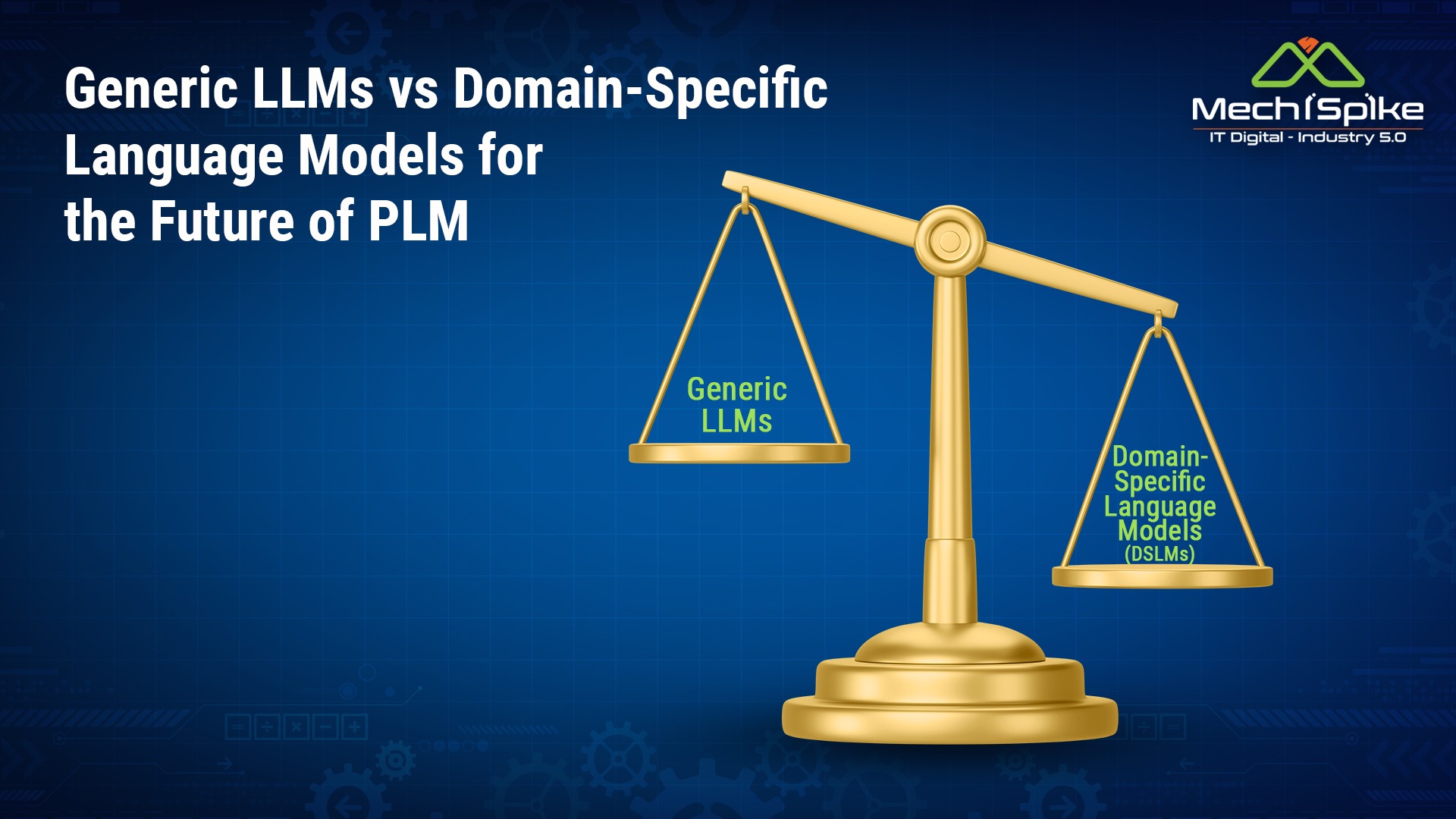
Generic LLMs vs Domain-Specific Language Models for the Future of PLM

In this article, let’s look at DSLMs aka Domain-Specific Language Models. Gartner predicts that by 2028, more than half of the Generative Artificial Intelligence (GenAI) models used by enterprises will be domain-specific. Let’s understand why they matter for PLM, their benefits and limitations, and what organizations must do to adopt them effectively.
Generic LLMs vs Domain-Specific Language Models & its Importance for the Future of PLM
Over the past few years, Large Language Models (LLMs) have transformed how organizations interact with data. From generating text to answering complex queries, general-purpose AI models have demonstrated impressive capabilities across industries.
However, as organizations attempt to apply these models to Product Lifecycle Management (PLM) and engineering workflows, a critical limitation becomes clear:
Generic AI lacks deep understanding of engineering context, product structures, and lifecycle complexity.
This is where Domain-Specific Language Models (DSLMs) come into play.
Rather than being trained on broad internet data, DSLMs are tailored to specific domains—such as mechanical engineering, manufacturing, or PLM systems—enabling them to understand specialized terminology, relationships, and workflows.
Gartner predicts that by 2028, more than half of the Generative Artificial Intelligence (GenAI) models used by enterprises will be domain-specific.
This article explores what DSLMs are, why they matter for PLM, their benefits and limitations, and what organizations must do to adopt them effectively.
What Are Domain-Specific Language Models?
A Domain-Specific Language Model is an AI model trained or fine-tuned on specialized datasets relevant to a particular field.
In the context of PLM and engineering, this includes:
- CAD models and feature definitions
- Bills of Materials (BOMs)
- Engineering change records
- Simulation results
- Manufacturing process data
- Compliance and regulatory documentation
Unlike general LLMs, DSLMs understand:
- Engineering terminology (e.g., tolerances, constraints, materials)
- Product relationships (parent-child hierarchies, configurations)
- Lifecycle context (design → manufacturing → service → disposal)
In simple terms:
Generic LLMs understand language. DSLMs understand engineering language and product logic.
Why DSLMs Are Critical for the PLM World
PLM systems are not just databases—they are complex, interconnected representations of products and processes.
Key challenges include:
- Highly structured data
- Deep relationships between objects
- Strict compliance requirements
- Context-dependent decision-making
Generic AI struggles with this complexity because:
- It lacks structured understanding of product data
- It cannot reliably interpret engineering intent
- It may hallucinate in critical scenarios
DSLMs address these gaps by embedding domain knowledge directly into the model.
Key Benefits of DSLMs in PLM
1. Context-Aware Engineering Intelligence
DSLMs understand relationships between parts, assemblies, and processes.
Example: When analyzing a design change, a DSLM can identify:
- affected components
- downstream manufacturing impact
- compliance implications
2. Improved Accuracy and Reduced Hallucination
Because DSLMs are trained on domain-specific data, they produce more reliable outputs.
This is critical in engineering, where errors can lead to:
- product failures
- safety risks
- regulatory violations
3. Faster Decision-Making
DSLMs can analyze complex datasets quickly and provide actionable insights.
Example: An engineer can ask:
- “What is the impact of changing material X to Y?” and receive a structured analysis across cost, performance, and compliance.
4. Enhanced Knowledge Reuse
PLM systems store vast amounts of historical data, but much of it is underutilized.
DSLMs can:
- surface relevant past designs
- identify reusable components
- extract lessons learned
5. Natural Language Interface to PLM
DSLMs enable conversational interaction with PLM systems.
Instead of navigating complex interfaces, users can:
- ask questions
- request reports
- trigger analyses
6. Foundation for AI Agents
DSLMs serve as the intelligence layer for AI agents operating within PLM systems.
Agents can:
- interpret engineering context
- perform actions
- coordinate workflows
Current State of Development
DSLMs are still evolving but gaining traction.
Current approaches include:
- Fine-tuning general LLMs on engineering datasets
- Building retrieval-augmented systems using PLM data
- Developing hybrid models combining rules and AI
Challenges still being addressed:
- Access to high-quality domain data
- Integration with PLM systems
- Ensuring explainability and traceability
- Handling complex parametric relationships
In most organizations, DSLMs are currently used in:
- pilot projects
- limited-scope implementations
- knowledge retrieval systems
Pros of DSLMs in PLM
1. High Domain Relevance
Better understanding of engineering concepts and workflows.
2. Improved Decision Quality
More accurate analysis leads to better outcomes.
3. Reduced Training Effort for Users
Natural language interaction simplifies system usage.
4. Scalable Expertise
Expert-level insights can be replicated across teams.
5. Better Integration with AI Agents
Enables autonomous or semi-autonomous workflows.
Cons and Limitations
1. Data Dependency
DSLMs require high-quality, domain-specific data.
2. High Development Cost
Training or fine-tuning models can be expensive.
3. Integration Complexity
Connecting DSLMs with PLM systems is non-trivial.
4. Maintenance Overhead
Models must be updated as products and processes evolve.
5. Risk of Overconfidence
Even domain-trained models can produce incorrect outputs if not validated.
Real-World Use Cases
1. Engineering Change Analysis
A DSLM evaluates change requests and identifies impacted components, suppliers, and processes.
2. Design Assistance
Engineers receive suggestions for materials, geometries, and standards based on past designs.
3. Compliance Monitoring
The model checks designs against regulatory requirements and flags issues.
4. Knowledge Retrieval
Engineers query PLM data conversationally to find relevant designs or documents.
5. Manufacturing Planning Support
DSLMs suggest process optimizations based on historical production data.
Organizational Changes Required
To implement DSLMs effectively, organizations must evolve in several ways.
1. Strengthen Data Foundations
- Clean, structured, and connected PLM data is essential
- Data silos must be eliminated
2. Invest in Data Governance
- Define ownership and quality standards
- Ensure traceability and compliance
3. Build AI-Ready Architecture
- API-first systems
- Integration between PLM, ERP, MES, and data platforms
4. Redesign Workflows
- Shift from manual analysis to AI-assisted decision-making
- Define human vs AI responsibilities
5. Upskill the Workforce
Engineers must develop:
- AI literacy
- systems thinking
- critical evaluation skills
6. Establish Governance for AI Decisions
- Define approval mechanisms
- Ensure auditability
- Manage risk
The Future: DSLMs as the Brain of PLM Systems
Looking ahead, DSLMs will become the core intelligence layer of PLM systems.
Instead of:
- navigating screens
- searching manually
- analyzing data step by step
Engineers will:
- interact with intelligent systems
- receive contextual insights
- supervise AI-driven workflows
PLM will evolve from a Data Management System to a Decision Intelligence Platform.
Conclusion
Domain-Specific Language Models represent a critical evolution in applying AI to engineering and manufacturing. By embedding domain knowledge into AI systems, DSLMs enable more accurate, context-aware, and actionable insights within the complex world of PLM.
While challenges remain—particularly around data quality, integration, and governance—the potential benefits are significant: faster decisions, better design outcomes, and more efficient use of organizational knowledge.
For product design and manufacturing organizations, the path forward is clear. Success will depend not just on adopting DSLMs, but on transforming data foundations, workflows, and skillsets to fully leverage their capabilities.
In the end, the future of PLM will not be driven by generic intelligence—but by deep, domain-specific understanding that aligns AI with the realities of engineering.
MechiSpike can be of great help here to take your organization to the future of Product Design as well as Manufacturing with our focus on AI & Industry 5.0 using our prowess in PLM, Engineering and IT Digital.
Click here to know more about us.
For Corporates :
MechiSpike can be of great help to your organization to help you improve your PLM ROI and 30% Savings, be it the hiring cost in staffing or setting up an ODC.
We do this with efficient planning, organizing and controlling Product Master data with seamless data exchange among Engineering, Manufacturing and Enterprise systems.
With our well established niche expertise in PLM, we are now serving more than 15 Global Clients. They are now looking at us as a ‘Go To’ partner for Engineering, IT and PLM. With this confidence, we are expanding our scope of services beyond PLM to Industry 5.0 Digital Transformation i.e. PLM, ERP, CAD, Cloud, AI and DevOps.
Why MechiSpike :

RightSourcing is ‘Better Outsourcing’, given to ‘NICHE EXPERTS’.

Click here to know how we can actually help you with our Proven Methodologies.
For PLM Careers :
Learn More | Earn More | Grow More
Interactive UI : Every Application will get a response with a recruiter contact details and the applicant will get a notification at each phase until the applicant is positioned well with our 15+ global clients in India, USA & Germany.
Candidate Referral Program : Refer a candidate and earn INR 25,000.
Mechispike Solutions Pvt Ltd is a PLM focused company, having all kinds of PLM projects to enable employee career growth and add value to clients. We can position you better with our 15+ global clients in India, USA & Germany.
We believe in “Grow Together” and “Employee First” culture.
Dream more than a Job. Grow your PLM Career to the Fullest with MechiSpike
Click Here to explore our Job Openings.
Subscribe Now :
Our mission : To equip you with the knowledge and tools you need to drive value, streamline operations, and maximize return on investment from your PLM initiatives.
PLM ROI Newsletter will guide you through a comprehensive roadmap to help you unlock the full potential of your PLM investment.
We are committed to be your trusted source of knowledge and support throughout your PLM journey. Our team of experts and thought leaders will bring you actionable insights, best practices, case studies, and the latest trends in PLM.
Subscribe Now to get this weekly series delivered into your Inbox directly, as and when we publish it.
To your PLM success!
Warm regards,
Visit Us: www.mechispike.com
For PLM Services : Click Here to Schedule a Call with us.