The Hidden Cost of Your “Free” Spreadsheet Systems

The Hidden Cost of Your “Free” Spreadsheet Systems
Excel doesn’t send you an invoice for every mistake. But your business may still be paying for it.
Imagine a small manufacturing company managing its Bills of Materials (BOMs), engineering changes, component specifications and production information through spreadsheets.
It works. Everyone knows where the files are—or at least, they think they do.
There is no additional software licence to buy. No complex implementation. No new system for employees to learn.
So, why change anything?
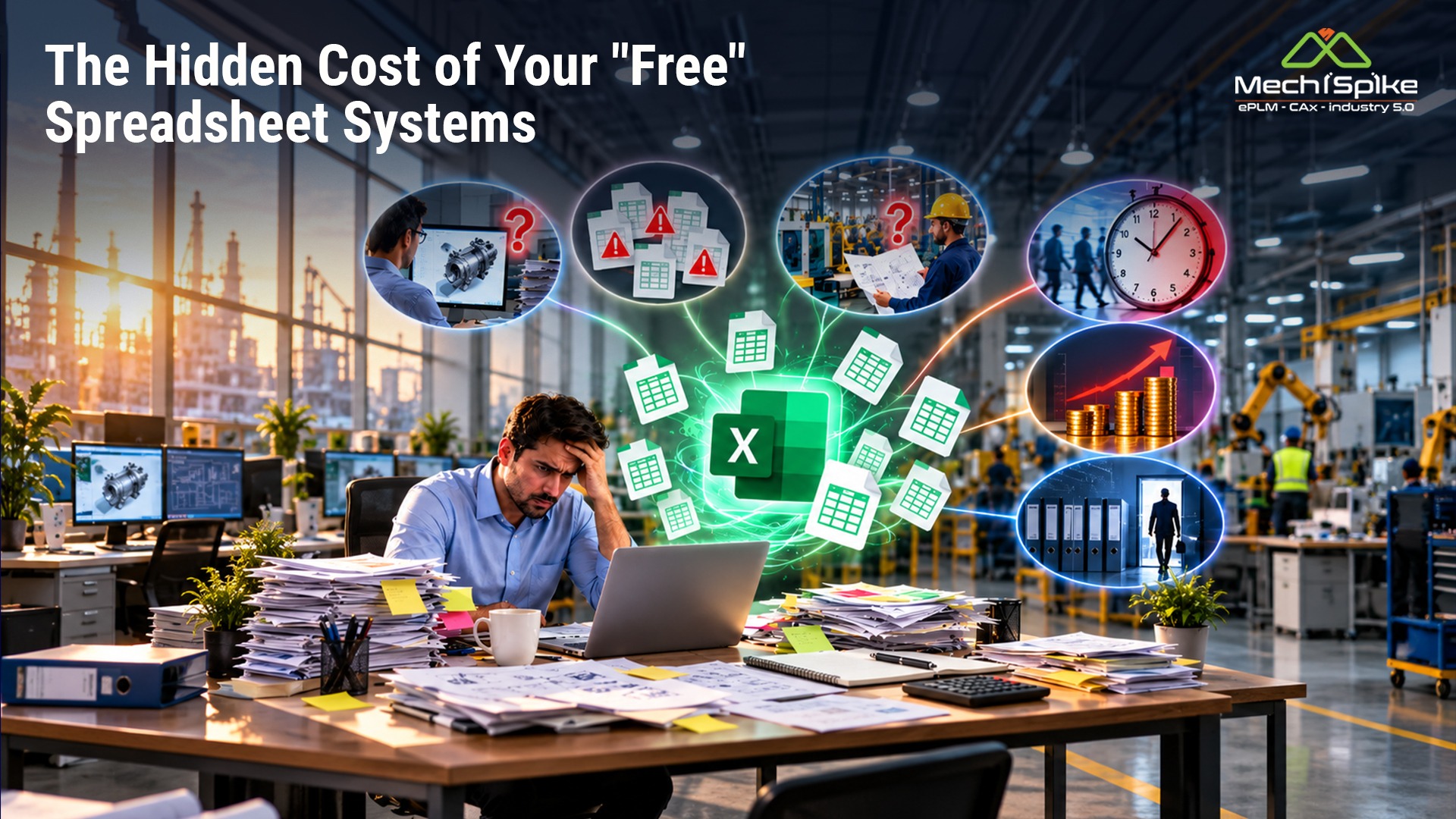
Because the real cost of a spreadsheet-based process rarely appears in your software budget. It hides in engineering hours, production errors, duplicate data entry, delayed decisions and the time people spend trying to establish which information is correct.
The spreadsheet may be free. The process built around it isn’t.
Why Spreadsheets Become a Problem
Spreadsheets are excellent tools. They are flexible, familiar and useful for calculations, analysis and managing small datasets.
The problem begins when they become the backbone of business-critical processes.
Consider what happens when an engineering team maintains a product BOM in Excel.
Purchasing downloads a copy. Manufacturing creates another version. An engineer updates the original file, but forgets to notify everyone. Someone saves a new version under a different filename.
Suddenly, several versions of the same information exist.
Which one is correct?
Someone has to investigate.
And that investigation consumes time, creates uncertainty and increases the risk of mistakes.
The problem isn’t Excel itself. It is relying on disconnected files to manage information that must remain consistent across people, departments and business systems.
Five Hidden Costs of Spreadsheet-Based Processes
1. The Cost of Engineering Time
Your engineers are hired to design products, solve technical problems and improve performance. But how much time do they spend searching for drawings, comparing BOMs, checking revisions, correcting part numbers and responding to questions about the latest specifications?
Imagine that five engineers each spend 30 minutes every working day resolving spreadsheet-related issues.
That’s 2.5 hours per day across the team.
Over 220 working days, it amounts to 550 hours annually.
At an illustrative fully loaded cost of ₹1,500 per engineering hour, that’s ₹8.25 lakh per year spent on these activities.
This is not necessarily a direct cash saving if you eliminate the work. But it represents engineering capacity that could potentially be redirected toward higher-value activities.
The bigger question is: how much innovation is being delayed because your best engineers are busy managing information?
2. The Cost of Working With the Wrong Information
A spreadsheet can contain perfectly accurate information when it is created.
The problem is whether it remains accurate after the product changes.
Suppose an engineer revises a component, but production continues using an older drawing referenced in a spreadsheet.
The consequences could include incorrect manufacturing, rework, material wastage, inspection failures or delayed deliveries.
Not every spreadsheet error creates a production problem. But when spreadsheets control critical product information without reliable revision management, the risk increases.
Even a small number of incidents can become expensive.
And the cost extends beyond the material wasted. Employees must investigate the issue, correct records, repeat work and potentially explain the incident to customers.
The hidden cost isn’t just incorrect data. It’s everything the business must do because that data was incorrect.
3. The Cost of Duplicate Data Entry
Consider the journey of a new component.
Engineering creates the part information. Someone enters it into an Excel BOM. Another employee creates the corresponding record in ERP. Manufacturing maintains its own production list.
The same information is entered, copied or checked multiple times. Each handoff introduces an opportunity for inconsistency.
As the number of parts, products and variants grows, so does the effort required to keep the information aligned.
This is where systems such as Product Lifecycle Management (PLM) can help. A properly configured PLM environment can manage product structures, revisions and engineering changes, while appropriate integration can transfer approved information to ERP and other downstream systems.
The objective isn’t to eliminate spreadsheets everywhere.
It is to stop repeatedly recreating business-critical information when a more reliable process is justified.
4. The Cost of Slow Decisions
Imagine a customer asks whether a proposed design change will affect an existing product.
To answer, your team searches multiple spreadsheets, emails and folders.
Someone checks the BOM. Another person contacts purchasing. Engineering reviews the drawing. Manufacturing confirms which revision is currently being used.
Hours—or sometimes days—may pass before the organization has a dependable answer.
Now imagine the same question arising during a customer audit or an urgent quality investigation.
The delay becomes more than an administrative inconvenience. It can affect delivery commitments, customer confidence and management decisions.
Reliable product data and controlled change processes make it easier to establish what is known, what has changed and which decisions are required.
Better information doesn’t just reduce errors. It helps businesses respond faster.
5. The Cost of Growth
Spreadsheets often work reasonably well when a business has a limited product range, a small team and relatively few engineering changes. But growth changes the equation.
More products mean more BOMs. More customers introduce more requirements. More engineers create more handoffs. More suppliers increase the need for consistent product information.
The spreadsheet system that once felt convenient may gradually become dependent on a few experienced employees who know where everything is stored and which files can be trusted.
What happens when one of them leaves?
Knowledge that was never formally documented may disappear with them.
This creates operational dependency and makes onboarding new employees more difficult.
As complexity grows, the business may need stronger controls, structured workflows and a more reliable way to maintain product information.
Should Every SMB Manufacturer Abandon Spreadsheets?
Absolutely not.
That would be replacing one oversimplification with another.
Spreadsheets remain useful for analysis, planning, reporting and many everyday tasks.
The real question is whether they are being used for the right purpose.
A spreadsheet used to analyze production costs is different from one serving as the only record of approved engineering revisions.
The latter carries greater operational risk because multiple people and processes may depend on the information being current and consistent.
Before introducing new software, identify where the current process actually breaks.
Ask yourself:
- Do different departments maintain different versions of the same BOM?
- Can engineers reliably identify the latest approved drawing?
- Are engineering changes communicated through email and manual updates?
- Does anyone regularly reconcile spreadsheet data with ERP?
- Can the business trace important product decisions without searching multiple files?
If several answers reveal recurring problems, it may be time to evaluate a more structured approach.
A Practical Way Forward: Don’t Automate the Mess
The solution doesn’t have to begin with a massive digital transformation project.
Start with one important workflow.
Step 1: Map the process. Follow a part from engineering design through purchasing and manufacturing. Identify every manual handoff.
Step 2: Identify the cost. Estimate the time spent correcting errors, reconciling records and searching for information. Include rework and delays where reliable data is available.
Step 3: Fix the underlying data. Establish consistent part numbers, clear ownership and dependable revision practices.
Step 4: Introduce the right controls. Depending on the problem, this might mean improving the existing process, implementing PDM or PLM, or connecting engineering data with ERP.
Step 5: Measure the result. Compare the time, error rates and process performance before and after the change.
This approach allows an SMB manufacturer to invest where the business case is strongest rather than buying technology simply because it is available.
Conclusion
Spreadsheets are not the enemy. Uncontrolled information is.
For an SMB manufacturer, the challenge is to recognize when a convenient tool has quietly become a business-critical system without the controls needed to support it.
The answer isn’t to replace every spreadsheet with enterprise software.
It is to understand where information errors, manual effort and delays are costing the business more than a better process would.
Your spreadsheet may be free. But is the way you use it still economical?
The most useful next step may not be buying new software. It may be calculating what your existing process is actually costing you.
Measure the waste. Fix the bottleneck. Then invest in the solution.
About MechiSpike Solutions
MechiSpike Solutions works with SMB manufacturers on PLM, MES, ERP, AI, engineering and Industry 5.0 initiatives—with an emphasis on right-sized technology, practical adoption and measurable business outcomes. The company’s approach is to understand the requirement first, then configure only what the industry and users actually need.
MechiSpike can be of great help to make your organization get ready for this and more with our focus on AI & Industry 5.0 using our prowess in PLM, Engineering and IT Digital.
Click here to know more about us.
Quickly Assess your Industry 5.0 Solutions Online | Schedule a call →
Subscribe Now :
Subscribe now to get this weekly series delivered directly to your inbox.
To your success!
Thank you!!
Always at my Best,
Founder | Trusted Advisor – PLM ROI, Industry 5.0 Solutions
Bridging Strategy, Talent & Technology for Industry 5.0
Tailored PLM, Engineering & IT Solutions for Global Manufacturers