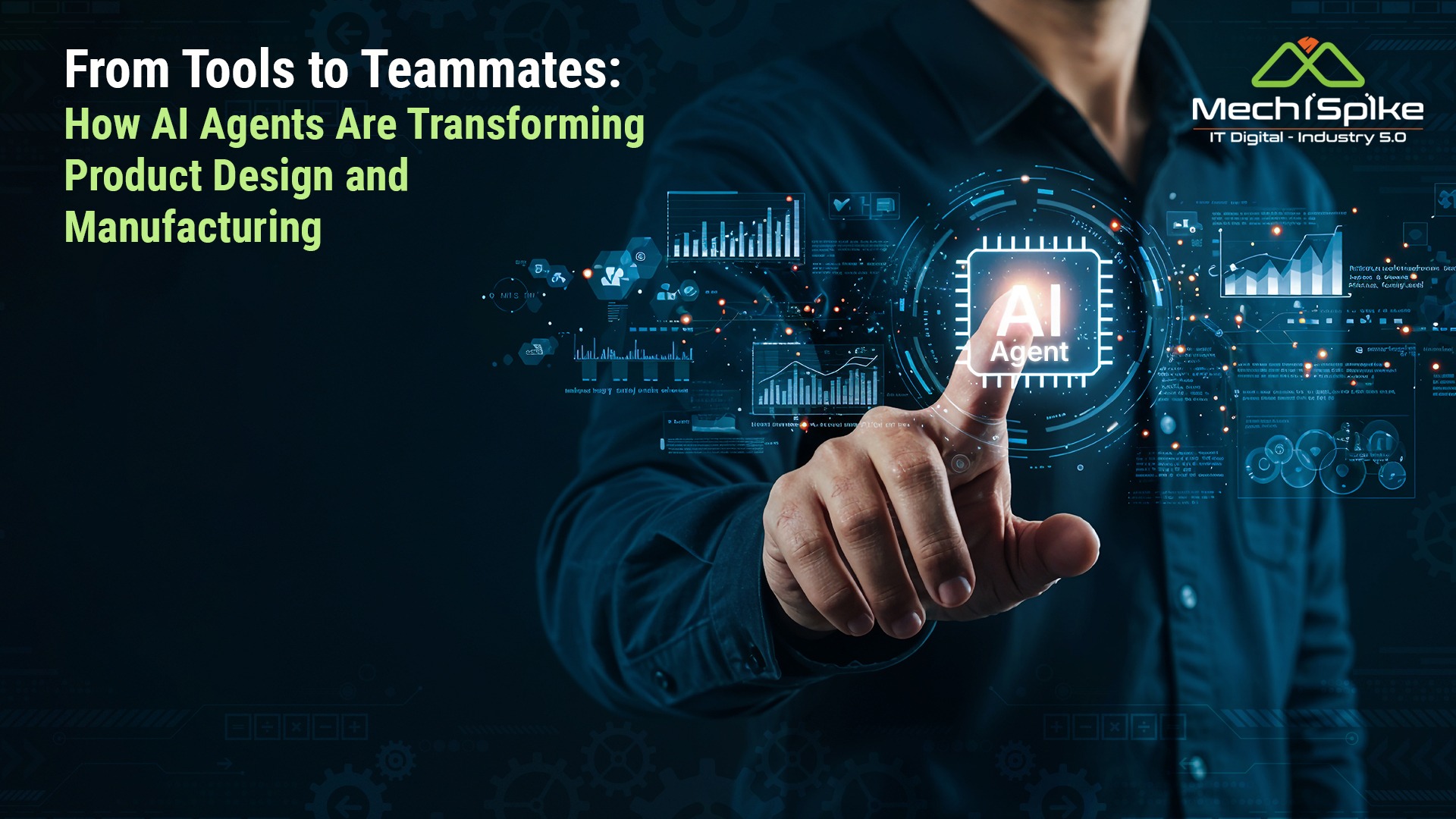
From Tools to Teammates: How AI Agents Are Transforming Product Design and Manufacturing

In this article, let’s look at what AI agents are, how they differ from traditional AI, where they create real value in engineering-driven products, where they are not a good fit and how manufacturers can identify the right areas to pilot them first.
From Tools to Teammates: How AI Agents Are Transforming Product Design and Manufacturing
For years, manufacturing organizations have used software as tools—CAD systems to draw, PLM systems to manage data, ERP systems to plan resources. Even AI, until recently, behaved mostly like a smart calculator: predict, classify, optimize.
That model is now changing.
With the rise of AI Agents, we are moving from tools that assist humans to digital teammates that collaborate with humans.
In product design and manufacturing—especially where engineering complexity is high—AI agents are poised to redefine how work gets done, how decisions are made, and how performance is measured.
This article explains what AI agents are, how they differ from traditional AI, where they create real value in engineering-driven products, where they are not a good fit and a checklist to identify the right areas to pilot them first.
What Are AI Agents (and How Are They Different)?
An AI Agent is an autonomous or semi-autonomous software entity that can:
- Understand goals
- Observe context
- Reason over data
- Take actions across systems
- Learn from outcomes
- Collaborate with humans and other agents
Unlike traditional AI models that respond to a single prompt or prediction request, AI agents:
- Work continuously
- Operate across workflows
- Coordinate multiple steps
- Interact with multiple systems
- Make recommendations or decisions over time
In simple terms:
- AI models answer questions
- AI agents get work done
How AI Agents Help Across Product Design and Manufacturing
1. AI Agents in Concept & Design
AI agents can:
- Monitor evolving requirements
- Generate and compare multiple design alternatives
- Track trade-offs between cost, weight, performance, and sustainability
- Flag conflicts early
Example: When a design engineer changes a material, an AI agent immediately checks:
- Structural impact
- Supplier availability
- Cost delta
- Regulatory compliance
Instead of discovering problems weeks later, issues surface in minutes.
2. AI Agents in Engineering Change Management
Engineering changes are one of the costliest pain points in manufacturing.
AI agents can:
- Track change requests across PLM, CAD, ERP, and MES
- Perform automated impact analysis
- Identify affected parts, suppliers, and processes
- Recommend approval paths
Example: An AI agent detects that a proposed design change will invalidate an existing tooling setup and increase lead time by 3 weeks—before approval.
3. AI Agents in Manufacturing Planning
Manufacturing involves constant trade-offs:
- Capacity vs demand
- Cost vs speed
- Standardization vs customization
AI agents can:
- Continuously monitor schedules
- Simulate alternate production plans
- Adapt to disruptions in near real time
Example: A machine failure occurs. The AI agent:
- Re-routes production
- Suggests alternate tooling
- Updates delivery forecasts
- Notifies planners with recommended actions
4. AI Agents in Quality and Compliance
Quality and compliance rely heavily on documentation, traceability, and vigilance.
AI agents can:
- Monitor process deviations
- Correlate defects with upstream design or process changes
- Maintain audit-ready compliance records
- Proactively flag risks
Example: An AI agent notices a spike in defects correlated with a recent supplier change and alerts both quality and procurement teams.
5. AI Agents in Service Feedback Loops
Service data is often underutilized.
AI agents can:
- Analyze field failures
- Identify recurring patterns
- Feed insights back into design and manufacturing
Example: A service agent identifies that failures occur only in high-temperature regions and suggests a design update for thermal tolerance.
Where AI Agents Are NOT a Good First Fit
AI agents are not ideal initially for:
- Highly creative, ambiguous ideation without constraints
- One-off, non-repeatable tasks
- Poorly digitized environments
- Processes with no clear ownership or data trail
They thrive where rules, data, and workflows already exist—even if imperfect.
Checklist: Where Should Product Manufacturers Pilot AI Agents First?
Use this checklist to identify AI-agent-ready areas.
✔ Process Readiness
- ☐ The process is repeatable
- ☐ Clear inputs and outputs exist
- ☐ Rules or heuristics are already defined
- ☐ Human decisions follow recognizable patterns
✔ Data Readiness
- ☐ Data exists across PLM, ERP, MES, or QMS
- ☐ Data quality is reasonable (not perfect)
- ☐ Relationships between objects are known
- ☐ Historical decisions are available
✔ Business Impact
- ☐ Delays or errors are costly
- ☐ Decisions affect multiple downstream teams
- ☐ Late discovery causes rework or scrap
- ☐ Management visibility is limited today
✔ Human Acceptance
- ☐ Users are overloaded, not resistant
- ☐ Teams already rely on digital systems
- ☐ There is appetite for augmentation, not replacement
- ☐ Clear human-in-the-loop checkpoints can be defined
If you check most boxes, that area is an excellent AI agent pilot candidate.
KPI Changes Required to Support AI Agents
Traditional KPIs assume humans execute and systems support. AI agents invert that relationship.
Old KPIs (No Longer Sufficient)
- Cycle time
- Utilization
- Cost per unit
- Headcount efficiency
New KPI Shifts Required
1. Decision Latency
How fast does the organization move from signal to decision?
2. Rework Avoidance Rate
How many downstream issues were prevented by early AI intervention?
3. Change Impact Accuracy
How accurate are impact assessments before execution?
4. Human–AI Collaboration Index
How effectively humans and AI agents work together?
5. Exception Resolution Speed
How quickly are AI-flagged anomalies resolved?
6. First-Time-Right with AI Support
Percentage of tasks completed correctly with agent assistance.
These KPIs reward intelligence and foresight, not just activity.
Organizational and Cultural Implications
Introducing AI agents is not just a technology decision—it’s an operating model shift.
Organizations must accept that:
- Not all decisions start with humans
- Humans increasingly supervise instead of execute
- Trust is built through transparency, not blind automation
Conclusion: AI Agents as Force Multipliers for Engineering Organizations
AI agents are not magic. They are force multipliers.
In product design and manufacturing—where complexity, cost, and coordination define success—AI agents help organizations:
- Decide faster
- Detect risks earlier
- Reduce rework
- Improve quality
- Scale expertise
The companies that win will not deploy AI agents everywhere at once. They will pilot them thoughtfully, align KPIs with intelligence, and train people to collaborate—not compete—with machines.
In the next decade, the most effective engineering organizations won’t be those with the most automation—but those with the best human–AI teamwork.
That future starts with AI agents, deployed where they matter most.
MechiSpike can be of great help here to take your organization to the future of Product Design as well as Manufacturing with our focus on Industry 5.0 using our prowess in PLM, Engineering and IT Digital.
Click here to know more about us.
For Corporates :
MechiSpike can be of great help to your organization to help you improve your PLM ROI and 30% Savings, be it the hiring cost in staffing or setting up an ODC.
We do this with efficient planning, organizing and controlling Product Master data with seamless data exchange among Engineering, Manufacturing and Enterprise systems.
With our well established niche expertise in PLM, we are now serving more than 15 Global Clients. They are now looking at us as a ‘Go To’ partner for Engineering, IT and PLM. With this confidence, we are expanding our scope of services beyond PLM to Industry 5.0 Digital Transformation i.e. PLM, ERP, CAD, Cloud, AI and DevOps.
Why MechiSpike :

RightSourcing is ‘Better Outsourcing’, given to ‘NICHE EXPERTS’.

For PLM Careers :
Learn More | Earn More | Grow More
Interactive UI : Every Application will get a response with a recruiter contact details and the applicant will get a notification at each phase until the applicant is positioned well with our 15+ global clients in India, USA & Germany.
Candidate Referral Program : Refer a candidate and earn INR 25,000.
Mechispike Solutions Pvt Ltd is a PLM focused company, having all kinds of PLM projects to enable employee career growth and add value to clients. We can position you better with our 15+ global clients in India, USA & Germany.
We believe in “Grow Together” and “Employee First” culture.
Dream more than a Job. Grow your PLM Career to the Fullest with MechiSpike
Click Here to explore our Job Openings.
Subscribe Now :
Our mission : To equip you with the knowledge and tools you need to drive value, streamline operations, and maximize return on investment from your PLM initiatives.
PLM ROI Newsletter will guide you through a comprehensive roadmap to help you unlock the full potential of your PLM investment.
We are committed to be your trusted source of knowledge and support throughout your PLM journey. Our team of experts and thought leaders will bring you actionable insights, best practices, case studies, and the latest trends in PLM.
Subscribe Now to get this weekly series delivered into your Inbox directly, as and when we publish it.
To your PLM success!
Warm regards,
Visit Us: www.mechispike.com
If you want to Grow your PLM Career to the Fullest, Click Here to explore our Job Openings.
For PLM Services : Click Here to Schedule a Call with us.