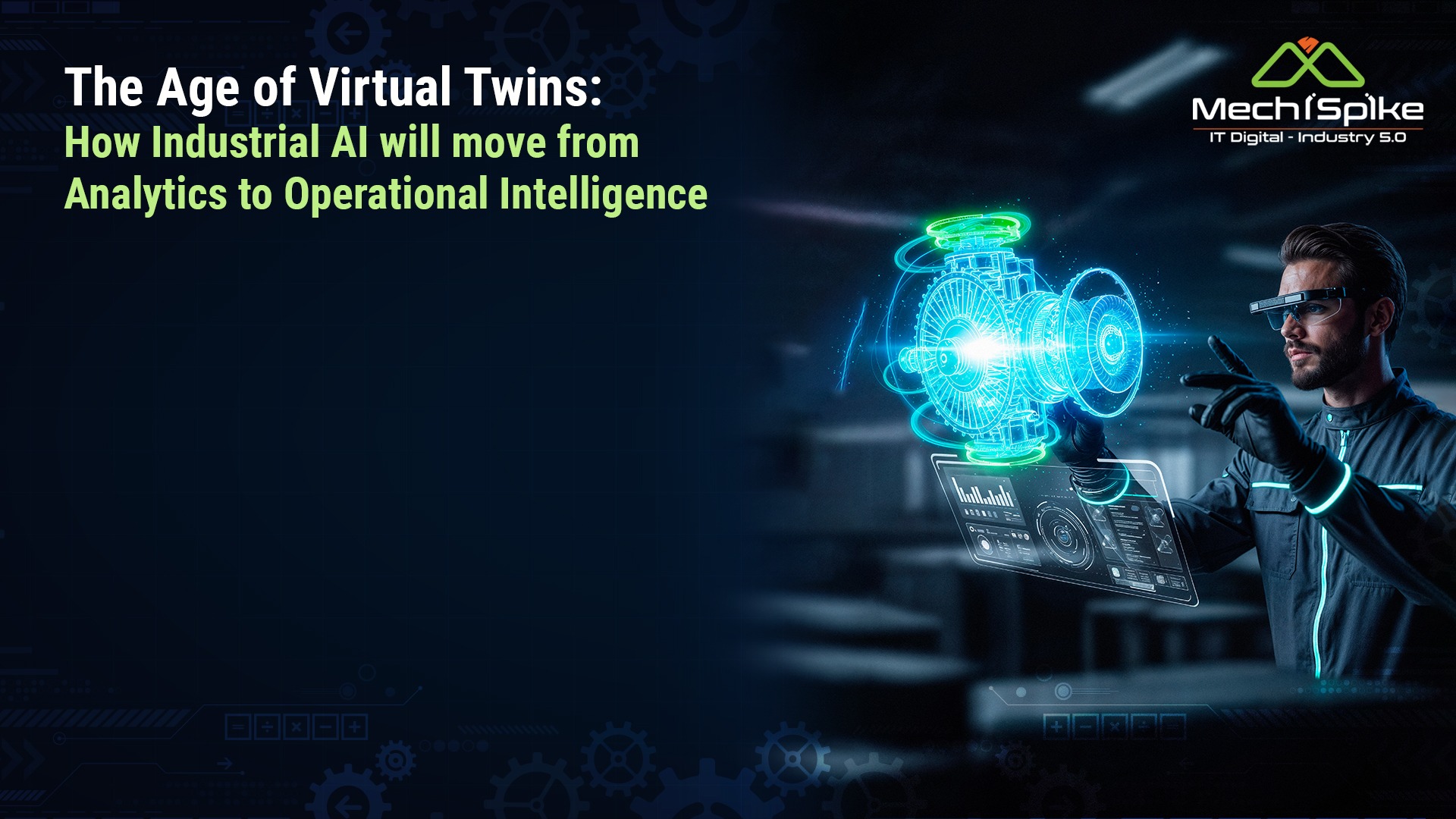
The Age of Virtual Twins: How Industrial AI will move from Analytics to Operational Intelligence

In this article, let’s deep dive into Virtual Twins & look at the future of Industrial AI through the lens of AI-powered Virtual Twins.
The Age of Virtual Twins: How Industrial AI will move from Analytics to Operational Intelligence
Industrial AI is entering a decisive new phase. What began as isolated applications—predictive maintenance models, quality analytics, or scheduling optimizers—is evolving into something far more transformative: Virtual Twins powered by AI.
These are not just digital models or simulations, but living, learning representations of products, factories, and systems, continuously synchronized with the real world and capable of reasoning, predicting, and guiding decisions.
The future of industries—especially those driven by complex engineering products—will not be designed, tested, or manufactured primarily in the physical world. Instead, they will be conceived, validated, optimized, and evolved in virtual spaces first, with AI acting as the intelligence layer that makes these virtual environments actionable.
This article explores the future of Industrial AI through the lens of AI-powered Virtual Twins, explains their impact on product design and manufacturing, outlines the KPI shifts required, and provides a practical checklist for manufacturers to prepare for this transformation.
From Digital Models to AI-Powered Virtual Twins
Traditional digital models are static. They represent a snapshot in time—CAD geometry, process simulations, or production layouts. Virtual Twins represent a fundamental leap forward.
A Virtual Twin is:
- A multi-physics, multi-domain digital representation of a product or system
- Continuously updated with real-world data (IoT, sensors, operations)
- Connected across the entire lifecycle—from concept to end-of-life
- Powered by AI that can reason, predict, and recommend actions
In essence, a Virtual Twin becomes a decision environment, not just a visualization.
When AI is layered on top, the twin is no longer passive. It can:
- Simulate future scenarios
- Detect emerging risks
- Suggest design or process changes
- Learn from outcomes and improve over time
This is where Industrial AI moves from analytics to operational intelligence.
Why the Future of Industry Is Virtual-First
Engineering-driven industries—automotive, aerospace, industrial equipment, energy, medical devices—face growing pressure:
- Products are more complex and software-defined
- Regulatory and sustainability constraints are tighter
- Supply chains are volatile
- Time-to-market expectations are shrinking
Physical experimentation alone is too slow, too costly, and too risky.
Virtual Twins change the paradigm: Instead of testing reality and learning from failures, industries will test virtual reality and deploy only what is already validated.
This shift is similar to how software development moved from direct production changes to staging, testing, and simulation environments—but applied to physical products and factories.
How Virtual Twins Powered by AI Transform Product Design
1. Concept Exploration at Scale
AI-driven Virtual Twins allow engineers to explore thousands of design alternatives virtually, balancing performance, cost, manufacturability, and sustainability.
Example: A mechanical system can be tested under extreme thermal, vibration, and load conditions in a virtual environment long before a physical prototype exists.
This dramatically expands the design space while reducing prototyping costs.
2. Design Decisions Become Predictive
Instead of relying solely on experience and past data, AI-powered twins predict how a design will behave across its entire lifecycle.
- How will it perform after five years of use?
- What failure modes are likely in specific environments?
- How sensitive is performance to supplier variability?
Design becomes forward-looking, not reactive.
3. Continuous Design Validation
As field and manufacturing data flows back into the Virtual Twin, AI updates models continuously.
Design does not “freeze” at release—it evolves intelligently.
How Virtual Twins Transform Manufacturing and Production
1. Virtual Factories Before Physical Ones
Manufacturing lines, layouts, and logistics flows can be designed and optimized entirely in virtual space.
Example: A factory layout is simulated with AI agents testing throughput, bottlenecks, energy consumption, and worker ergonomics before any equipment is installed.
2. AI-Driven Operational Optimization
Virtual Twins mirror real production systems in near real time.
AI can:
- Predict equipment failures
- Optimize schedules dynamically
- Balance quality, cost, and delivery trade-offs
- Adapt production to demand or supply disruptions
The factory becomes self-aware and adaptive, not just automated.
3. Human-Machine Collaboration in Virtual Space
Operators, engineers, and managers interact with Virtual Twins using immersive and conversational interfaces.
- Humans bring judgment and context
- AI brings memory, prediction, and optimization
This aligns perfectly with Industry 5.0’s human-centric vision.
Why Engineering-Driven Products Benefit the Most
Engineering products are ideal candidates for Virtual Twins because they:
- Have long lifecycles
- Require high reliability
- Involve strict compliance
- Are costly to redesign after release
AI-powered Virtual Twins reduce late-stage surprises, rework, and recalls—while increasing innovation confidence.
KPI Shifts Required in the Virtual Twin Era
Traditional KPIs focus on execution efficiency. Virtual-first industries require intelligence-driven KPIs.
Old KPIs (Insufficient Alone)
- Cycle time
- Utilization
- Cost per unit
- Downtime
New KPI Categories
1. Predictive Design KPIs
- Design Space Coverage – how many viable options were evaluated
- Design Confidence Index – predicted vs actual performance alignment
2. Manufacturing Intelligence KPIs
- First-Time-Right via Virtual Validation
- Mean Time to Adapt (MTTA) to disruptions
- Virtual vs Physical Iteration Ratio
3. Lifecycle KPIs
- Lifecycle Carbon per Product
- Failure Prediction Accuracy
- Closed-Loop Learning Rate (how fast field data improves design)
4. Human-AI Collaboration KPIs
- Decision Latency Reduction
- Human-AI Productivity Index
- Exception Handling Effectiveness
These KPIs reward foresight, learning, and resilience, not just output.
Checklist: How Product Manufacturers Can Prepare
Strategy & Vision
- ☐ Shift mindset from physical-first to virtual-first
- ☐ Treat Virtual Twins as strategic assets, not tools
Data & Architecture
- ☐ Build a unified digital thread across lifecycle stages
- ☐ Ensure high-quality engineering, manufacturing, and field data
- ☐ Enable AI access to contextual, cross-domain data
Technology
- ☐ Adopt multi-physics simulation and system modeling
- ☐ Layer AI for prediction, reasoning, and orchestration
- ☐ Integrate IoT and operational feedback loops
Organization & Process
- ☐ Redesign decision workflows around virtual validation
- ☐ Pilot Virtual Twins in high-impact areas first
- ☐ Establish human-in-the-loop governance
People & Skills
- ☐ Develop AI literacy among engineers and managers
- ☐ Strengthen systems thinking capabilities
- ☐ Encourage collaboration between domain experts and data specialists
Examples of Early Adoption Scenarios
- Virtual validation of new product variants before market launch
- AI-driven factory twins for energy optimization
- Service feedback loops that update design twins automatically
- Scenario testing for geopolitical or supply disruptions
Conclusion: Industrial AI’s Future Is Virtual, Intelligent, and Human-Centric
The future of Industrial AI is not about replacing humans or automating everything. It is about moving intelligence upstream, where decisions are cheaper, faster, and safer to make.
AI-powered Virtual Twins will become the primary environment where products and factories are designed, tested, and optimized, long before reality is touched.
Physical execution will increasingly be the final step—not the learning phase.
For engineering-driven industries, this represents a once-in-a-generation shift:
- From reactive to predictive
- From trial-and-error to virtual certainty
- From automation to human-AI collaboration
The manufacturers who prepare today—by rethinking KPIs, investing in Virtual Twins, and upskilling people—will define the industrial leaders of tomorrow.
The future of industry will not just be digital. It will be virtual, intelligent, and profoundly human-centric.
MechiSpike can be of great help here to take your organization to the future of Product Design as well as Manufacturing with our focus on Industry 5.0 using our prowess in PLM, Engineering and IT Digital.
Click here to know more about us.
For Corporates :
MechiSpike can be of great help to your organization to help you improve your PLM ROI and 30% Savings, be it the hiring cost in staffing or setting up an ODC.
We do this with efficient planning, organizing and controlling Product Master data with seamless data exchange among Engineering, Manufacturing and Enterprise systems.
With our well established niche expertise in PLM, we are now serving more than 15 Global Clients. They are now looking at us as a ‘Go To’ partner for Engineering, IT and PLM. With this confidence, we are expanding our scope of services beyond PLM to Industry 5.0 Digital Transformation i.e. PLM, ERP, CAD, Cloud, AI and DevOps.
Why MechiSpike :

RightSourcing is ‘Better Outsourcing’, given to ‘NICHE EXPERTS’.

Click here to know how we can actually help you with our Proven Methodologies.
For PLM Careers :
Learn More | Earn More | Grow More
Interactive UI : Every Application will get a response with a recruiter contact details and the applicant will get a notification at each phase until the applicant is positioned well with our 15+ global clients in India, USA & Germany.
Candidate Referral Program : Refer a candidate and earn INR 25,000.
Mechispike Solutions Pvt Ltd is a PLM focused company, having all kinds of PLM projects to enable employee career growth and add value to clients. We can position you better with our 15+ global clients in India, USA & Germany.
We believe in “Grow Together” and “Employee First” culture.
Dream more than a Job. Grow your PLM Career to the Fullest with MechiSpike
Click Here to explore our Job Openings.
Subscribe Now :
Our mission : To equip you with the knowledge and tools you need to drive value, streamline operations, and maximize return on investment from your PLM initiatives.
PLM ROI Newsletter will guide you through a comprehensive roadmap to help you unlock the full potential of your PLM investment.
We are committed to be your trusted source of knowledge and support throughout your PLM journey. Our team of experts and thought leaders will bring you actionable insights, best practices, case studies, and the latest trends in PLM.
Subscribe Now to get this weekly series delivered into your Inbox directly, as and when we publish it.
To your PLM success!
Warm regards,
Visit Us: www.mechispike.com
For PLM Services : Click Here to Schedule a Call with us.