New KPIs for Product Design and Manufacturing in AI Era after 2026

The Rise of Build-Operate-Transfer (BOT) Model in Engineering & PLM
Building Scalable Capabilities Without the Hiring Burden
Product manufacturers across the world are under pressure from multiple directions at once. Engineering complexity is increasing, PLM landscapes are expanding and AI is reshaping how work gets done. At the same time, engineering and PLM talent is becoming scarce, expensive, and difficult to retain.
In this environment, many organizations are rethinking a fundamental question:
How do we build deep, long-term engineering and PLM capabilities without permanently expanding our payroll or taking excessive execution risk?
One model that is seeing a strong resurgence—this time with a modern twist—is the Build–Operate–Transfer (BOT) model.
Why BOT Is Gaining Momentum in Engineering & PLM
Traditionally, BOT was associated with infrastructure projects or captive offshore centers. Today, the model has evolved and is increasingly used to accelerate engineering and PLM transformations, including:
- PLM platform implementations and upgrades
- Digital thread and digital twin initiatives
- CAD/CAE automation and customization
- Data migration, BOM harmonization, and process standardization
- AI-enabled engineering workflows
The modern BOT model is no longer just about “offshoring.” It is about capability creation—with a clear path from external dependency to internal ownership.
What Does BOT Mean in the Engineering & PLM Context?
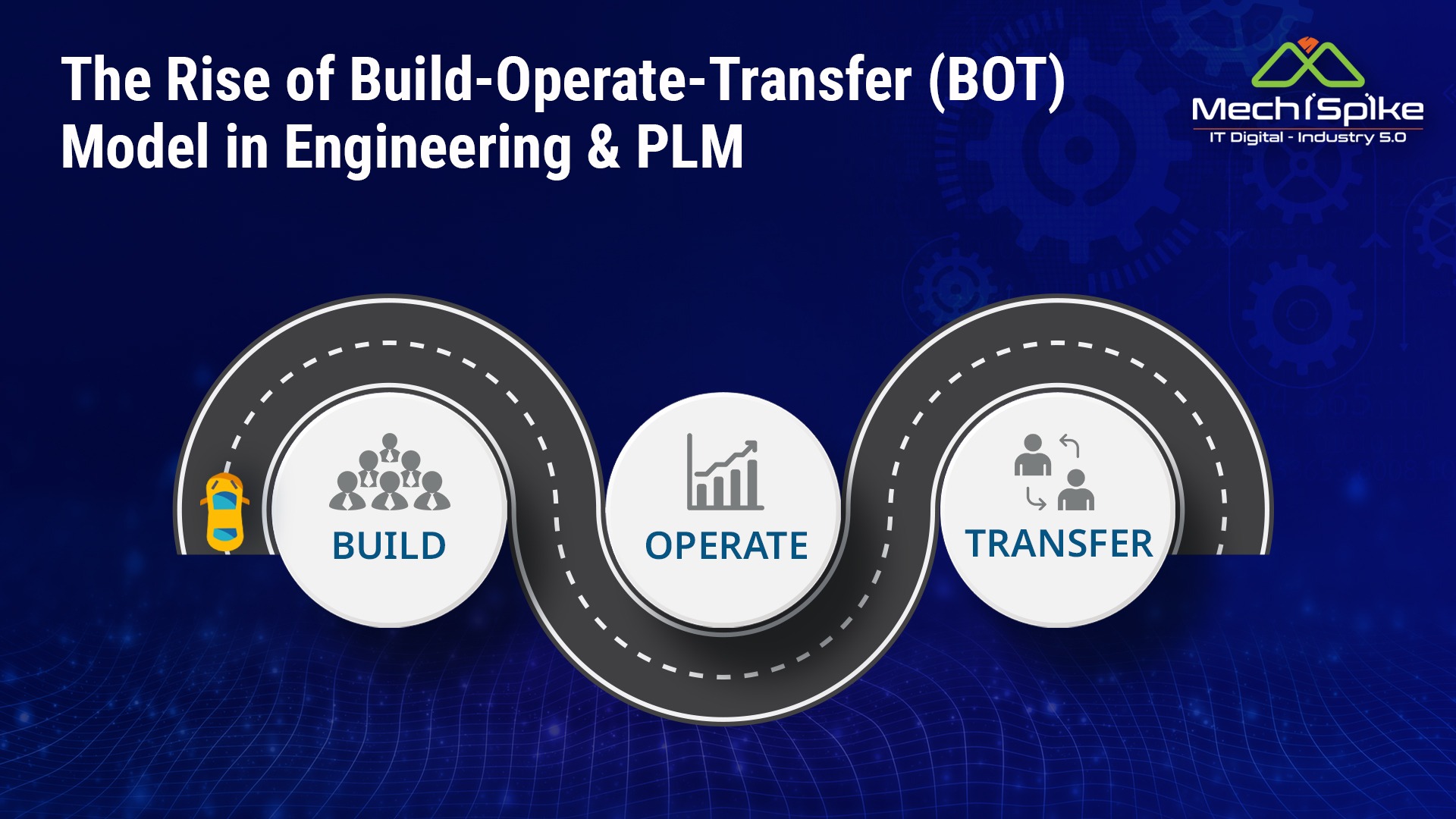
In simple terms, the BOT model works in three structured phases:
1. Build
A service provider builds a dedicated engineering or PLM capability for the client:
- Hiring engineers with specific PLM, CAD, CAE, or domain skills
- Setting up processes, tools, governance, and delivery models
- Creating domain-specific knowledge bases and documentation
The key difference from staff augmentation is intent. This team is not random capacity; it is built with long-term ownership in mind.
2. Operate
Once the team is established, the provider operates it for a defined period:
- The team works exclusively (or near-exclusively) for the client
- Delivery is aligned to the client’s engineering roadmap
- KPIs, productivity metrics, and quality benchmarks are tracked
- Knowledge transfer and capability maturity steadily increase
During this phase, the team remains on the supplier’s payroll, significantly reducing the client’s hiring, compliance, and attrition risks.
3. Transfer
After stabilization and maturity:
- The team, processes, IP, and sometimes infrastructure are transferred
- Engineers move to the client’s payroll (fully or partially)
- The client gains a ready-made, battle-tested capability
In some cases, companies choose to extend the Operate phase or do a phased transfer. The model is flexible by design.
Why BOT Works When Engineering Talent Is Scarce
1. It Bypasses the Hiring Bottleneck
Hiring experienced PLM architects, CAD automation specialists, or domain engineers can take months. BOT allows companies to parallelize hiring and delivery through a specialized partner.
2. It Reduces Long-Term Risk
Instead of committing to permanent headcount upfront, companies:
- Test the capability in real projects
- Validate team performance and cultural fit
- Decide on transfer timing based on business conditions
3. It Accelerates Transformation Programs
PLM transformations fail more often due to execution gaps than strategy flaws. BOT ensures continuity of skills across multi-year programs.
Key KPIs to Track in a BOT Model
BOT success depends on measuring the right outcomes—not just effort.
Capability & Talent KPIs
- Time-to-build the team
- Skill coverage vs required skill matrix
- Attrition rate during Operate phase
- Certification and upskilling progress
Delivery & Quality KPIs
- Engineering throughput (features, changes, releases)
- First-time-right design ratio
- Rework and defect leakage
- Change request turnaround time
PLM-Specific KPIs
- BOM accuracy and consistency
- Data migration completeness
- Process adoption rate across functions
- System performance and user satisfaction
Knowledge Transfer KPIs
- Documentation completeness
- Shadow-to-own ratio (how many tasks fully owned by team)
- Dependency reduction over time
Financial & ROI KPIs
- Productivity improvement vs baseline
- Avoided hiring and attrition costs
Tracking these KPIs ensures BOT remains a capability-building model, not disguised staff augmentation.
Benefits of BOT for Product Manufacturers
1. Faster Time to Capability
Manufacturers can stand up PLM or engineering centers in months instead of years.
2. Reduced Organizational Disruption
HR, payroll, compliance, and local employment risks stay with the provider during the most volatile phase.
3. Better Knowledge Retention
Unlike short-term vendors, BOT teams are incentivized to document, standardize, and institutionalize knowledge.
4. Strategic Control Without Early Commitment
Manufacturers retain architectural and roadmap control without being forced into premature internal hiring.
5. AI-Ready Engineering Teams
Modern BOT teams increasingly include:
- AI-assisted design workflows
- Automation scripts and copilots
- Data readiness for AI-driven PLM use cases
This prepares manufacturers for Industry 5.0 realities.
Steps Product Manufacturers Should Follow to Adopt the BOT Model
1. Define the Capability, Not Just the Headcount
Be explicit about:
- Skills
- Domain depth
- Tools
- Expected maturity after transfer
2. Choose the Right BOT Partner
Look beyond cost. Evaluate:
- PLM and engineering depth
- Knowledge transfer approach
- Attrition management capability
- Cultural compatibility
3. Establish Clear Governance Early
Define:
- Decision rights
- Escalation paths
- KPI ownership
- Communication cadence
4. Plan the Transfer from Day One
Ironically, BOT works best when the exit strategy is defined upfront. This avoids unhealthy long-term dependencies.
5. Invest in Knowledge Management
Treat documentation, training, and process capture as first-class deliverables—not afterthoughts.
The People Skills That Make or Break BOT
Technology alone does not make BOT successful. People skills are critical.
For Leadership
- Systems thinking: Seeing BOT as capability evolution, not outsourcing
- Change leadership: Helping internal teams accept external-built capabilities
For Managers
- Vendor collaboration skills
- Remote and hybrid team leadership
- Outcome-based performance management
For Teams
- Knowledge-sharing mindset
- Cross-cultural communication
- Learning agility in AI-assisted environments
Organizations that fail at BOT often fail not on contracts—but on human collaboration and trust.
Conclusion: BOT as a Strategic Lever, Not a Tactical Shortcut
The rise of the BOT model in Engineering & PLM is not accidental. It is a direct response to talent scarcity, accelerating digital complexity, and the need for faster transformation with lower risk.
When executed well, BOT enables product manufacturers to build future-ready engineering and PLM capabilities without the traditional hiring burden.
It creates a bridge between external expertise and internal ownership—allowing organizations to scale intelligently in an Industry 5.0 world shaped by AI, uncertainty, and constant change.
In short, BOT is no longer just a delivery model. It is becoming a strategic capability-building instrument for modern product manufacturers.
MechiSpike can be of great help here to take your organization to the future of Product Design as well as Manufacturing with our focus on Industry 5.0 using our prowess in PLM, Engineering and IT Digital.
Click here to know more about us.
For Corporates :
MechiSpike can be of great help to your organization to help you improve your PLM ROI and 30% Savings, be it the hiring cost in staffing or setting up an ODC.
We do this with efficient planning, organizing and controlling Product Master data with seamless data exchange among Engineering, Manufacturing and Enterprise systems.
With our well established niche expertise in PLM, we are now serving more than 15 Global Clients. They are now looking at us as a ‘Go To’ partner for Engineering, IT and PLM. With this confidence, we are expanding our scope of services beyond PLM to Industry 5.0 Digital Transformation i.e. PLM, ERP, CAD, Cloud, AI and DevOps.
Why MechiSpike :

RightSourcing is ‘Better Outsourcing’, given to ‘NICHE EXPERTS’.

For PLM Careers :
Learn More | Earn More | Grow More
Interactive UI : Every Application will get a response with a recruiter contact details and the applicant will get a notification at each phase until the applicant is positioned well with our 15+ global clients in India, USA & Germany.
Candidate Referral Program : Refer a candidate and earn INR 25,000.
Mechispike Solutions Pvt Ltd is a PLM focused company, having all kinds of PLM projects to enable employee career growth and add value to clients. We can position you better with our 15+ global clients in India, USA & Germany.
We believe in “Grow Together” and “Employee First” culture.
Dream more than a Job. Grow your PLM Career to the Fullest with MechiSpike
Click Here to explore our Job Openings.
Subscribe Now :
Our mission : To equip you with the knowledge and tools you need to drive value, streamline operations, and maximize return on investment from your PLM initiatives.
PLM ROI Newsletter will guide you through a comprehensive roadmap to help you unlock the full potential of your PLM investment.
We are committed to be your trusted source of knowledge and support throughout your PLM journey. Our team of experts and thought leaders will bring you actionable insights, best practices, case studies, and the latest trends in PLM.
Subscribe Now to get this weekly series delivered into your Inbox directly, as and when we publish it.
To your PLM success!
Warm regards,
Visit Us: www.mechispike.com
For PLM Services : Click Here to Schedule a Call with us.