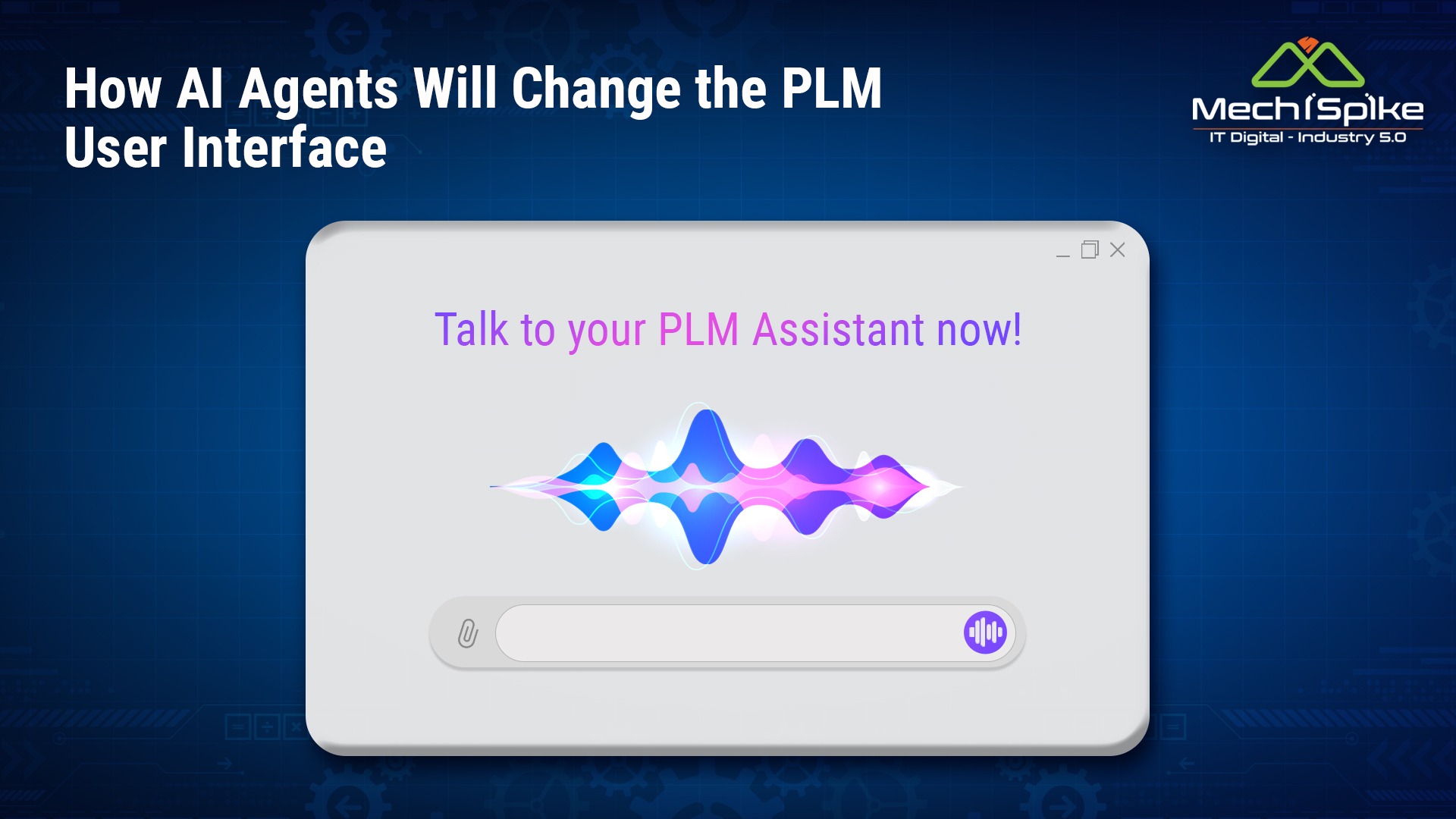
How AI Agents Will Change the PLM User Interface

In this article, let’s deep dive into how AI Agents will change the PLM User Interface/User Experience (UI/UX)
From Screens to Systems: How AI Agents Will Change the PLM User Interface (UI)
For decades, Product Lifecycle Management (PLM) systems have been designed around a simple assumption: humans are the primary operators of the system. Every feature, workflow, and customization effort has centered on helping people navigate complexity through structured user interfaces.
But that assumption is about to change.
To understand why, we must first recognize a fundamental truth:
PLM Software Has Two Core Parts
Every PLM system consists of two distinct layers:
1. The Core Product Data (Product Memory)
This is the structured representation of:
- Parts
- BOMs
- Revisions
- Configurations
- Requirements
- Documents
- Compliance records
- Relationships across the lifecycle
This is the true asset of PLM — the digital memory of the product.
2. The User Interface / User Experience (UI/UX)
This is the layer where:
- Humans log in
- Screens organize information
- Forms capture inputs
- Workflows route tasks between people
- Navigation structures guide actions
In traditional PLM, the UI exists to manage human interaction with product memory. Workflows represent the movement of tasks between individuals. The system organizes collaboration through predefined screens and approval chains.
Product memory stores truth. UI/UX organizes how humans interact with that truth. But what happens when humans are no longer the primary executors?
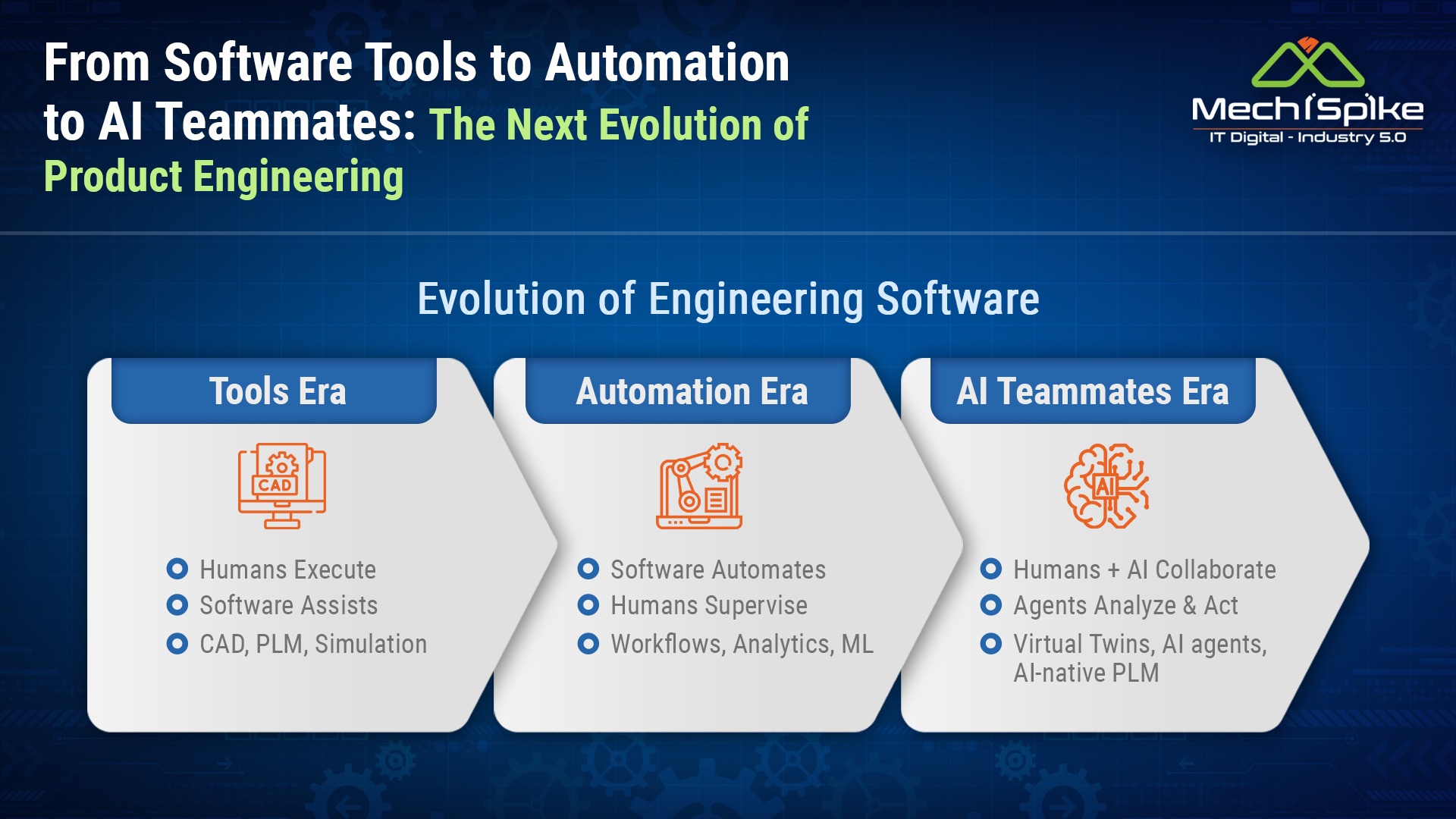
The AI Agent Shift: From UI-Centric to Data-Centric PLM
In the emerging AI-native model, AI agents directly access product memory under defined policies and constraints.
Instead of a human:
- Opening a screen
- Searching for a part
- Checking dependencies
- Running impact analysis
- Updating related objects
- Routing approvals
An AI agent can:
- Query product memory
- Analyze relationships
- Simulate impact
- Apply updates within defined rules
- Notify humans only when supervision is required
Humans move from executors to supervisors. This is a structural shift.
Why Adding AI to Existing UI Is Not Enough
Its but natural for ISVs to embed AI features inside existing PLM screens:
- AI search
- AI copilots
- AI suggestions in forms
These improvements help usability. But they do not change the fundamental architecture.
If humans still:
- Navigate screens
- Trigger workflows
- Move tasks manually
- Align actions to UI structure
Then the system is still UI-centric.
True transformation requires a shift from: “How should users navigate the system?” To “How should agents operate on product memory?”
That is a radically different design philosophy.
The Emergence of the AI-Native Product Workspace
In the AI-native model, the system reorganizes around product memory as the center.
Instead of screens being the primary interface, the architecture evolves into three layers:
1. Product Memory (Core Data Layer)
This remains the foundation:
- Structured product definitions
- Configuration logic
- Traceability
- Compliance relationships
- Engineering history
But it must now be:
- Machine-accessible
- Policy-governed
- Context-rich
- API-first
2. Collaborative Workspace Layer
This is where:
- Context is captured
- Discussions are recorded
- Decisions are documented
- Exceptions are reviewed
Instead of navigating menus, humans interact through:
- Contextual conversations
- Decision summaries
- AI-generated analysis
- Real-time alerts
3. AI Agent Execution Layer
AI agents:
- Prepare data
- Run simulations
- Perform impact analysis
- Apply changes within constraints
- Trigger policy-based approvals
- Coordinate across systems
Humans intervene where:
- Ethical judgment is required
- Exceptions arise
- Trade-offs require accountability
This will be the beginning of the future : AI-native PLM.
Data Becomes the Interface
In this new model: Data becomes the primary interface. Interaction emerges from context rather than predefined screens.
Instead of:
- “Go to Change Management → Open Form → Fill Fields → Route Workflow”
The system becomes:
- “A material change impacts 17 downstream assemblies. Here is the risk summary. Approve, modify, or reject.”
The navigation tree disappears. The context surfaces automatically.
What Happens to UI Customization and Workflow Engineering?
This shift has profound implications.
Today, a large portion of PLM implementation effort goes into:
- Custom screen design
- Workflow routing
- User training on navigation
- Role-based UI personalization
- Aligning business processes to system structure
In an AI-native system:
- Agents handle routing automatically.
- Context determines task visibility.
- Policies govern actions instead of manual workflow steps.
- UI complexity becomes less economically justified.
As AI workflow automation engineering improves, many UI-driven customization projects will shrink in importance.
Implementation moves from: “Align people to software structure” to “Align policies and constraints to autonomous agents”
This changes the economics of PLM consulting and implementation entirely.
Organizational Changes Required
Companies must prepare for structural transformation.
1. Strengthen Product Data Governance
AI agents depend on clean, structured, trusted data. Data integrity becomes more important than UI design.
2. Redesign Approval Models
Shift from sequential workflow approvals to policy-based governance frameworks.
3. Develop AI Supervision Competency
Engineers must learn:
- How to validate AI outputs
- How to define constraints
- How to intervene effectively
4. Reduce UI-Centric Thinking
Organizations must stop optimizing for navigation efficiency and start optimizing for decision intelligence.
5. Invest in API-First Architectures
PLM systems must expose structured, machine-readable product memory.
6. Redefine Implementation KPIs
Success metrics must shift from:
- User adoption rates
- Screen performance
- Workflow compliance
to:
- Decision latency reduction
- Rework avoidance
- AI intervention effectiveness
- Human-AI collaboration efficiency
The Future: PLM Without Navigation
We are moving toward a world where:
- Engineers do not “use” PLM.
- AI agents operate continuously on product memory.
- Humans supervise intelligent workflows.
- Interaction is conversational and contextual.
- The system organizes around decisions, not screens.
PLM becomes less of an application and more of an intelligent product operating system.
Conclusion: The End of UI-Centric PLM
PLM began as a human-driven system where UI/UX defined productivity. But as AI agents gain the ability to access product memory directly under defined constraints, the center of gravity shifts from navigation to intelligence.
Adding AI features to old screens does not create transformation. Reorganizing around product memory, collaborative context, and agent-driven execution does.
In the coming decades, the most advanced organizations will operate AI-native product workspaces where:
- Data is the interface
- Agents perform execution
- Humans provide judgment
The future of PLM is not about better screens. It is about better decisions made in partnership with intelligent systems.
Of course, there is a long way to go. Even though AI is here, Adopting AI in Mission Critical Projects will take time. But there is always a CHANGE in the offing and this time that CHANGE is really BIG.
MechiSpike can be of great help here to take your organization to the future of Product Design as well as Manufacturing with our focus on AI & Industry 5.0 using our prowess in PLM, Engineering and IT Digital.
Click here to know more about us.
For Corporates :
MechiSpike can be of great help to your organization to help you improve your PLM ROI and 30% Savings, be it the hiring cost in staffing or setting up an ODC.
We do this with efficient planning, organizing and controlling Product Master data with seamless data exchange among Engineering, Manufacturing and Enterprise systems.
With our well established niche expertise in PLM, we are now serving more than 15 Global Clients. They are now looking at us as a ‘Go To’ partner for Engineering, IT and PLM. With this confidence, we are expanding our scope of services beyond PLM to Industry 5.0 Digital Transformation i.e. PLM, ERP, CAD, Cloud, AI and DevOps.
Why MechiSpike :

RightSourcing is ‘Better Outsourcing’, given to ‘NICHE EXPERTS’.

Click here to know how we can actually help you with our Proven Methodologies.
For PLM Careers :
Learn More | Earn More | Grow More
Interactive UI : Every Application will get a response with a recruiter contact details and the applicant will get a notification at each phase until the applicant is positioned well with our 15+ global clients in India, USA & Germany.
Candidate Referral Program : Refer a candidate and earn INR 25,000.
Mechispike Solutions Pvt Ltd is a PLM focused company, having all kinds of PLM projects to enable employee career growth and add value to clients. We can position you better with our 15+ global clients in India, USA & Germany.
We believe in “Grow Together” and “Employee First” culture.
Dream more than a Job. Grow your PLM Career to the Fullest with MechiSpike
Click Here to explore our Job Openings.
Subscribe Now :
Our mission : To equip you with the knowledge and tools you need to drive value, streamline operations, and maximize return on investment from your PLM initiatives.
PLM ROI Newsletter will guide you through a comprehensive roadmap to help you unlock the full potential of your PLM investment.
We are committed to be your trusted source of knowledge and support throughout your PLM journey. Our team of experts and thought leaders will bring you actionable insights, best practices, case studies, and the latest trends in PLM.
Subscribe Now to get this weekly series delivered into your Inbox directly, as and when we publish it.
To your PLM success!
Warm regards,
Visit Us: www.mechispike.com
For PLM Services : Click Here to Schedule a Call with us.