From Software Tools to Automation to AI Teammates: The Next Evolution of Product Engineering

In this article, let’s deep dive into how the life of product engineers has been changed from Tools to Automation to AI Teammates.
From Software Tools to Automation to AI Teammates: The Next Evolution of Product Engineering
For the past three decades, engineering and manufacturing organizations have relied heavily on software tools to design products, manage data, and run factories. Computer-aided design (CAD), Product Lifecycle Management (PLM), simulation platforms, and enterprise systems have dramatically improved productivity.
But despite all these advances, the basic operating model remained unchanged:
Humans used software tools to execute tasks.
Engineers navigated complex interfaces, ran simulations, reviewed documents, routed workflows, and made decisions. Software accelerated the work, but humans still performed every step.
Today, that model is beginning to change.
With the rapid emergence of Large Language Models (LLMs), AI agents, and virtual twins, engineering organizations are moving toward a fundamentally different paradigm:
Software is no longer just a tool—it is becoming a teammate.
This shift will transform how products are designed, how manufacturing systems operate, and how organizations measure performance.
The Three Eras of Engineering Software
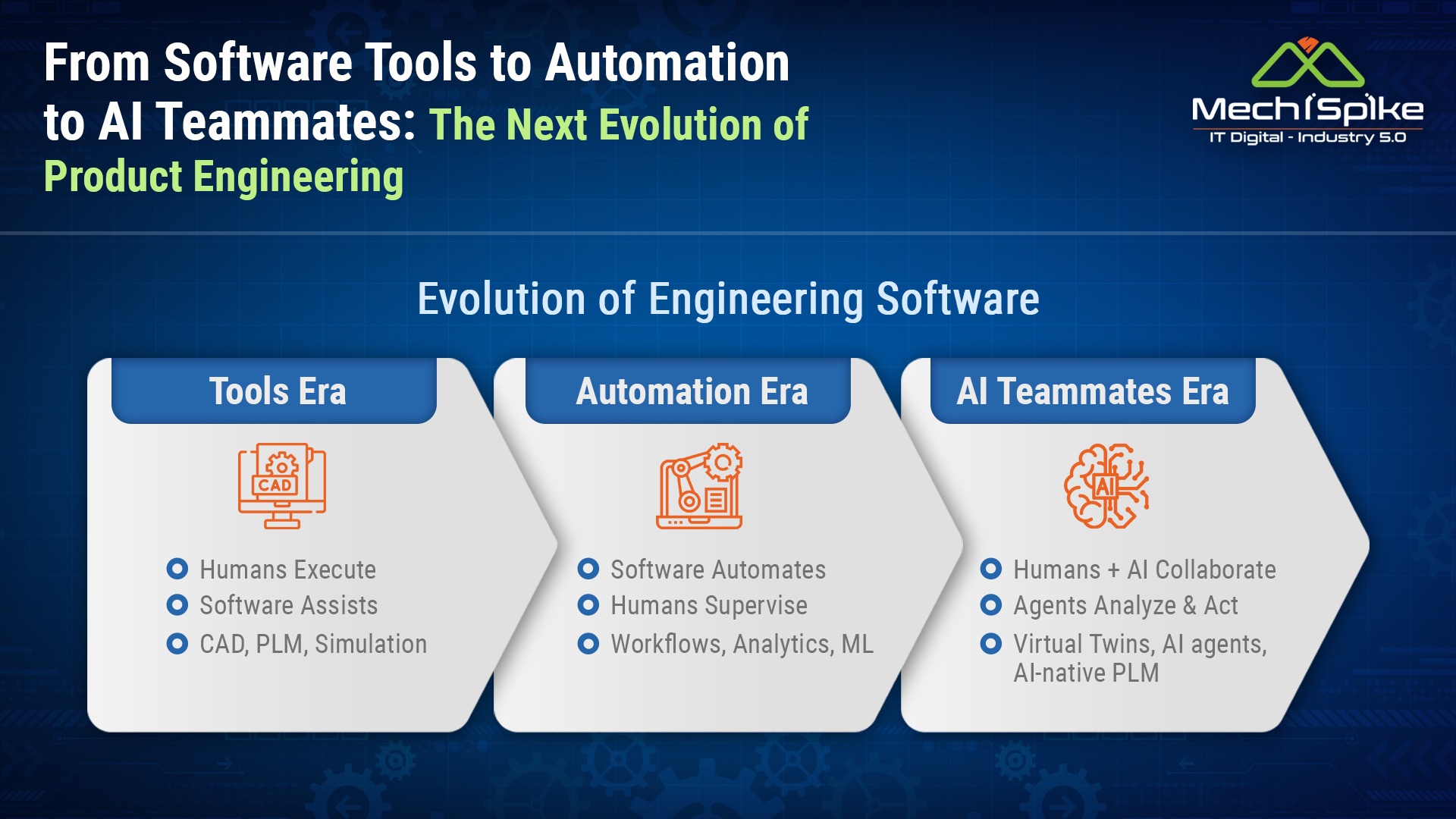
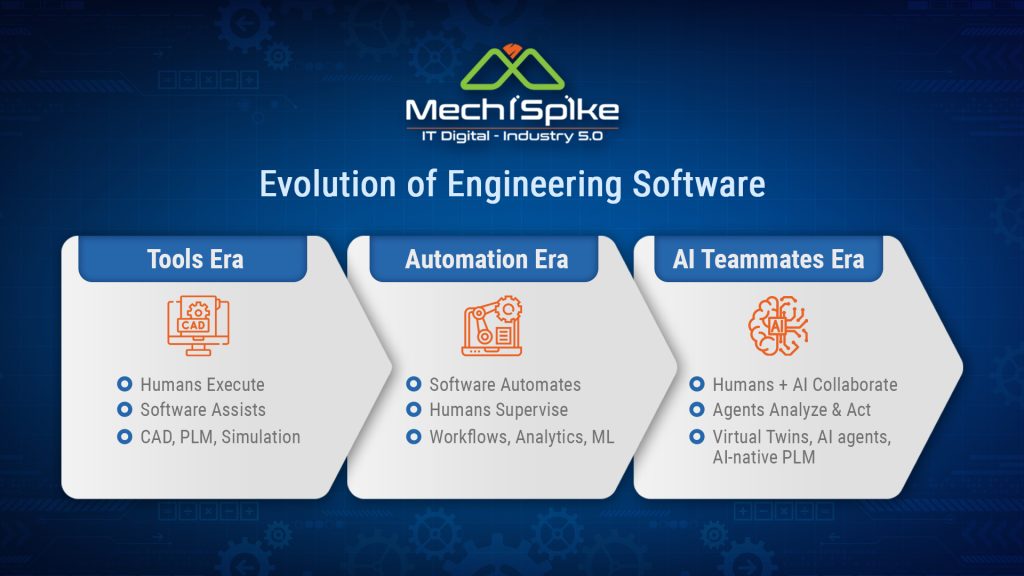
To understand the significance of this shift, it helps to view the evolution of engineering software in three stages.
1. The Tools Era
The first era began with digital engineering tools such as CAD, PLM, and simulation platforms.
These tools helped engineers:
- Draft designs faster
- Store product data digitally
- Track revisions and configurations
- Run computational analysis
But the core model remained simple:
Humans executed the work. Software assisted them.
Even the most advanced PLM systems still required engineers to navigate complex screens, search for data, trigger workflows, and manually analyze impacts.
2. The Automation Era
The second era introduced automation and analytics.
Scripts, workflow engines, and machine learning improved efficiency by:
- Automating repetitive tasks
- Detecting anomalies
- Optimizing production schedules
- Improving predictive maintenance
However, these systems were still reactive.
They waited for humans to initiate processes, interpret results, and decide what to do next.
3. The AI Teammate Era
We are now entering the third phase.
In this new model, AI systems actively collaborate with engineers rather than simply assisting them.
AI agents can:
- Analyze complex product relationships
- Evaluate design alternatives
- Perform change impact analysis
- Monitor manufacturing systems
- Suggest decisions
- Execute actions within defined constraints
Instead of waiting for commands, AI becomes an active participant in engineering workflows.
This is where software transitions from a passive tool to an intelligent teammate.
How AI Teammates Will Change Product Design
Engineering design is one of the first domains where this shift is visible.
With generative AI and simulation-based virtual twins, engineers can explore vastly larger design spaces than ever before.
For example, instead of manually creating a few design options, AI systems can generate hundreds of alternatives optimized for:
- weight
- strength
- cost
- manufacturability
- sustainability
Engineers then evaluate these alternatives and select the best trade-offs.
In this model, AI expands the design space while humans apply judgment and experience.
The result is faster innovation and better-informed decisions.
The Rise of Virtual Twins
Another key component of the AI teammate era is the Virtual Twin.
While Digital Twins monitor existing assets using sensor data, Virtual Twins represent complete systems that can exist before the physical product is built.
A Virtual Twin combines:
- engineering models
- manufacturing processes
- supply chain constraints
- operational data
- AI-driven predictions
This allows organizations to simulate entire product lifecycles before committing to physical execution.
For example, a Virtual Twin of a production line can evaluate:
- throughput
- machine utilization
- worker ergonomics
- energy consumption
- failure scenarios
Decisions that once required physical trial and error can now be made in a virtual environment.
AI Agents and the Future of PLM
Product Lifecycle Management systems are also undergoing a major transformation.
Traditionally, PLM systems required users to navigate complex interfaces and manually route workflows.
But as AI agents gain direct access to structured product data, the operating model changes.
Instead of:
- searching for parts
- running impact analysis
- routing approvals
AI agents can perform these tasks automatically within defined governance policies.
Humans step in primarily to:
- review outcomes
- handle exceptions
- provide strategic judgment
This represents the beginning of AI-native PLM, where systems are organized around data and actions rather than user navigation.
Why This Matters for Manufacturing
The AI teammate model is especially powerful in manufacturing environments.
Manufacturing systems generate vast amounts of data, but interpreting that data quickly is often difficult.
AI agents can continuously monitor operations and identify opportunities to improve performance.
For example:
- A scheduling agent may detect an upcoming production bottleneck and propose adjustments.
- A quality agent may correlate defects with a recent supplier change.
- A maintenance agent may predict equipment failure and recommend preventive action.
Instead of reacting to problems, factories become anticipatory and adaptive.
New KPIs for the AI Teammate Era
As AI becomes embedded in engineering workflows, traditional KPIs will need to evolve.
Historically, organizations measured performance using metrics such as:
- cycle time
- cost per unit
- machine utilization
- defect rates
While these metrics remain important, new KPIs will emerge that measure decision intelligence and collaboration with AI.
Examples include:
Design Intelligence KPIs
- Design space coverage
- Rework reduction rate
- Design decision cycle time
Manufacturing Adaptability KPIs
- Mean Time to Adapt (MTTA)
- First-time-right with AI assistance
- Virtual-to-physical iteration ratio
Human-AI Collaboration KPIs
- Decision latency reduction
- Human-AI productivity index
- AI-driven insight adoption rate
These metrics reflect a shift from pure efficiency to intelligent performance.
Preparing for the AI Teammate Future
Product manufacturers that want to benefit from this transformation should begin preparing now.
Key steps include:
1. Strengthen Product Data Foundations
AI agents rely on clean, structured product data across the digital thread.
2. Invest in Virtual Twin Capabilities
Simulation and system modeling will become central decision environments.
3. Introduce AI Agents Through Pilot Projects
Start with areas such as engineering change analysis or production planning.
4. Redesign Decision Workflows
Shift from human-executed processes to AI-assisted decision models.
5. Upskill the Workforce
Engineers must develop skills in:
- AI literacy
- systems thinking
- human-AI collaboration
Conclusion
Engineering organizations are entering a new era where software is no longer just a productivity tool—it is becoming an active collaborator.
AI agents, virtual twins, and intelligent data systems will transform how products are designed, validated, and manufactured.
The most successful companies will not be those that simply deploy AI features, but those that rethink how humans and machines work together.
In the coming decade, the defining advantage of engineering organizations will not just be their technology or talent.
It will be their ability to build effective human-AI teams.
MechiSpike can be of great help here to take your organization to the future of Product Design as well as Manufacturing with our focus on AI & Industry 5.0 using our prowess in PLM, Engineering and IT Digital.
Click here to know more about us.
For Corporates :
MechiSpike can be of great help to your organization to help you improve your PLM ROI and 30% Savings, be it the hiring cost in staffing or setting up an ODC.
We do this with efficient planning, organizing and controlling Product Master data with seamless data exchange among Engineering, Manufacturing and Enterprise systems.
With our well established niche expertise in PLM, we are now serving more than 15 Global Clients. They are now looking at us as a ‘Go To’ partner for Engineering, IT and PLM. With this confidence, we are expanding our scope of services beyond PLM to Industry 5.0 Digital Transformation i.e. PLM, ERP, CAD, Cloud, AI and DevOps.
Why MechiSpike :

RightSourcing is ‘Better Outsourcing’, given to ‘NICHE EXPERTS’.

Click here to know how we can actually help you with our Proven Methodologies.
For PLM Careers :
Learn More | Earn More | Grow More
Interactive UI : Every Application will get a response with a recruiter contact details and the applicant will get a notification at each phase until the applicant is positioned well with our 15+ global clients in India, USA & Germany.
Candidate Referral Program : Refer a candidate and earn INR 25,000.
Mechispike Solutions Pvt Ltd is a PLM focused company, having all kinds of PLM projects to enable employee career growth and add value to clients. We can position you better with our 15+ global clients in India, USA & Germany.
We believe in “Grow Together” and “Employee First” culture.
Dream more than a Job. Grow your PLM Career to the Fullest with MechiSpike
Click Here to explore our Job Openings.
Subscribe Now :
Our mission : To equip you with the knowledge and tools you need to drive value, streamline operations, and maximize return on investment from your PLM initiatives.
PLM ROI Newsletter will guide you through a comprehensive roadmap to help you unlock the full potential of your PLM investment.
We are committed to be your trusted source of knowledge and support throughout your PLM journey. Our team of experts and thought leaders will bring you actionable insights, best practices, case studies, and the latest trends in PLM.
Subscribe Now to get this weekly series delivered into your Inbox directly, as and when we publish it.
To your PLM success!
Warm regards,
Visit Us: www.mechispike.com
For PLM Services : Click Here to Schedule a Call with us.