
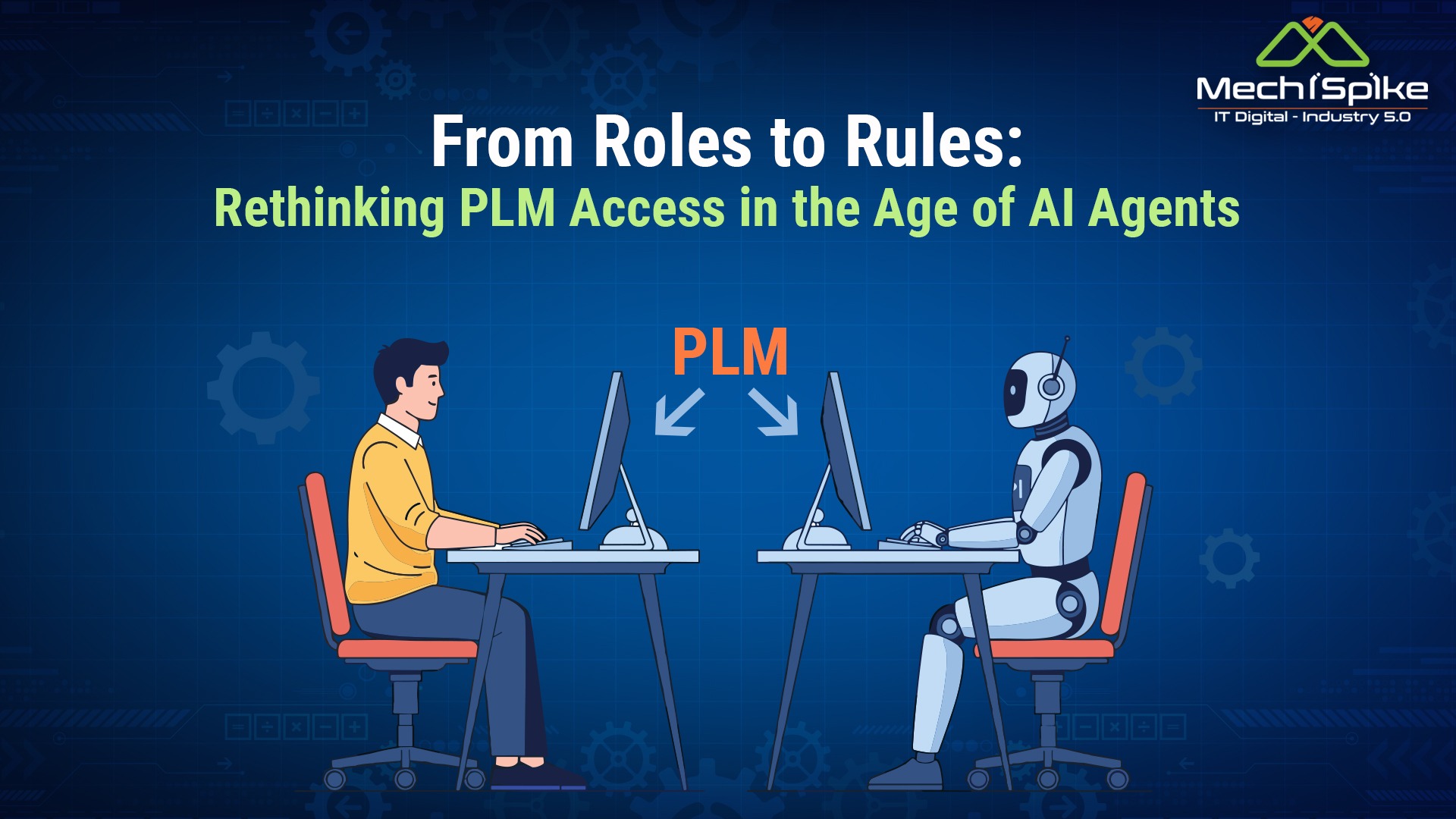

In this article, let’s look at how AI Agents will change the PLM Access and related workflows.
From Roles to Rules: Rethinking PLM Access in the Age of AI Agents
For decades, Product Lifecycle Management (PLM) systems have been built around a simple organizing principle: role-based access for human users.
Design engineers create and modify product data. Manufacturing engineers validate and plan processes. Quality teams review compliance. Managers approve workflows.
Access rights, workflows, and system behaviors are all structured around who the user is and what role they play.
But with the rise of AI agents capable of directly interacting with PLM systems, this model is beginning to evolve.
The question is no longer:
“Which human role should access this data?”
It is becoming:
“Which agent is allowed to perform which action under what constraints?”
This shift from role-based access to rule-based autonomy has deep implications for how PLM systems operate, how licensing works, and how organizations govern product data.
How PLM Works Today: Role-Based Access and Workflows
In traditional PLM systems:
- Access is granted based on user roles
- Workflows define task movement between people
- Actions are explicitly performed by logged-in users
- Systems track who did what and when
For example:
- A design engineer creates a part
- A reviewer checks it
- A manager approves it
- A manufacturing engineer uses it downstream
This model ensures:
- Accountability
- Traceability
- Control
But it also creates:
- Manual effort
- Delays in decision-making
- Dependency on human availability
The Shift: AI Agents as Active Participants in PLM
AI agents introduce a new operating model.
Instead of humans performing every step, agents can:
- Query product data
- Analyze relationships (BOMs, dependencies, revisions)
- Perform change impact analysis
- Suggest or apply updates
- Trigger downstream actions
- Coordinate across systems
This fundamentally changes how work flows in PLM.
Example: Engineering Change Management
Traditional Flow:
- Engineer submits change request
- Impact analysis performed manually
- Multiple teams review
- Workflow routes approvals
AI Agent-Driven Flow:
- AI agent analyzes the change instantly
- Identifies impacted parts, suppliers, processes
- Simulates cost, risk, and timeline impact
- Suggests approval or flags exceptions
- Humans intervene only where needed
This reduces latency and improves decision quality.
Example: BOM Management
AI agents can:
- Detect inconsistencies across BOM structures
- Suggest standardization
- Automatically reconcile differences between engineering and manufacturing BOMs
This eliminates repetitive manual reconciliation tasks.
Example: Compliance and Quality
AI agents can:
- Continuously monitor compliance rules
- Flag violations proactively
- Maintain audit-ready documentation
PLM becomes proactive instead of reactive.
The Impact on End User License Agreements (EULAs)
This shift introduces a major disruption in how PLM systems are licensed.
Traditional Model:
- License per human user (named user or concurrent user)
- Pricing based on number of users accessing the system
AI Agent Model Challenges:
1. Who Is the “User”?
If an AI agent performs:
- 1000 actions per day
- Across multiple workflows
Is it:
- One user?
- Multiple users?
- A service account?
2. Explosion of Activity
AI agents operate continuously, not occasionally.
This creates:
- Higher system load
- More API calls
- Increased data processing
Traditional licensing models are not designed for this scale.
3. Need for New Licensing Models
Future PLM licensing may shift toward:
- Usage-based pricing (transactions, API calls)
- Agent-based licensing
- Outcome-based models
This will require renegotiation of vendor contracts and internal cost structures.
Pros of AI Agent Access to PLM Systems
1. Faster Decision-Making
AI agents reduce delays caused by manual workflows and human dependencies.
2. Reduced Rework
Early impact analysis prevents downstream errors.
3. Improved Data Consistency
Agents can continuously monitor and correct inconsistencies.
4. Increased Productivity
Engineers focus on high-value decisions rather than repetitive tasks.
5. Continuous Operations
AI agents work 24/7, enabling real-time responsiveness.
6. Better Cross-System Coordination
Agents can operate across PLM, ERP, MES, and supply chain systems seamlessly.
Cons and Risks of AI Agent Access
1. Loss of Direct Human Control
Autonomous actions may reduce visibility if not properly governed.
2. Data Integrity Risks
Incorrect AI decisions can propagate across systems quickly.
3. Governance Complexity
Defining rules, constraints, and accountability becomes more challenging.
4. Security and Access Risks
Agents accessing sensitive product data increase cybersecurity exposure.
5. Licensing and Cost Uncertainty
New usage patterns may significantly increase costs if not managed properly.
6. Trust and Adoption Challenges
Users may resist relying on AI-generated actions without transparency.
Key Organizational Changes Required
To enable AI agent access to PLM systems, companies must evolve in several ways:
1. Shift from Role-Based Access to Policy-Based Governance
Access must be defined by:
- What actions are allowed
- Under what conditions
- With what constraints
2. Strengthen Data Governance
AI agents require:
- Clean, structured data
- Clear relationships
- High data integrity
3. Redesign Workflows
Move from:
- Sequential human approvals to
- AI-driven actions with human exception handling
4. Introduce AI Supervision Models
Define:
- When humans must review
- When agents can act autonomously
5. Upgrade Architecture for API and Agent Access
PLM systems must support:
- Machine-to-machine interaction
- Scalable API access
- Real-time data exchange
6. Redefine KPIs
New KPIs may include:
- Autonomous execution rate
- Human intervention ratio
- Decision cycle time
- Rework reduction
- AI accuracy and trust metrics
Checklist for PLM Leaders
PLM leaders can use this checklist to prepare for AI agent integration.

Conclusion
The introduction of AI agents into PLM systems marks a fundamental shift from human-driven workflows to agent-assisted execution.
While traditional PLM systems are built around role-based access and human interaction, the future will be governed by policy-based autonomy, data-centric operations, and human supervision.
This transformation brings significant benefits—speed, efficiency, and intelligence—but also introduces new challenges in governance, security, and licensing.
For PLM leaders, the path forward is not about replacing humans with AI, but about redefining how humans and AI collaborate.
The organizations that succeed will be those that:
- Build strong data foundations
- Define clear governance frameworks
- Adapt workflows intelligently
- Embrace new KPI models
In the end, PLM will evolve from a system where people execute tasks to one where intelligent agents operate on product data—and humans guide the outcomes.
MechiSpike can be of great help here to take your organization to the future of Product Design as well as Manufacturing with our focus on AI & Industry 5.0 using our prowess in PLM, Engineering and IT Digital.
Click here to know more about us.
For Corporates :
MechiSpike can be of great help to your organization to help you improve your PLM ROI and 30% Savings, be it the hiring cost in staffing or setting up an ODC.
We do this with efficient planning, organizing and controlling Product Master data with seamless data exchange among Engineering, Manufacturing and Enterprise systems.
With our well established niche expertise in PLM, we are now serving more than 15 Global Clients. They are now looking at us as a ‘Go To’ partner for Engineering, IT and PLM. With this confidence, we are expanding our scope of services beyond PLM to Industry 5.0 Digital Transformation i.e. PLM, ERP, CAD, Cloud, AI and DevOps.

