
Product Data to Product Context : How Manufacturers Can Create Better Product Context

Product Data to Product Context : How Manufacturers Can Create Better Product Context
PLM was built around a fundamental objective: Capture, organize, control and retrieve product data.
And it has done that remarkably well.
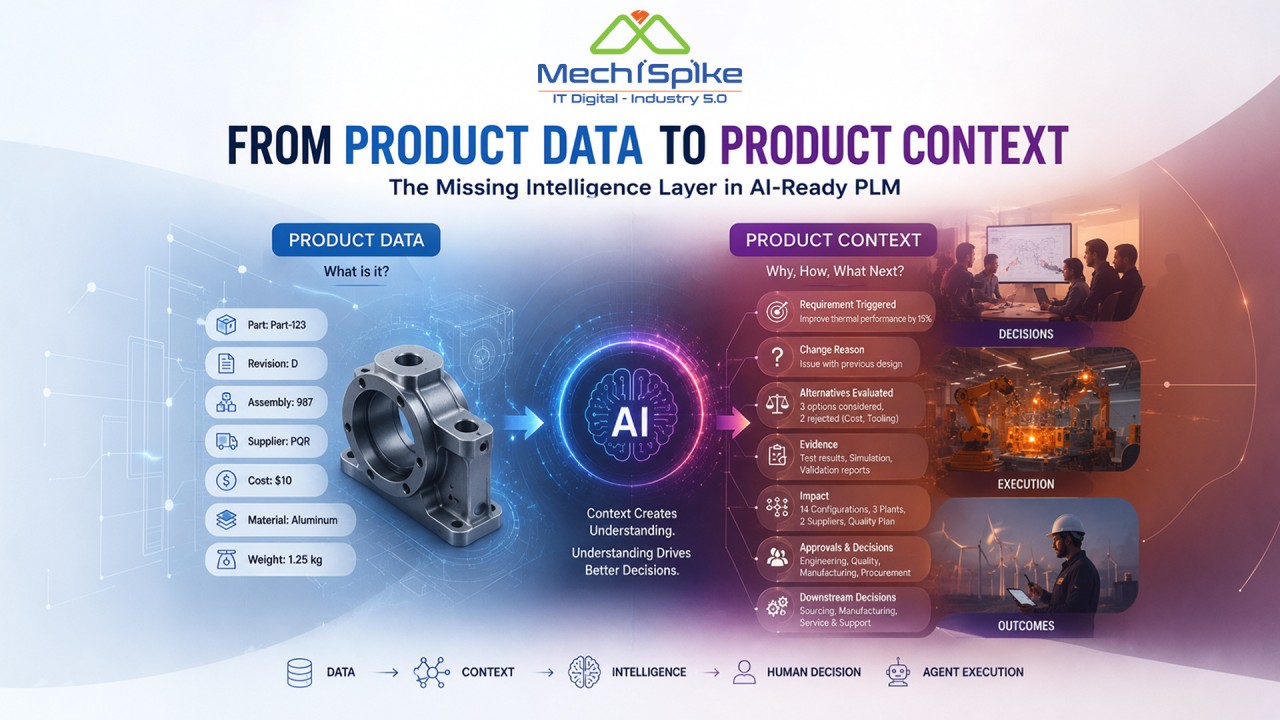
A modern PLM system can tell us that Part-123, revision D, is used in Assembly-987, supplied by PQR, at a cost of $10.
Useful? Absolutely.
But is that enough to make a good engineering decision? Not necessarily.
The engineer will immediately ask a different set of questions:
Why was Revision D created?
Which requirement triggered it?
Which product configurations are affected?
Was the supplier change temporary or permanent?
Which test established that the change was acceptable?
Which alternatives were considered—and rejected? Why?
Who approved the decision?
Which manufacturing, sourcing, quality and service decisions depend on it?
These questions cannot be answered by looking at the part record alone.
They require Product Context.
And as AI increasingly enters PLM, the distinction between Product Data and Product Context could become one of the most important concepts in the future of Product Lifecycle Management.
What Is Product Data?
Product Data is the factual information describing a product, its components and its lifecycle.
Examples include:
- Part numbers
- Revisions
- BOMs
- CAD files
- Specifications
- Material information
- Dimensions
- Supplier details
- Costs
- Manufacturing instructions
- Quality records
- Test results
For example:
Part-123 | Revision D | Assembly-987 | Supplier PQR | $10
This is Product Data.
It answers:
What is it?
Where is it?
What version is it?
Who supplies it?
What does it cost?
These facts are essential.
But facts alone don’t necessarily explain decisions.
What Is Product Context?
Product Context explains the circumstances, relationships and reasoning surrounding Product Data.
It answers questions such as:
- Why does this part exist?
- Why was it changed?
- What requirement caused the change?
- What problem was the change intended to solve?
- Which configurations does it affect?
- Which alternatives were evaluated?
- What evidence supports the decision?
- Who made the decision?
- Which downstream processes depend on it?
Therefore, Product Context can be thought of as: The meaning surrounding Product Data.
A useful conceptual model is:
Product Context = Product Data + Relationships + History + Provenance + Configuration + Decisions + Rules + Evidence + Communication
This is why simply adding more data to PLM does not necessarily create more intelligence.
The organization needs to understand how that data relates to everything around it.
Metadata Is Not Enough—Think “Decision Context”
The word metadata is often used to describe “data about data.”
That is technically correct, but it doesn’t fully capture the concept we are discussing.
For Product Lifecycle Management, a more useful term might be: Product Decision Context
It includes metadata, but goes beyond it.
Consider a drawing.
The drawing itself is Product Data.
Its:
- author,
- revision,
- creation date,
- approval status,
are Metadata.
But the reason it was changed, the requirement that triggered the change, the test that validated it, the alternatives rejected, and the manufacturing consequences together form its Decision Context.
That context is what allows an engineer—or an AI system—to understand the why behind the product.
An Example: A Simple Engineering Change
Suppose Part-123 changes from Revision C to Revision D.
Product Data tells us:
- Revision D exists.
- It is used in Assembly-987.
- Supplier PQR provides it.
- The cost is $10.
Now consider the context.
Revision D was created because: A customer requirement demanded a 15% improvement in thermal performance.
The engineering team evaluated three alternatives.
Alternative A was rejected because of cost.
Alternative B was rejected because it required a tooling change.
Alternative C was selected.
Testing demonstrated that it met the new requirement.
Quality approved the test results.
Manufacturing confirmed that the existing process could accommodate it.
Procurement determined that the supplier could produce it.
Engineering approved the ECO.
That is Product Context. And it is enormously more valuable for decision-making than the part record alone.
Why Product Context Is Becoming Critical Because of AI
Traditional software primarily searched and retrieved data.
AI can reason over connected information.
This changes the value equation.
Imagine asking an AI assistant:
“Why did we change this component two years ago?”
A traditional PLM search might return Revision D.
An AI-enabled PLM system with strong Product Context could potentially reconstruct the story:
“Revision D was introduced following a customer thermal-performance requirement. Three alternatives were evaluated. The selected design passed validation testing and avoided a tooling change. The change affected 14 product configurations and was approved through ECO-4587.”
That is dramatically more useful.
The AI isn’t simply retrieving information.
It is assembling context.
From Data to Context to Decision
This creates an interesting evolution:
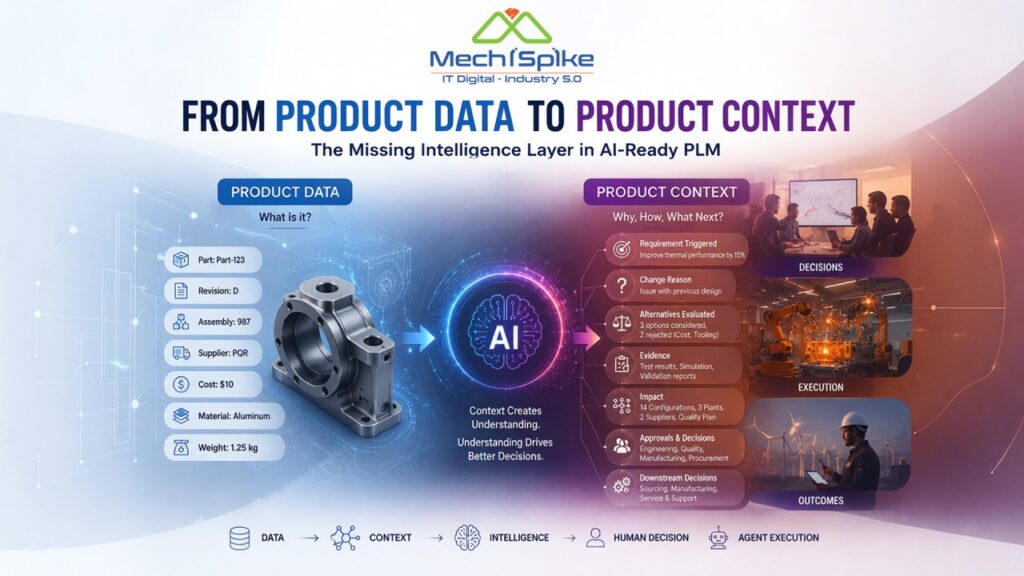
Product Data
↓
Product Context
↓
AI Understanding
↓
Human Decision
↓
Agentic Execution
This could become a powerful operating model for Industry 5.0.
Humans remain responsible for judgment and accountability.
AI provides contextual intelligence.
Agents increasingly execute approved actions.
How Manufacturers Can Create Better Product Context
Product manufacturers should focus on several areas.
1. Capture Relationships, Not Just Objects
Do not simply store:
“Part-123.”
Capture relationships such as:
- Used in,
- Derived from,
- Replaced by,
- Required by,
- Tested by,
- Approved by,
- Supplied by.
Relationships create context.
2. Preserve History
Do not treat the latest revision as the entire truth. Historical decisions matter.
AI needs to understand:
What changed?
Why did it change?
What happened afterward?
3. Capture Decision Rationale
This is one of the most valuable—and frequently neglected—forms of engineering knowledge.
Don’t just record:
“Alternative C selected.”
Record:
“Alternative C selected because it met the requirement without tooling modification and provided the best cost-performance trade-off.”
That sentence could become extremely valuable training context for future AI systems.
4. Connect Evidence
Engineering decisions should connect to:
- Test results,
- Simulations,
- Requirements,
- Quality reports,
- Customer feedback,
- Regulatory documentation.
This allows AI to distinguish decisions supported by evidence from decisions based just a judgment.
5. Strengthen BOM Context
BOMs should capture more than part relationships.
Where appropriate, organizations should understand:
- Effectivity,
- Configurations,
- Manufacturing relationships,
- Supplier dependencies,
- Service implications.
A BOM is not merely a list. It is a representation of product structure and business decisions.
6. Improve Change Management
Engineering Changes should capture:
- Trigger,
- Rationale,
- Impact,
- Alternatives,
- Evidence,
- Approvals,
- Implementation outcome.
This turns the Engineering Change repository into a valuable organizational memory.
7. Capture Human Expertise
A significant amount of product knowledge exists outside PLM:
- Emails,
- Meetings,
- Engineering discussions,
- Service reports,
- Supplier conversations.
Not everything should necessarily be captured. But important decisions and rationale should not disappear into individual inboxes.
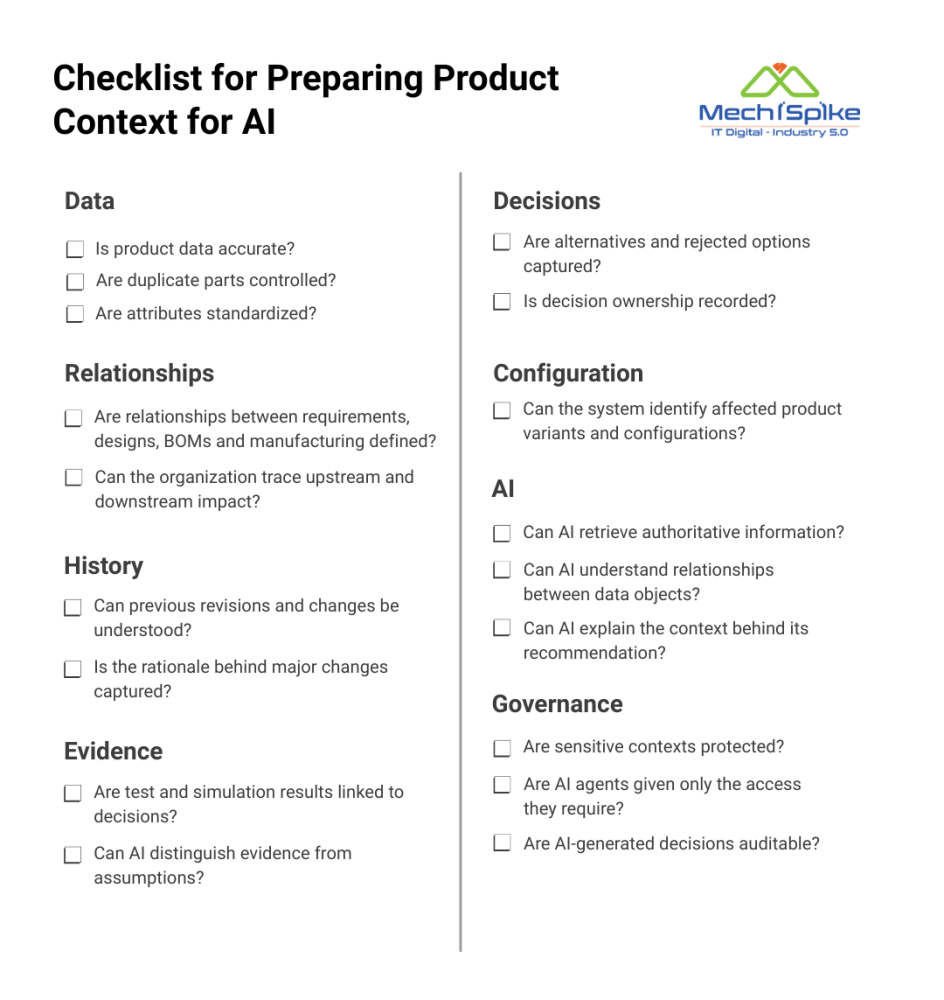
Checklist for Preparing Product Context for AI
Manufacturers should ask:
The Future Role of Engineers
This transition will also change engineering work.
Today, engineers spend considerable time searching for information and reconstructing context.
They ask colleagues:
“Why was this designed this way?”
“Who made that decision?”
“Was this tested?”
“Didn’t we try this solution before?”
Much of this knowledge exists—but is difficult to retrieve.
Future AI-enabled PLM can potentially make that context available instantly.
The engineer could ask:
“Show me all previous attempts to solve this problem, why they failed, and which design eventually worked.”
AI becomes a context retrieval and reasoning partner. The engineer remains the decision-maker.
The Bigger Opportunity: Organizational Memory
Perhaps the greatest value of Product Context is not AI itself. It is preserving organizational memory.
Engineers retire.
People change companies.
Projects end.
Suppliers change.
Teams reorganize.
Without context, organizations repeatedly solve the same problems.
With contextual product knowledge, an organization can retain the reasoning behind its products—not merely the files associated with them.
AI makes this organizational memory dramatically more useful because machines can now search, correlate and reason across it.
Conclusion
Traditional PLM was designed primarily to manage Product Data. The future of PLM must increasingly manage Product Context.
Product Data tells us: What exists.
Product Context tells us: Why it exists, how it got there, what it is connected to, what evidence supports it, and what decisions depend on it.
This distinction becomes particularly important as AI enters the product lifecycle.
AI can use Product Data to retrieve facts.
But it can use Product Context to understand relationships, reconstruct decisions, identify patterns and support better decisions.
And as Agentic AI becomes capable of executing actions, contextual understanding becomes even more critical.
The journey is therefore moving from:
Data → Context → Intelligence → Decision → Execution
Product manufacturers that build this foundation will be able to combine the strengths of both humans and AI:
Humans provide judgment, creativity and accountability.
AI provides contextual understanding at scale.
Agents provide increasingly autonomous execution.
The organizations that master this combination will have a significant advantage in the Industry 5.0 era.
Because ultimately, the future PLM system should not merely know what the product is. It should understand why the product became what it is—and help the organization decide what it should become next.
MechiSpike can be of great help to make your organization get a significant advantage in the Industry 5.0 era with our focus on AI & Industry 5.0 using our prowess in PLM, Engineering and IT Digital.
Click here to know more about us.
Quickly Assess your Industry 5.0 Solutions Online | Schedule a call →
Subscribe Now :
Subscribe now to get this weekly series delivered directly to your inbox.
To your success!
Thank you!!
Always at my Best,
Founder | Trusted Advisor – PLM ROI, Industry 5.0 Solutions
Bridging Strategy, Talent & Technology for Industry 5.0
Tailored PLM, Engineering & IT Solutions for Global Manufacturers