Is Your PLM Data Ready for AI?
In this article, let’s explore the basic preparation to get ready for AI in PLM – Data Quality. Let’s understand why data quality is important, what does good PLM Data actually mean?, Different problems seen due to poor data quality, How AI Changes the Economics of Good Data, How to prepare your PLM Data for the AI Era with a PLM AI-Readiness Checklist.
Is Your PLM Data Ready for AI?
Artificial Intelligence is rapidly becoming part of the Product Lifecycle Management landscape.
AI copilots can help engineers find information. Generative AI can summarize technical documents. AI can analyze engineering changes, identify similar components, assist with requirements, detect anomalies in BOMs, and potentially orchestrate increasingly autonomous engineering workflows.
The possibilities are enormous.
But underneath all these capabilities sits something far less exciting:
Data.
More specifically:
Good-quality engineering data.
For years, manufacturers could survive with imperfect PLM data because humans compensated for it.
An experienced engineer knew that two differently named parts were actually identical.
A manufacturing engineer knew which BOM attribute could be trusted.
A PLM administrator knew that a particular field had stopped being maintained five years ago.
A senior engineer knew where to find the “real” specification despite several versions existing across different systems.
AI does not automatically possess this institutional understanding.
And this creates an uncomfortable reality for manufacturers:
The more AI becomes involved in PLM, the more expensive poor data quality becomes.
Data Quality Is No Longer an IT Problem
Historically, data quality was frequently treated as an administrative responsibility.
Clean the database.
Remove duplicates.
Complete missing attributes.
Standardize naming conventions.
Important—but hardly strategic.
That perception is changing.
Product manufacturers increasingly depend on engineering data to drive:
- Automation,
- Analytics,
- Digital twins,
- Digital threads,
- AI copilots,
- Predictive quality,
- Automated change management,
- Agentic AI.
Data quality therefore determines what the enterprise can automate and how much it can trust the resulting decisions.
That makes data quality a business strategy, not merely a PLM housekeeping activity.
What Does Good PLM Data Actually Mean?
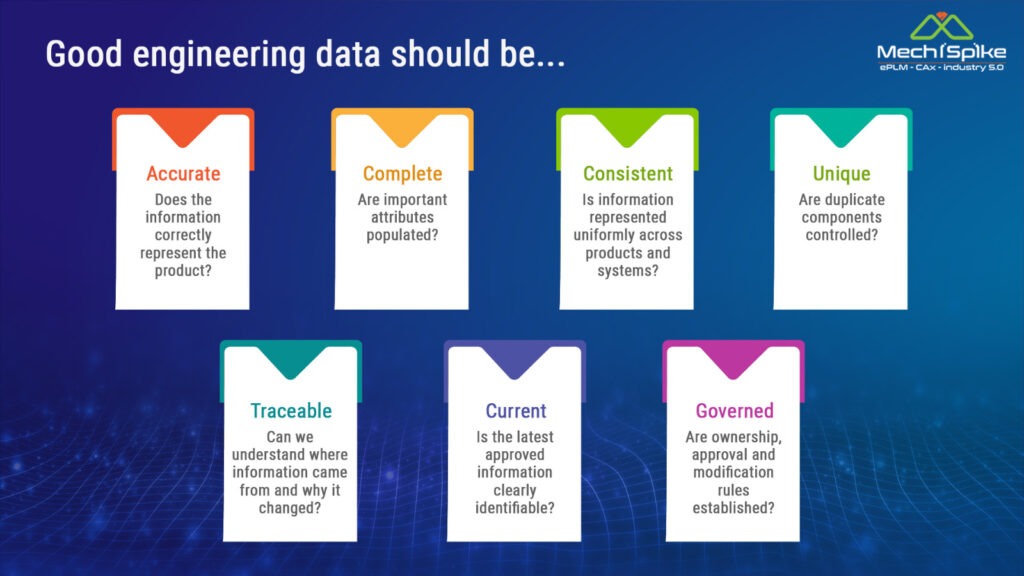
Good engineering data should be:
Accurate: Does the information correctly represent the product?
Complete: Are important attributes populated?
Consistent: Is information represented uniformly across products and systems?
Unique: Are duplicate components controlled?
Traceable: Can we understand where information came from and why it changed?
Current: Is the latest approved information clearly identifiable?
Governed: Are ownership, approval and modification rules established?
These characteristics have always mattered.
AI makes them essential.
Problem #1: Duplicate Parts
Duplicate parts are a classic engineering-data problem.
Imagine three engineers creating effectively the same fastener:
BOLT-M8-40
M8X40-BOLT
FASTENER-00872
A human engineer might examine the drawings and realise that these are effectively identical.
An AI system looking at poorly structured metadata may treat them as three separate engineering objects.
Now imagine asking an AI assistant:
“How many unique fasteners do we use across this product family?”
The answer may be technically correct according to the database—and completely wrong from a business perspective.
Duplicate parts also affect:
- Procurement,
- Inventory,
- Supplier negotiations,
- Reuse,
- Cost optimization,
- Manufacturing complexity.
AI doesn’t eliminate duplicate-data problems. It can amplify them at machine speed.
Problem #2: Inconsistent Attributes
Consider something as simple as material information.
Different engineering teams may enter:
- Stainless Steel
- SS
- SS304
- Stainless 304
- AISI 304
Humans often understand these variations.
Algorithms need structure.
Now imagine an AI agent trying to identify all components manufactured from a specific material because a supplier disruption has occurred.
If attributes are inconsistent, the AI may miss affected components.
The consequence is no longer merely a poor search result.
It could influence a real engineering or supply-chain decision.
This is why taxonomy, classification and metadata standards become increasingly important in AI-enabled PLM.
Problem #3: Weak BOM Governance
The Bill of Materials is among the most important information structures in any product manufacturing organisation.
But many organisations still struggle with:
- outdated BOMs,
- disconnected EBOMs and MBOMs,
- incorrect quantities,
- unclear effectivity,
- missing relationships,
- unmanaged variants,
- and synchronisation problems between PLM and ERP.
Now consider an AI agent performing change-impact analysis.
You ask:
“If we replace this motor, which products, manufacturing plants and service configurations will be affected?”
AI can potentially perform this analysis in seconds.
But only if the underlying relationships are trustworthy.
If BOM governance is weak, the AI may produce an elegant, confident—and incomplete—answer.
The sophistication of the model cannot compensate for missing product relationships.
Problem #4: Poor Change Management
Engineering data is not static.
Products evolve continuously.
Requirements change.
Suppliers change.
Materials change.
Drawings change.
Software changes.
Manufacturing processes change.
Good PLM therefore requires not only accurate information but also accurate change history.
AI will increasingly analyze historical changes to answer questions such as:
“Why was this component replaced?”
“Have we experienced a similar failure before?”
“Which previous engineering changes affected this assembly?”
“What risks typically occur when this type of component changes?”
Imagine the value of an AI system capable of learning from 15 years of Engineering Change Requests and Engineering Change Orders.
Now imagine those same records containing:
- vague descriptions,
- incomplete reasoning,
- undocumented decisions,
- incorrect links,
- and missing outcomes.
The organization’s history exists—but AI cannot reliably learn from it.
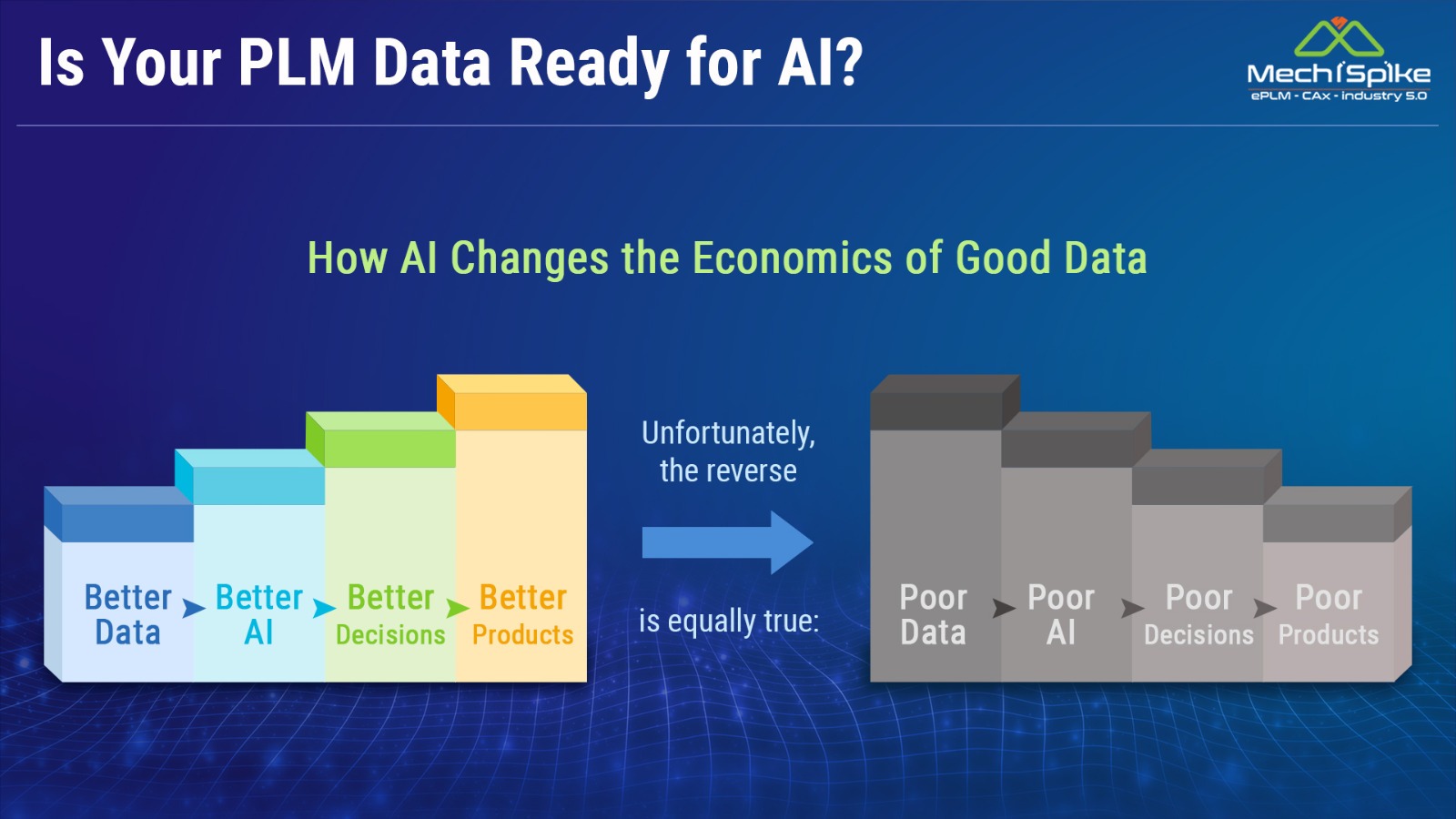
AI Changes the Economics of Good Data
There is an interesting shift happening here.
Historically, improving engineering data required significant efforts while the benefits were sometimes difficult to quantify – But AI changes the equation.
One clean component record might improve one process.
But a clean engineering knowledge base can potentially improve thousands of future AI interactions.
Good data becomes reusable intelligence.
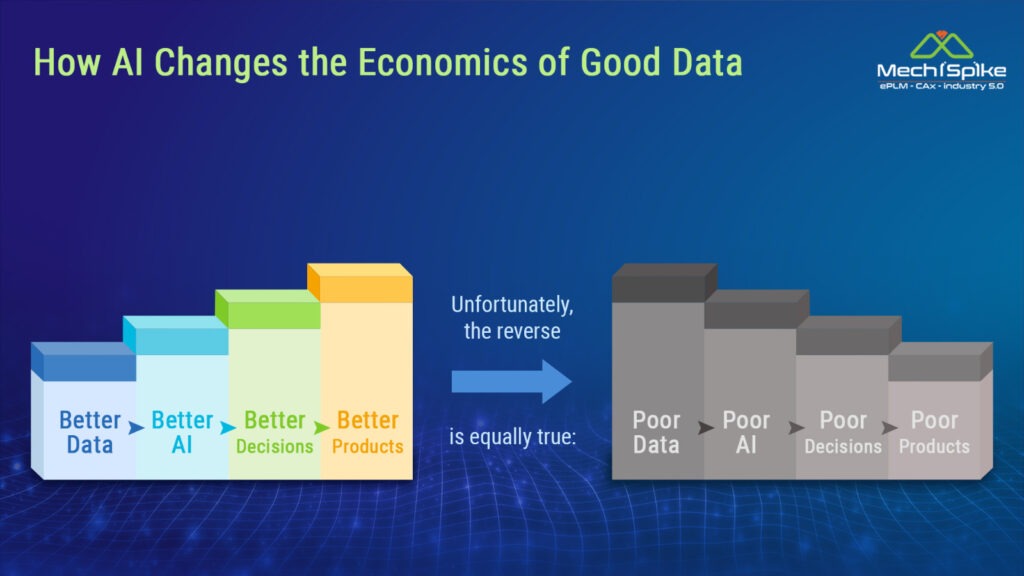
This creates a multiplier:
Better Data → Better AI → Better Decisions → Better Products
Unfortunately, the reverse is equally true:
Poor Data → Poor AI → Poor Decisions → Scaled Errors
The danger with AI is not simply that it may make mistakes.
It is that automation can allow those mistakes to propagate much faster.
The Digital Thread Depends on Data Quality Too
Industry 5.0 manufacturers increasingly talk about creating a Digital Thread connecting:
Requirements → Design → PLM → Manufacturing → Quality → Service
AI can potentially become the intelligence layer operating across this thread.
For example, a quality problem detected on the shop floor could trigger AI to examine:
- Manufacturing parameters,
- Affected serial numbers,
- Engineering changes,
- Design tolerances,
- Supplier batches,
- Historical failures.
That is extremely powerful.
But only when relationships across these systems are reliable.
A broken Digital Thread cannot magically become an Intelligent Thread simply by adding AI.
Preparing PLM Data for the AI Era
Manufacturers should begin treating AI readiness and data readiness as the same transformation.
A practical approach should include:
1. Establish Data Ownership
Every important engineering-data domain needs accountable owners.
Who owns component classification?
Who owns BOM quality?
Who owns material attributes?
Who owns change records?
Without ownership, governance quickly deteriorates.
2. Measure Data Quality
Create metrics for:
- duplicate rates,
- missing attributes,
- classification accuracy,
- BOM completeness,
- change-record quality,
- and obsolete information.
What gets measured gets improved.
3. Standardise Before Automating
Do not automate chaotic processes.
Standardize:
- naming,
- attributes,
- classifications,
- lifecycle states,
- and change processes.
Then introduce AI.
4. Clean High-Value Data First
Trying to clean decades of PLM data simultaneously may be unrealistic.
Prioritise data connected to:
- active products,
- high-value product families,
- critical components,
- current engineering programs,
- and planned AI use cases.
5. Use AI to Improve Data Quality
Interestingly, AI itself can become part of the solution.
AI can help identify:
- potential duplicate parts,
- inconsistent descriptions,
- missing attributes,
- suspicious BOM relationships,
- and abnormal change records.
Humans can then validate recommendations.
AI therefore creates a virtuous cycle:
Better data improves AI—and AI helps improve the data.
If many answers are “No,” the organisation’s first AI project may actually need to be a data-quality project.
The Future Role of PLM Teams
PLM professionals will therefore need to evolve.
Historically, PLM teams concentrated on:
- configuration,
- workflows,
- integrations,
- upgrades,
- and user support.
Future PLM teams will increasingly become custodians of engineering intelligence.
Their responsibilities will include ensuring that product information is:
- structured,
- contextual,
- connected,
- machine-readable,
- governed,
- and trustworthy enough for AI.
Data governance may consequently become one of the most valuable skills in the future PLM profession.
Conclusion
AI promises to transform PLM.
It can make engineering knowledge easier to discover, accelerate change-impact analysis, improve component reuse, detect anomalies and eventually enable increasingly autonomous engineering processes.
But AI cannot manufacture reliable engineering truth from unreliable engineering data.
Organisations with duplicate parts, inconsistent attributes, weak BOM governance and poor Change Management will struggle to capture these benefits—regardless of how advanced their AI tools become.
The manufacturers that stand out in the Industry 5.0 era may therefore not simply be those that invest most aggressively in AI.
They will be those that first create an engineering-data foundation worthy of AI.
Because as PLM moves from being a System of Record toward becoming a System of Intelligence, one principle will become increasingly important:
The quality of AI outcomes will depend heavily on the quality of engineering data.
In Summary
AI will make data quality more—not less—important.
Clean parts, consistent attributes, governed BOMs and traceable engineering changes are becoming prerequisites for intelligent PLM.
The AI race in product manufacturing may therefore begin somewhere surprisingly familiar: : Getting the engineering data right.
MechiSpike can be of great help here to take your organisation to the future of Design & Manufacturing with our focus on AI & Industry 5.0 using our prowess in PLM, Engineering and IT Digital.
Click here to know more about us.
For Corporates :
MechiSpike can be of great help to your organisation to help you improve your PLM ROI and 30% Savings, be it the hiring cost in staffing or setting up an ODC.
We do this with efficient planning, organising, and controlling Product Master data with seamless data exchange among Engineering, Manufacturing and Enterprise systems.
With our well-established niche expertise in PLM, we are now serving more than 15 Global Clients. They are now looking at us as a ‘Go To’ partner for Engineering, IT and PLM. With this confidence, we are expanding our scope of services beyond PLM to Industry 5.0 Digital Transformation, i.e. PLM, ERP, CAD, Cloud, AI and DevOps.
Why MechiSpike :
RightSourcing is ‘Better Outsourcing’, given to ‘NICHE EXPERTS’.
Click here to know how we can actually help you with our Proven Methodologies.
For PLM Careers :
Learn More | Earn More | Grow More
Interactive UI : Every Application will get a response with a recruiter contact details and the applicant will get a notification at each phase until the applicant is positioned well with our 15+ global clients in India, USA & Germany.
Candidate Referral Program : Refer a candidate and earn INR 25,000.
Mechispike Solutions Pvt Ltd is a PLM focused company, having all kinds of PLM projects to enable employee career growth and add value to clients. We can position you better with our 15+ global clients in India, USA & Germany.
We believe in “Grow Together” and “Employee First” culture.
Dream more than a Job. Grow your PLM Career to the Fullest with MechiSpike
Click Here to explore our Job Openings.
Subscribe Now :
Our mission : To equip you with the knowledge and tools you need to drive value, streamline operations, and maximize return on investment from your PLM initiatives.
PLM ROI Newsletter will guide you through a comprehensive roadmap to help you unlock the full potential of your PLM investment.
We are committed to be your trusted source of knowledge and support throughout your PLM journey. Our team of experts and thought leaders will bring you actionable insights, best practices, case studies, and the latest trends in PLM.
Subscribe Now to get this weekly series delivered into your Inbox directly, as and when we publish it.
To your PLM success!
Warm regards,
Visit Us: www.mechispike.com
For PLM Services : Click Here to Schedule a Call with us.