
In this article, let’s explore Engineering Change Management (ECM), What it is, Why it has always been important and How AI will transform it in future. Challenges, Risks and Benefits AI will offer in ECM. We will also look at how an engineer’s role will change and the BEST Practices organizations should follow along with a simple checklist to implement an AI Based Change Management in an organization.
Engineering Change Management : How AI Will Transform ECM in PLM
Every great product changes.
Requirements evolve. Designs improve. Materials change. Suppliers change. Manufacturing processes evolve. Regulatory requirements become stricter.
Managing these changes effectively is one of the most critical responsibilities of every Product Lifecycle Management (PLM) system.
Yet, for many product manufacturers, Engineering Change Management remains one of the slowest, most manual, and most expensive business processes.
Engineers spend countless hours:
- Identifying impacted parts,
- Co-ordinating reviews,
- Collecting approvals,
- Assessing risks,
- Updating documentation,
- Ensuring downstream teams stay aligned.
Artificial Intelligence is poised to fundamentally change this process.
Rather than simply digitizing change management, AI is enabling something much more powerful: Autonomous Change Management.
Instead of humans coordinating every activity, intelligent AI agents can analyze, orchestrate, recommend, and even execute large parts of the engineering change process while humans supervise exceptions and strategic decisions.
For Product Lifecycle Management (PLM), this could become one of the defining transformations of the Industry 5.0 era.
Why Change Management Has Always Been Critical
Every manufactured product undergoes change throughout its lifecycle.
A single Engineering Change Request (ECR) might originate because of:
- Customer feedback,
- Quality issues,
- Supplier changes,
- Cost reduction initiatives,
- New regulations,
- Manufacturing improvements,
- Sustainability goals,
- Product innovation.
These changes eventually flow through Engineering Change Orders (ECOs) and influence:
- CAD models,
- Bills of Materials (BOMs),
- Manufacturing instructions,
- Supplier documentation,
- ERP systems,
- Service manuals,
- Quality plans.
A poorly managed engineering change can lead to:
- Production delays,
- Inventory losses,
- Compliance failures,
- Warranty claims,
- Expensive recalls,
- Customer dissatisfaction.
That is why Change Management has always been one of the core pillars of PLM.
The Traditional Engineering Change Process
A typical Engineering Change process involves:
- Identify the issue.
- Raise an Engineering Change Request.
- Perform Impact analysis.
- Identify affected products.
- Review with multiple departments.
- Estimate cost and schedule impact.
- Obtain approvals.
- Release Engineering Change Order.
- Update downstream systems.
- Monitor implementation.
Although PLM systems automate workflow routing, many of these activities remain heavily dependent on human effort.
This creates:
- Long approval cycles,
- Inconsistent decisions,
- Duplicated analysis,
- Communication delays,
- Unnecessary rework.
How AI can Transform that : From Workflow Automation to Autonomous Change Management
Traditional workflow automation follows predefined rules.
For example:
“If Engineering approves, send the request to Manufacturing.”
AI goes much further.
Instead of merely routing tasks, AI can understand context.
It can:
- Analyze product structures,
- Identify affected assemblies,
- Estimate downstream impact,
- Detect similar historical changes,
- Recommend approvers,
- Identify potential risks,
- Prioritize requests,
- Generate documentation.
This transforms Change Management from workflow automation into intelligent decision support.
The next evolution is Autonomous Change Management.
What Is Autonomous Change Management?
Autonomous Change Management combines PLM systems with AI agents capable of independently performing many engineering change activities within predefined governance boundaries.
Imagine an AI agent receiving a design modification.
Instead of waiting for multiple manual reviews, the agent automatically:
- Identifies all impacted BOMs,
- Analyzes supplier dependencies,
- Estimates manufacturing impact,
- Checks compliance requirements,
- Predicts schedule delays,
- Generates revised documentation,
- Recommends approval paths.
Engineers review exceptions rather than performing repetitive analysis.
Humans remain accountable.
AI accelerates execution.
A Practical Example
Consider a consumer electronics manufacturer introducing a new battery supplier.
Traditionally, engineers would spend several days:
- Identifying affected products,
- Reviewing drawings,
- Checking compliance,
- Notifying procurement,
- Updating documentation.
With Autonomous Change Management:
The AI agent immediately:
- Identifies every product using that battery,
- Evaluates mechanical compatibility,
- Checks regulatory certifications,
- Estimates inventory impact,
- Generates implementation recommendations,
- Prepares change documentation.
The engineering team focuses on evaluating recommendations rather than collecting information.
The Benefits of AI-Driven Change Management
1. Faster Decision-Making
Impact analysis that previously required days can be completed in minutes.
2. Better Risk Assessment
AI can simultaneously evaluate:
- Manufacturing,
- Supply chain,
- Quality,
- Compliance,
- Service implications.
3. Reduced Manual Effort
Engineers spend less time gathering information.
More time solving engineering problems.
4. Improved Knowledge Reuse
AI learns from previous Engineering Change Orders and recommends best practices.
5. Better Cross-Functional Collaboration
AI automatically connects:
- Engineering,
- Manufacturing,
- Procurement,
- Quality,
- Service.
6. Shorter Product Development Cycles
Faster changes mean faster innovation.
Challenges and Risks
Despite its advantages, Autonomous Change Management introduces new challenges.
1. Data Quality
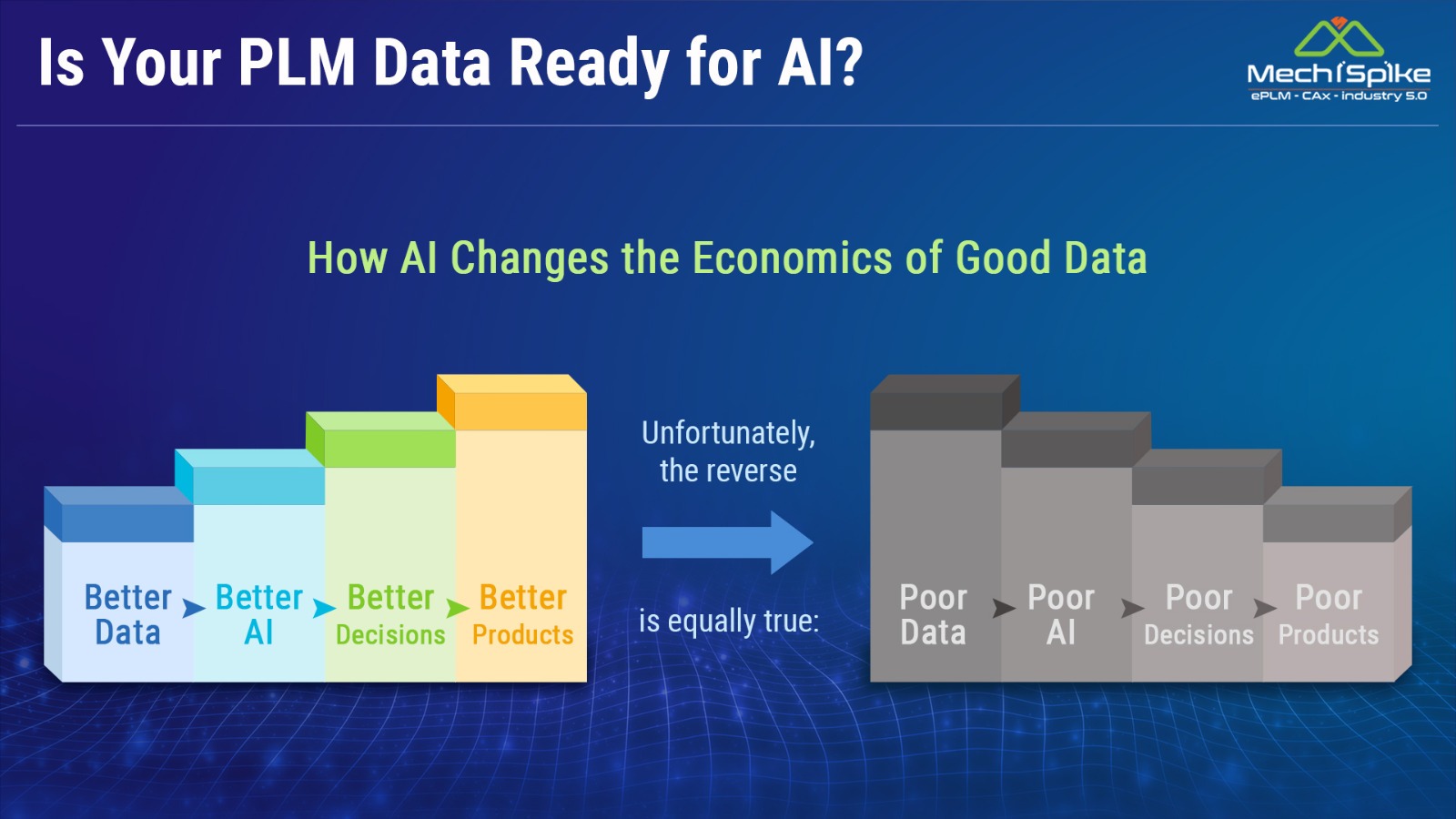
Poor PLM data results in poor AI recommendations.
Garbage in.
Garbage out.
2. Governance
Organizations must clearly define:
- Which decisions AI can make,
- When humans intervene,
- Approval thresholds,
- Accountability.
3. Explainability
Engineers must understand: Why did AI recommend this change?
Trust requires transparency.
4. Cybersecurity
AI agents interacting with PLM systems require strong access controls.
5. Cultural Resistance
Many experienced engineers initially hesitate to trust AI-generated recommendations.
Successful adoption depends on positioning AI as a collaborator rather than a replacement.
How the Engineer’s Role Will Change
Autonomous Change Management will not eliminate engineering roles. It will redefine them.
Today’s engineer spends significant time on:
- Documentation,
- Co-ordination,
- Approvals,
- Searching information,
- Repetitive analysis.
Tomorrow’s engineer will increasingly focus on:
- Evaluating AI recommendations,
- Solving complex engineering problems,
- Innovation,
- Systems thinking,
- Exception handling,
- Strategic decision-making.
The engineer evolves from: Process Executor to Engineering Decision Maker.
Best Practices for Product Organizations
To successfully adopt Autonomous Change Management, manufacturers should follow these principles.
Build High-Quality Product Data
AI depends on accurate:
- BOMs,
- CAD metadata,
- Requirements,
- Supplier information,
- Configuration data.
Standardize Engineering Processes
AI performs better when processes are clearly defined.
Start with Low-Risk Changes
Automate:
- Document generation,
- Impact analysis,
- Notifications,
- Reporting.
Expand autonomy gradually.
Maintain Human Oversight
High-risk engineering decisions should always include human approval.
Continuously Train AI Models
AI should learn from:
- Successful ECOs,
- Failed changes,
- Engineering feedback,
- Manufacturing outcomes.
Measure Outcomes
Track:
- Change cycle time,
- Approval delays,
- Rework reduction,
- Engineering productivity,
- AI recommendation accuracy.

Preparing Teams for the Future
Organizations should invest in upskilling engineers in:
- AI literacy
- PLM data quality
- Prompt engineering
- Systems thinking
- Data interpretation
- Change leadership
- Digital thread concepts
- Human-AI collaboration
Equally important are new habits:
- Trust data before assumptions.
- Validate AI recommendations rather than rejecting them outright.
- Think across the entire product lifecycle.
- Continuously improve engineering processes.
- Treat every Engineering Change as an opportunity to improve organizational knowledge.
Looking Ahead
As Industry 5.0 matures, Engineering Change Management will become increasingly intelligent.
Future PLM environments may include specialized AI agents responsible for:
- Impact analysis,
- Compliance verification,
- Supplier coordination,
- Document generation,
- Workflow orchestration,
- Implementation monitoring.
Rather than navigating lengthy approval chains, engineers will increasingly collaborate with intelligent assistants capable of processing thousands of relationships in seconds.
Organizations that embrace this transformation will reduce engineering cycle times, improve product quality, and respond faster to market demands.
Conclusion
Engineering Change Management has always been central to successful product development, ensuring that design changes are controlled, traceable, and aligned across engineering, manufacturing, quality, and supply chain functions.
Autonomous Change Management represents the next major evolution of this discipline. By combining PLM with AI, manufacturers can automate repetitive analysis, accelerate decision-making, improve cross-functional collaboration, and enable engineers to focus on innovation instead of administration.
The transition will require more than new technology. It demands high-quality product data, strong governance, transparent AI, and a workforce prepared to collaborate with intelligent systems.
The future of PLM is not one where AI replaces engineers. It is one where AI manages routine complexity, while engineers apply creativity, judgment, and expertise to the decisions that matter most.
In the Industry 5.0 era, the most successful manufacturers will be those that transform Engineering Change Management from a slow administrative process into an intelligent, adaptive capability that continuously drives product innovation.
MechiSpike can be of great help here to take your organization to the future of automation with our focus on AI & Industry 5.0 using our prowess in PLM, Engineering and IT Digital.
Click here to know more about us.
For Corporates :
MechiSpike can be of great help to your organization to help you improve your PLM ROI and 30% Savings, be it the hiring cost in staffing or setting up an ODC.
We do this with efficient planning, organizing and controlling Product Master data with seamless data exchange among Engineering, Manufacturing and Enterprise systems.
With our well established niche expertise in PLM, we are now serving more than 15 Global Clients. They are now looking at us as a ‘Go To’ partner for Engineering, IT and PLM. With this confidence, we are expanding our scope of services beyond PLM to Industry 5.0 Digital Transformation i.e. PLM, ERP, CAD, Cloud, AI and DevOps.
Why MechiSpike :