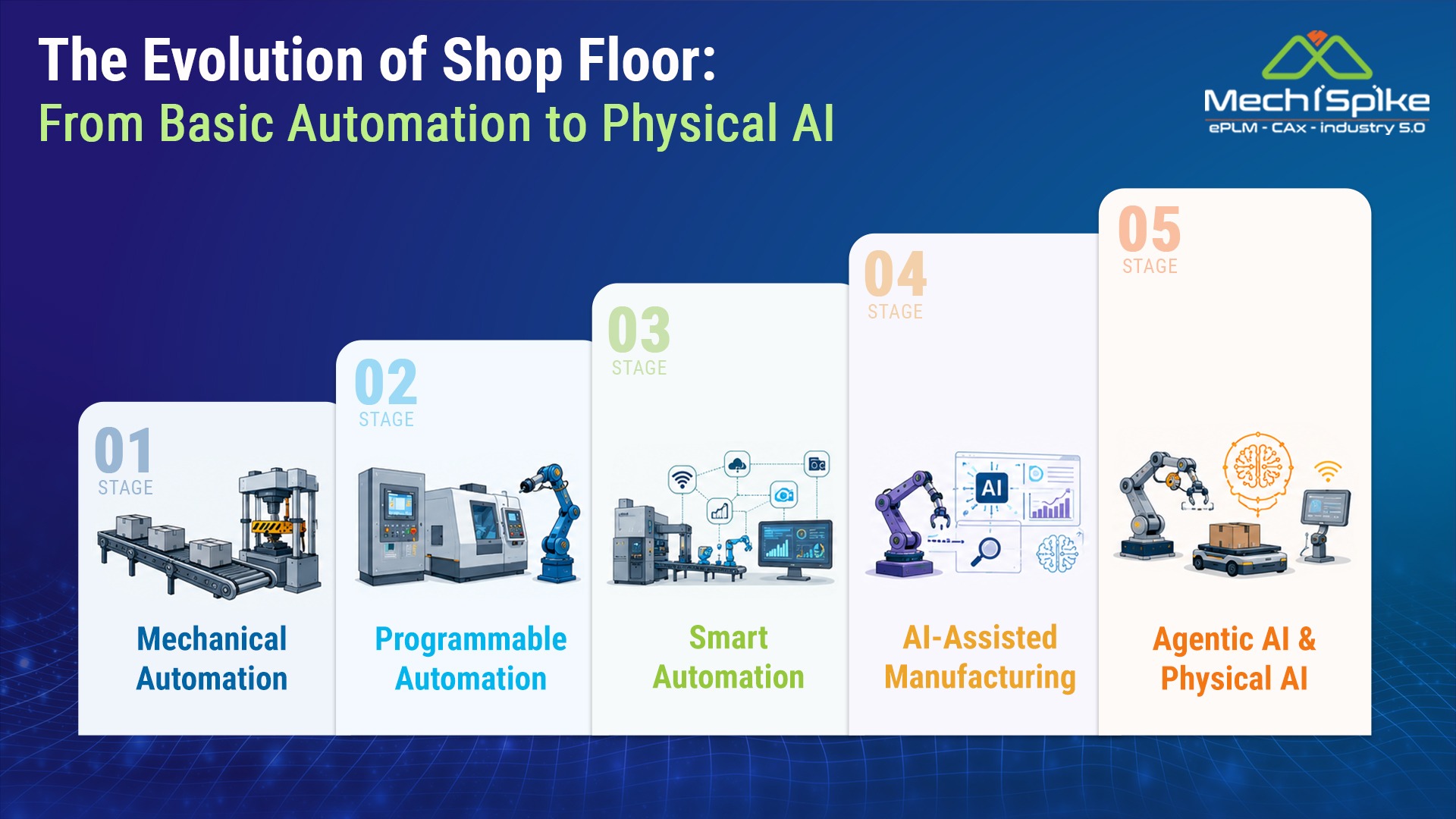

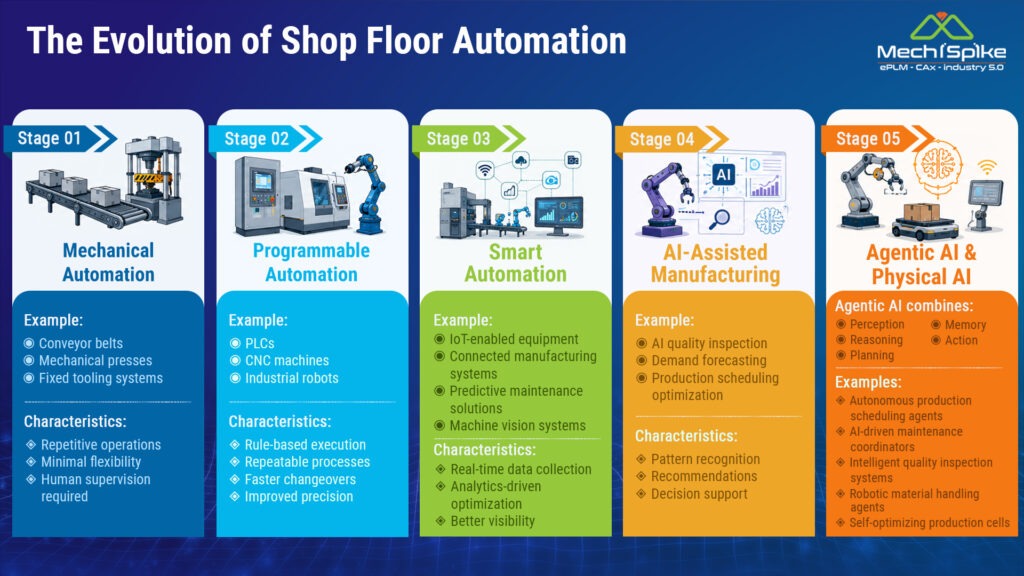
Stage 1: Mechanical Automation
Examples:
- Conveyor belts
- Mechanical presses
- Fixed tooling systems
Characteristics:
- Repetitive operations
- Minimal flexibility
- Human supervision required
Stage 2: Programmable Automation
Examples:
- PLCs
- CNC machines
- Industrial robots
Characteristics:
- Rule-based execution
- Repeatable processes
- Faster changeovers
- Improved precision
Stage 3: Smart Automation
Examples:
- IoT-enabled equipment
- Connected manufacturing systems
- Predictive maintenance solutions
- Machine vision systems
Characteristics:
- Real-time data collection
- Analytics-driven optimization
- Better visibility
This marked the beginning of Industry 4.0.
Stage 4: AI-Assisted Manufacturing
Examples:
- AI quality inspection
- Demand forecasting
- Predictive maintenance
- Production scheduling optimization
Characteristics:
- Pattern recognition
- Recommendations
- Decision support
Humans remain responsible for execution.
Stage 5: Agentic AI and Physical AI
This is where manufacturing is heading.
Agentic AI combines:
- Perception,
- Reasoning,
- Planning,
- Memory &
- Action.
The AI does not simply recommend. It performs tasks autonomously within predefined boundaries.
Examples include:
- Autonomous production scheduling agents,
- AI-driven maintenance coordinators,
- Intelligent quality inspection systems,
- Robotic material handling agents,
- Self-optimizing production cells.
This evolution brings us into the era of Physical AI.
What Is Physical AI in Manufacturing?
Physical AI refers to AI systems that interact with the physical world through:
- Robots,
- Machines,
- Sensors,
- Autonomous vehicles,
- Industrial equipment.
Unlike traditional software AI, Physical AI directly affects real-world operations.
Examples include:
Intelligent Robotic Welding
AI adjusts parameters based on:
- Material properties,
- Environmental conditions,
- Previous weld quality.
Autonomous Mobile Robots
Robots dynamically optimize:
- Routes,
- Inventory movement,
- Production priorities.
AI-Based Quality Inspection
Computer vision systems:
- Identify defects,
- Classify issues,
- Trigger corrective actions.
Self-Healing Production Systems
AI agents automatically:
- Re-route production,
- Schedule maintenance,
- Co-ordinate downstream processes.
The Difference Between Automation and Agentic AI
Traditional Automation:
- Executes predefined instructions
- Operates under fixed rules
- Requires human intervention for exceptions
- Limited adaptability
Agentic AI:
- Understands goals
- Reasons about alternatives
- Learns from outcomes
- Coordinates across systems
- Acts autonomously within constraints
Simply put: Automation performs tasks. Agentic AI pursues objectives.

Pros of Physical AI in Manufacturing
1. Greater Flexibility
AI adapts to changing production conditions.
Traditional automation struggles with variability.
2. Better Decision-Making
AI can consider multiple variables simultaneously.
Examples:
- machine health,
- production demand,
- Energy costs,
- Supplier delays.
3. Reduced Downtime
Autonomous maintenance coordination improves equipment availability.
4. Improved Quality
AI continuously learns from defects and process outcomes.
5. Higher Productivity
Humans focus on high-value decisions rather than repetitive tasks.
6. Faster Innovation
Manufacturers can rapidly optimize processes and experiment with new approaches.
Challenges and Risks of Physical AI
1. Safety Concerns
Autonomous systems operating in physical environments require rigorous safety controls.
2. Loss of Human Visibility
Excessive automation may reduce operator understanding of underlying processes.
3. Data Quality Dependencies
Poor data leads to poor decisions.
4. Governance Complexity
Organizations must define:
- Authority levels,
- Escalation paths,
- Human intervention thresholds.
5. Cybersecurity Risks
Connected AI systems increase attack surfaces.
6. Workforce Resistance
Employees may fear replacement rather than collaboration.


Preparing for the Agentic AI Era
Manufacturers should develop capabilities in:
Data Governance
Clean and connected data remains essential.
Digital Twins
Virtual representations improve AI decision-making.
Human-AI Collaboration
Operators become supervisors and orchestrators.
AI Governance
Define:
- Accountability,
- Permissions,
- Safety controls.
Workforce Upskilling
Train employees on:
- AI literacy,
- Systems thinking,
- Robotics,
- Data analytics,
- Digital manufacturing.
The Future Factory
The factory of the future will not simply automate tasks. It will orchestrate intelligent ecosystems.
Machines, robots, AI agents, humans, digital twins, and enterprise systems will collaborate continuously.
Humans will remain central to:
- Strategy,
- Ethics,
- Creativity,
- Innovation,
- Complex decision-making.
Agentic AI will increasingly handle:
- Co-ordination,
- Optimization,
- Monitoring,
- Repetitive decision execution.
This is the true vision of Industry 5.0: Humans and intelligent machines working together to create smarter, safer, and more sustainable manufacturing systems.
Conclusion
Automation has always been a cornerstone of manufacturing excellence. From mechanical systems and PLCs to smart factories, each generation has improved productivity, quality, and efficiency.
Today, Agentic AI represents the next major evolution. Unlike traditional automation that follows predefined instructions, Agentic AI pursues objectives, adapts to changing conditions, and collaborates across systems to achieve better outcomes.
For product manufacturers, the challenge is not choosing between automation and AI, but understanding where each approach creates the greatest value. Traditional automation remains ideal for repetitive, deterministic processes, while Agentic AI unlocks new possibilities for complex, dynamic, and knowledge-intensive operations.
The future shop floor will combine both worlds—leveraging the reliability of automation and the intelligence of autonomous agents.
Manufacturers that build strong data foundations, robust governance frameworks, and human-centered AI strategies will be best positioned to thrive in the Industry 5.0 era.
Ultimately, the journey is not from humans to machines, but from isolated automation to intelligent collaboration across the entire manufacturing ecosystem.
MechiSpike can be of great help here to take your organization to the future of automation with our focus on AI & Industry 5.0 using our prowess in PLM, Engineering and IT Digital.
Click here to know more about us.
For Corporates :
MechiSpike can be of great help to your organization to help you improve your PLM ROI and 30% Savings, be it the hiring cost in staffing or setting up an ODC.
We do this with efficient planning, organizing and controlling Product Master data with seamless data exchange among Engineering, Manufacturing and Enterprise systems.
With our well established niche expertise in PLM, we are now serving more than 15 Global Clients. They are now looking at us as a ‘Go To’ partner for Engineering, IT and PLM. With this confidence, we are expanding our scope of services beyond PLM to Industry 5.0 Digital Transformation i.e. PLM, ERP, CAD, Cloud, AI and DevOps.
Why MechiSpike :