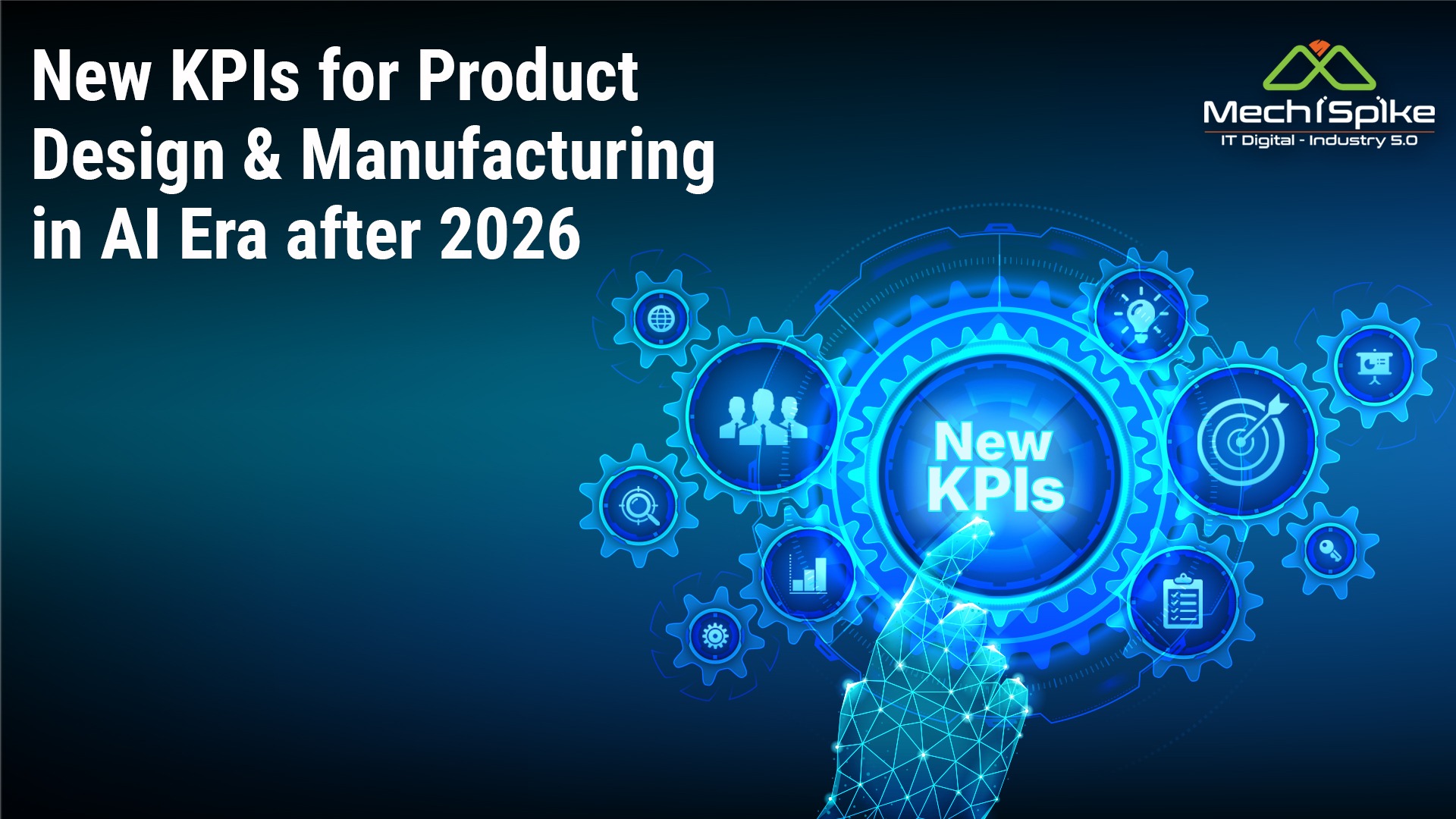
New KPIs for Product Design and Manufacturing in AI Era after 2026

In this article, let’s look at KPIs and how traditional KPIs are no longer sufficient in the new AI Era, how AI is reshaping the work, and what new KPIs product manufacturers must adopt 2026 onwards to remain competitive.
New KPIs for Product Design and Manufacturing in AI Era after 2026
For decades, Product Design and Manufacturing have been measured using familiar metrics—cost, throughput, utilization, cycle time, and defect rates.
These KPIs made sense in an era where work was linear, roles were siloed, and optimization was largely mechanical.
But as we approach 2026, the nature of work itself is changing.
Large Language Models (LLMs), Generative AI, AI agents, digital twins, and spatial interfaces are transforming how engineers design products, how factories operate, and how decisions are made.
Humans are no longer executing tasks alone; they are increasingly collaborating with AI systems that generate options, reason over complexity, and orchestrate workflows.
This shift fundamentally alters what “good performance” looks like—and therefore demands a new generation of KPIs.
This article explores why traditional KPIs are no longer sufficient, how LLMs are reshaping work, and what new KPIs product manufacturers must adopt 2026 onwards to remain competitive.
Why Traditional KPIs Are Becoming Incomplete
Classic KPIs focus on output efficiency:
- How fast was something produced?
- How much did it cost?
- How many defects occurred?
These metrics assume:
- Humans are the primary decision-makers
- Processes are relatively stable
- Optimization is incremental
However, in a world where:
- AI proposes designs
- Agents coordinate changes across systems
- Digital twins predict outcomes before execution
- Humans act as validators, supervisors, and innovators
…performance is no longer just about execution. It is about decision quality, adaptability, collaboration, and learning speed.
Traditional KPIs measure what happened. New KPIs must measure how intelligently it happened.
How LLMs Are Changing the Way Work Gets Done
LLMs are altering work in three fundamental ways:
1. From Task Execution to Decision Supervision
Engineers no longer start from a blank page. AI generates:
- Design alternatives
- Risk assessments
- Cost implications
- Compliance summaries
Humans supervise, refine, and choose—not just execute.
2. From Siloed Roles to Human–AI Teams
Work is now distributed across:
- Humans (Judgment, Ethics, Creativity)
- AI models (Pattern recognition, Generation, Memory)
- Agents (Coordination, Monitoring, Orchestration)
Performance is collective – Humans with Machines, not individual.
3. From Static Processes to Adaptive Systems
Manufacturing systems adapt in near real time based on:
- Sensor data
- Supply risk signals
- AI-driven predictions
KPIs must reflect adaptability, not just efficiency.
The Shift in KPI Philosophy beyond 2026
2026 onwards, KPIs must answer new questions:
- How fast do we learn?
- How well do humans and AI collaborate?
- How resilient are our decisions?
- How quickly can we adapt to change?
- How responsibly do we innovate?
This leads to four major KPI categories.
1. New KPIs for Product Design & Engineering
a) Design Space Coverage Index
What it measures:
How many viable design alternatives were explored before a decision was made.
Why it matters:
With generative AI, the risk is no longer “too few options” but “choosing too quickly.”
Example: An AI generates 500 design variants. Engineers evaluate and shortlist 20. Higher coverage = better-informed decisions.
b) Design-to-Decision Cycle Time
What it measures:
Time taken from concept initiation to final design decision.
Why it matters:
LLMs compress ideation cycles dramatically. The KPI reflects decision agility, not drafting speed.
c) Rework Reduction Rate
What it measures:
Percentage reduction in downstream changes caused by early design decisions.
Why it matters:
AI-assisted impact analysis should reduce late-stage surprises.
2. New KPIs for Manufacturing Operations
a) First-Time-Right with AI Assistance
What it measures:
Percentage of tasks completed correctly the first time with AI/AR guidance.
Why it matters:
This reflects the effectiveness of AI as a real-time production partner.
b) Mean Time to Adapt (MTTA)
What it measures:
How quickly manufacturing systems adjust to disruptions—supplier changes, machine failures, demand shifts.
Why it matters:
Resilience replaces static optimization as a core performance goal.
c) Human–AI Productivity Index
What it measures:
Output per worker with AI assistance, compared to baseline productivity.
Why it matters:
This KPI captures augmentation—not automation.
3. New KPIs for Sustainability & Responsibility
a) Lifecycle Carbon per Product
What it measures:
Total emissions from design, sourcing, manufacturing, service, and end-of-life.
Why it matters:
Sustainability is becoming a design constraint, not a reporting metric.
b) Circularity Index
What it measures:
Percentage of components designed for reuse, remanufacture, or recycling.
Why it matters:
AI enables early circularity decisions—KPIs must reinforce them.
c) Compliance Readiness Score
What it measures:
How prepared a product is for regulatory audits at any point in its lifecycle.
Why it matters:
AI agents continuously monitor compliance; readiness should be measurable.
4. New KPIs for Workforce & Collaboration
a) Skill Ramp-Up Time
What it measures:
Time required for a worker to become productive with AI/AR tools.
Why it matters:
AR-guided work and AI assistants dramatically shorten learning curves.
b) Digital Dexterity Score
What it measures:
Ability of teams to work fluidly across physical, digital, and AI systems.
Why it matters:
Future performance depends on comfort with hybrid intelligence.
c) Human Judgment Utilization Ratio
What it measures:
How often humans are involved in high-impact decisions vs routine execution.
Why it matters: In Industry 5.0, human judgment should be applied where it adds the most value.
How New KPIs Change the Management Behavior
Old KPIs reward:
- Speed at all costs
- Maximum utilization
- Minimizing headcount
New KPIs reward:
- Better decisions
- Faster learning
- Smarter collaboration
- Ethical and sustainable outcomes
This shift changes leadership behavior from command-and-control to enable-and-orchestrate.
Steps to Adopt New KPIs in Product Design and Manufacturing
1. Reassess What “Performance” Means
Align KPIs with strategic goals—innovation, resilience, sustainability—not just efficiency.
2. Separate Execution Metrics from Intelligence Metrics
Track not only output, but how decisions are made.
3. Integrate KPIs Across the Digital Thread
Design, manufacturing, supply chain, and service KPIs must be connected—not isolated.
4. Use AI to Measure AI
Leverage AI agents to continuously track and analyze new KPIs.
5. Pilot New KPIs Before Formal Adoption
Test KPIs in specific teams or plants before enterprise rollout.
6. Update Incentives and Reviews
Align rewards with new KPIs to drive behavioral change.
Conclusion: KPIs for an Intelligent, Human-Centric Future
After 2026, the most successful product manufacturers will not be those with the fastest factories—but those with the smartest decisions.
As LLMs and AI agents reshape how work is done, KPIs must evolve from measuring effort to measuring intelligence, adaptability, and collaboration.
New KPIs will reflect not just how much was produced, but how wisely it was designed, manufactured, and sustained.
In the Industry 5.0 era, what gets measured will define how humans and AI work together.
The organizations that rethink KPIs today will be the ones that lead tomorrow—not because they work harder, but because they work smarter, together.
MechiSpike can be of great help here to take your organization to the future of Product Design as well as Manufacturing with our focus on Super-Niche Talent PODs for critical Industry 5.0 programs enabled by our prowess in PLM, Engineering and IT Digital.
Click here to know more about us.
For Corporates :
MechiSpike can be of great help to your organization to help you improve your PLM ROI and 30% Savings, be it the hiring cost in staffing or setting up an ODC.
We do this with efficient planning, organizing and controlling Product Master data with seamless data exchange among Engineering, Manufacturing and Enterprise systems.
With our well established niche expertise in PLM, we are now serving more than 15 Global Clients. They are now looking at us as a ‘Go To’ partner for Engineering, IT and PLM. With this confidence, we are expanding our scope of services beyond PLM to Industry 5.0 Digital Transformation i.e. PLM, ERP, CAD, Cloud, AI and DevOps.
Why MechiSpike :

RightSourcing is ‘Better Outsourcing’, given to ‘NICHE EXPERTS’.

For PLM Careers :
Learn More | Earn More | Grow More
Interactive UI : Every Application will get a response with a recruiter contact details and the applicant will get a notification at each phase until the applicant is positioned well with our 15+ global clients in India, USA & Germany.
Candidate Referral Program : Refer a candidate and earn INR 25,000.
Mechispike Solutions Pvt Ltd is a PLM focused company, having all kinds of PLM projects to enable employee career growth and add value to clients. We can position you better with our 15+ global clients in India, USA & Germany.
We believe in “Grow Together” and “Employee First” culture.
Dream more than a Job. Grow your PLM Career to the Fullest with MechiSpike
Click Here to explore our Job Openings.
Subscribe Now :
Our mission : To equip you with the knowledge and tools you need to drive value, streamline operations, and maximize return on investment from your PLM initiatives.
PLM ROI Newsletter will guide you through a comprehensive roadmap to help you unlock the full potential of your PLM investment.
We are committed to be your trusted source of knowledge and support throughout your PLM journey. Our team of experts and thought leaders will bring you actionable insights, best practices, case studies, and the latest trends in PLM.
Subscribe Now to get this weekly series delivered into your Inbox directly, as and when we publish it.
To your PLM success!
Warm regards,
Visit Us: www.mechispike.com
If you want to Grow your PLM Career to the Fullest, Click Here to explore our Job Openings.
For PLM Services : Click Here to Schedule a Call with us.