What Manufacturers Must Not Forget While Adopting AI in PLM

In this article, let’s discover the critical factors manufacturers must not overlook while adopting AI in PLM. Let’s explore how AI will evolve from copilots and analytics to autonomous engineering agents, and why data quality, BOM governance, process discipline, cybersecurity, human expertise, user adoption and AI governance remain essential for successful AI-powered Product Lifecycle Management.
What Manufacturers Must Not Forget While Adopting AI in PLM
Artificial Intelligence is becoming one of the biggest technology priorities for Product Lifecycle Management.
AI copilots. Generative design. Intelligent search. Automated Engineering Change Management. BOM intelligence. Digital-thread analytics. AI Agents. Autonomous engineering workflows.
The possibilities are exciting.
But there is a danger.
As manufacturers rush to adopt AI, they may neglect the less glamorous foundations that have always made PLM successful.
Data quality. Process discipline. Governance. User adoption. Integration. Security. Change management.
Technology history provides an important lesson:
Organizations rarely fail because they adopted a new technology too slowly. They often fail because they adopted the technology without changing the surrounding system of people, processes and governance.
This is particularly relevant to AI in PLM.
How New Technologies Have Historically Been Adopted
Look at the evolution of manufacturing technology.
CAD
When CAD replaced drawing boards, the initial focus was on digitizing design.
But simply giving engineers CAD software did not automatically create better engineering.
Organizations had to establish:
- Modeling standards,
- Libraries,
- Naming conventions,
- Drawing standards,
- Revision practices,
- Training,
- Data management.
CAD created value only when the surrounding engineering process evolved.
ERP
ERP promised integrated enterprise processes.
But ERP implementations often struggled when organizations attempted to automate inconsistent processes without first standardizing them.
The lesson:
Technology can automate a process. It cannot automatically fix a badly designed process.
PLM
PLM itself followed a similar journey.
Organizations implemented PLM to control:
- Product data,
- BOMs,
- Revisions,
- Engineering Changes,
- Workflows,
- Collaboration.
But successful PLM required much more than software.
It required:
- Governance,
- Process standardization,
- Data ownership,
- Organizational change,
- User adoption.
Industry 4.0
IoT and connected manufacturing created another lesson.
Manufacturers installed sensors and collected enormous quantities of shop-floor data.
But collecting data did not automatically create intelligence.
The real challenge became:
Can we trust the data?
Can we connect it?
Can we interpret it?
Can we act on it?
AI is now arriving on top of all these layers. That makes the lessons from previous technology waves even more important.
The AI Adoption Curve in PLM
AI adoption in PLM will probably follow a similar progression.
Stage 1: AI as an Assistant
The first wave will focus on relatively low-risk applications:
- Intelligent search,
- Document summarization,
- Engineering knowledge retrieval,
- Drafting specifications,
- Generating reports,
- Conversational PLM interfaces.
The engineer remains firmly in control.
This stage will feel relatively safe.
Stage 2: AI as an Analyst
AI will increasingly analyze:
- BOMs,
- Engineering Changes,
- Requirements,
- Quality information,
- Supplier data,
- Historical engineering decisions.
It will answer questions such as:
“Which products are affected by this component change?”
or:
“Have we experienced this failure before?”
The value becomes much greater. But so does the importance of data quality.
Stage 3: AI as a Recommender
AI will begin recommending actions.
For example:
“These 14 products are likely to be affected by this Engineering Change.”
“Three existing components appear suitable for reuse.”
“This design may create a manufacturing risk.”
Humans will increasingly validate AI recommendations.
Stage 4: AI as an Agent
The next step is Agentic AI.
AI agents could:
- Perform impact analysis,
- Identify affected BOMs,
- Initiate workflows,
- Prepare Engineering Change Requests,
- Coordinate approvals,
- Update selected information,
- Interact with other enterprise systems.
The human role shifts from performing every task to supervising autonomous execution.
Stage 5: AI as an Autonomous Engineering System
Eventually, some bounded engineering processes may become highly autonomous.
An AI system could potentially detect an issue, investigate it, identify alternatives, simulate consequences, recommend a solution and initiate implementation.
At this point, AI is no longer merely a feature inside PLM.
It becomes part of the operating model of product development.
And this is where the risks of neglecting the fundamentals become enormous.
What Could Manufacturers Neglect?
1. Data Quality
AI needs trustworthy product information.
If PLM contains:
- duplicate parts,
- inconsistent attributes,
- incorrect BOM relationships,
- obsolete drawings,
- incomplete change history,
AI will inherit those problems.
The more autonomous AI becomes, the more dangerous poor data becomes.
Garbage in, garbage out becomes:
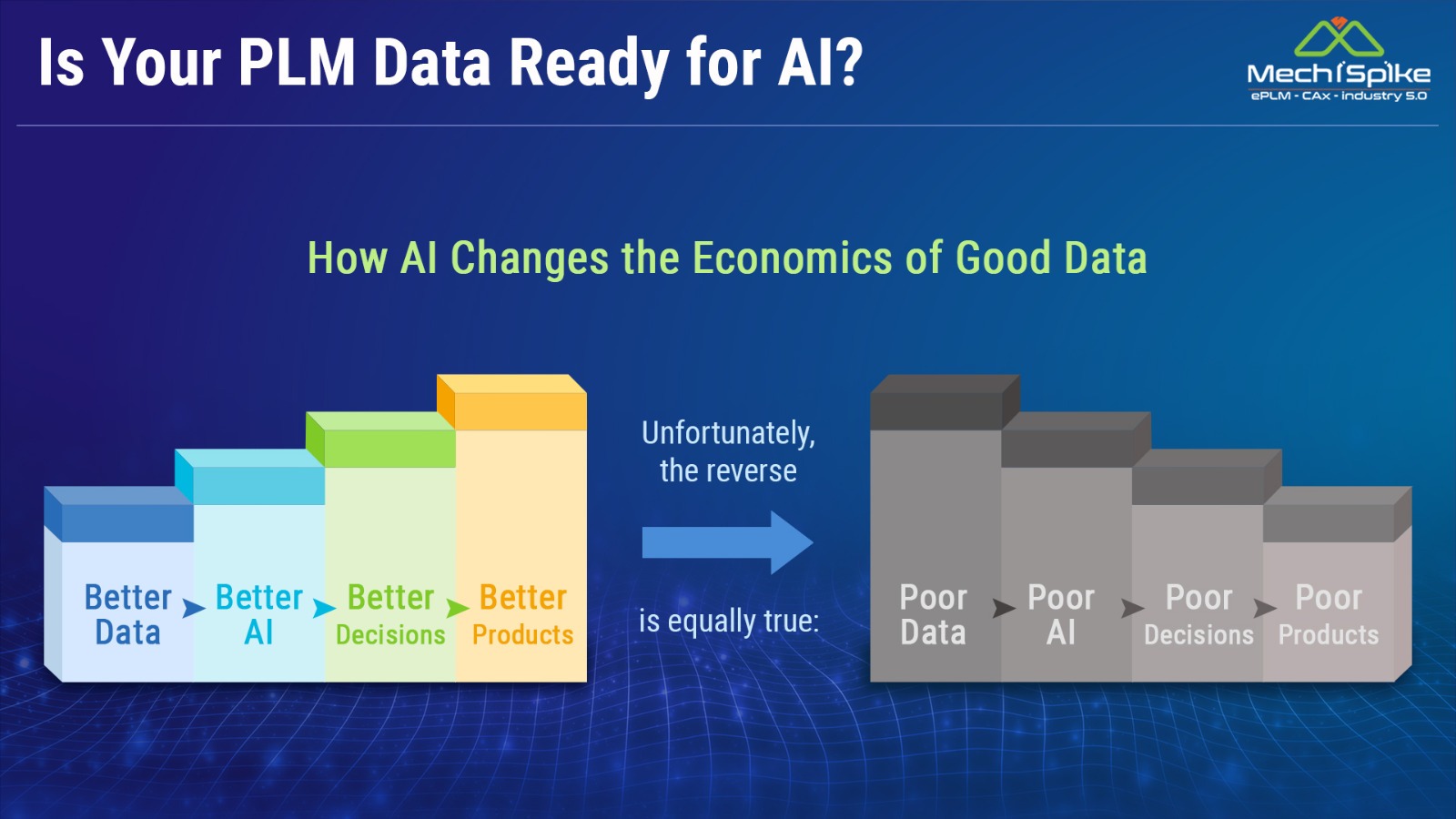
Bad engineering data → Bad AI decisions → Automated bad outcomes.
2. Process Standardisation
Organizations sometimes assume: “AI will figure out our processes.” That is dangerous.
If Engineering Change Management varies significantly between departments, AI has no consistent process to learn from.
Before introducing autonomous workflows, manufacturers should determine:
- What is the standard process?
- Which variations are legitimate?
- Which variations are simply historical habits?
AI should not automate organizational chaos.
3. Product Governance
AI can make decisions only within the boundaries established by the organization.
Who owns a component?
Who can approve an Engineering Change?
Which revision is authoritative?
What happens when EBOM and MBOM disagree?
What information can a supplier access?
These are governance questions—not AI questions.
And they become more important as AI gains autonomy.
4. Security and Intellectual Property
PLM contains some of the most valuable intellectual property in a manufacturing company.
AI introduces new access paths.
Copilots and agents may access:
- CAD data,
- BOMs,
- Specifications,
- Supplier information,
- Historical changes.
Organizations must therefore rethink access control.
The question is no longer simply:
“Which employee can access this?”
It becomes:
“Which human or AI agent can access this information, for what purpose, with what authority, and for how long?”
5. Integration
AI does not create value by sitting inside PLM alone.
The real opportunity emerges when AI can understand relationships across:
PLM → ERP → MES → Quality → Supply Chain → Service
But integration must be governed. Otherwise organizations may create multiple competing versions of product truth.
6. Human Expertise
One of the biggest mistakes would be assuming that AI eliminates the need for experienced engineers.
Engineering knowledge is not simply data.
It includes:
- Judgment,
- Intuition,
- physical understanding,
- Trade-offs,
- Customer context,
- Lessons learned from failures.
AI should initially augment this expertise.
Organizations must deliberately capture and transfer engineering knowledge rather than allowing it to disappear when experienced employees leave.
7. User Adoption
A technically impressive AI system can still fail if engineers don’t trust it.
Engineers need to understand:
- what AI can do,
- what it cannot do,
- when to challenge it,
- how to validate recommendations,
- and when human approval is mandatory.
The objective should not be:
“Get engineers to use AI.”
It should be:
“Help engineers become better at working with AI.”
Special Care for Product Manufacturers
AI adoption in product development has a unique characteristic.
Errors can become physical.
A bad marketing recommendation is inconvenient.
A bad engineering recommendation can become:
- a defective component,
- a manufacturing problem,
- a safety issue,
- a recall,
- or a failed product.
Therefore, the level of AI autonomy should depend on the consequence of failure.
A useful principle is:
Low Risk
AI can act relatively autonomously.
Examples:
- search,
- summarization,
- classification,
- document drafting.
Medium Risk
AI recommends; human validates.
Examples:
- BOM optimization,
- component reuse,
- change-impact analysis.
High Risk
AI assists; qualified humans approve.
Examples:
- safety-critical design changes,
- compliance decisions,
- product release,
- manufacturing parameter changes.
This creates a practical principle:
The greater the physical and business consequence, the stronger the human governance required.
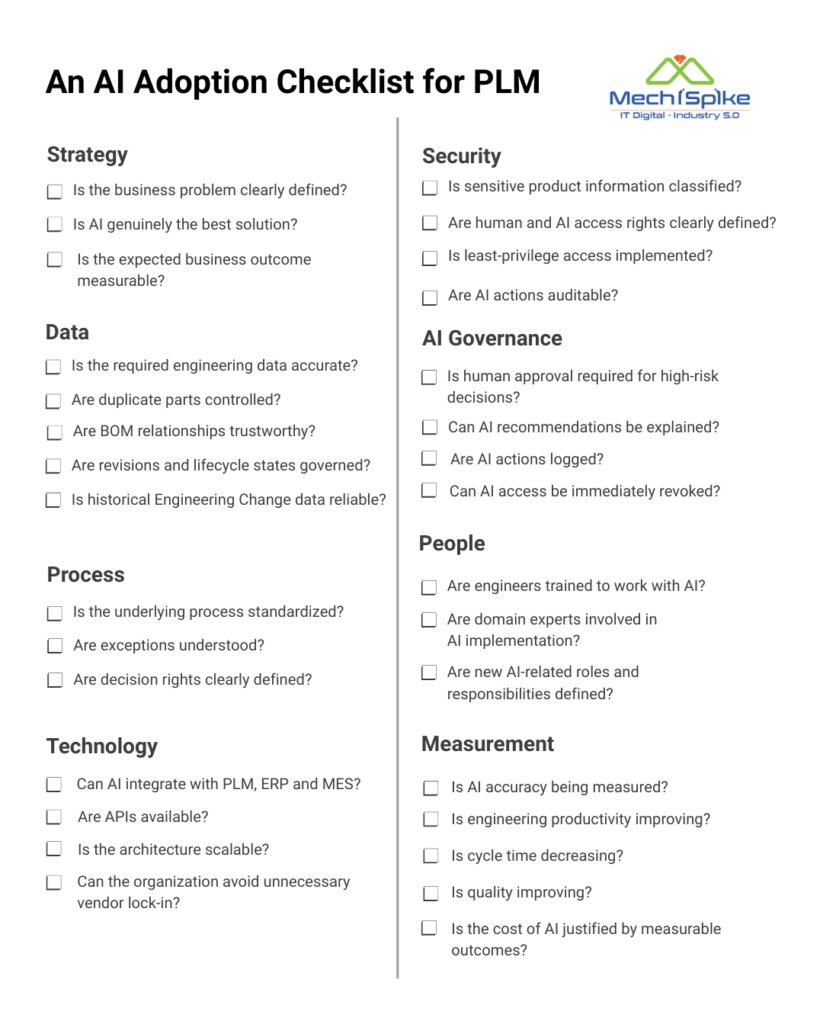
An AI Adoption Checklist for PLM
Before implementing an AI use case, product organizations should ask:
The Leadership Challenge
AI adoption will also change the responsibilities of PLM leaders.
Traditional PLM leadership focused heavily on:
- Systems,
- Processes,
- Implementations,
- Upgrades,
- Governance.
The future PLM leader must additionally understand:
- AI capabilities,
- AI limitations,
- Data quality,
- Agent governance,
- AI economics,
- Cybersecurity,
- Human-AI collaboration.
But perhaps the most important leadership responsibility will be knowing where not to use AI.
Not every process needs an AI agent.
Not every decision should be autonomous.
Not every problem needs another technology layer.
The best leaders will ask: “Where can AI create disproportionate value without compromising product quality, safety, governance or trust?”
The Bigger Lesson
Every major technology wave creates excitement.
CAD changed engineering.
ERP changed enterprise operations.
PLM changed product information management.
Industry 4.0 connected the factory.
AI may connect intelligence across the entire product lifecycle.
But history teaches us something important:
Technology adoption is never just technology adoption.
It changes processes.
It changes roles.
It changes governance.
It changes skills.
It changes culture.
And it creates new risks.
Manufacturers that focus only on the AI layer may therefore miss the transformation happening underneath it.
Conclusion
AI will undoubtedly transform PLM. The question is not whether manufacturers should adopt it. The question is how intelligently they should adopt it.
As AI progresses from assistant to analyst, recommender, agent and eventually autonomous system, the consequences of weak foundations will increase.
Organizations with poor data, inconsistent processes, weak governance, inadequate security and unprepared people will struggle to capture AI’s potential.
The winners will not necessarily be those that deploy the most AI.
They will be those that build the strongest foundation around it.
The future PLM environment will therefore require a balance:
AI + Data Quality
AI + Process Discipline
AI + Governance
AI + Human Expertise
AI + Security
AI + Change Management
The real opportunity is not to make PLM “AI-powered.” It is to make the entire product lifecycle more intelligent—without losing the discipline that makes engineering reliable.
In Summary
AI adoption in PLM should not become a technology race.
Before adding intelligence, manufacturers must strengthen the foundations that intelligence depends upon.
Because the most dangerous question is not:
“What can AI do for our PLM?”
It is:
“What important things might we neglect while AI is doing it?”
MechiSpike can be of great help here to take your organization to the future of Design & Manufacturing with our focus on AI & Industry 5.0 using our prowess in PLM, Engineering and IT Digital.
Click here to know more about us.
For Corporates :
MechiSpike can be of great help to your organization to help you improve your PLM ROI and 30% Savings, be it the hiring cost in staffing or setting up an ODC.
We do this with efficient planning, organizing and controlling Product Master data with seamless data exchange among Engineering, Manufacturing and Enterprise systems.
With our well established niche expertise in PLM, we are now serving more than 15 Global Clients. They are now looking at us as a ‘Go To’ partner for Engineering, IT and PLM. With this confidence, we are expanding our scope of services beyond PLM to Industry 5.0 Digital Transformation i.e. PLM, ERP, CAD, Cloud, AI and DevOps.
Why MechiSpike :

RightSourcing is ‘Better Outsourcing’, given to ‘NICHE EXPERTS’.

Click here to know how we can actually help you with our Proven Methodologies.
For PLM Careers :
Learn More | Earn More | Grow More
Interactive UI : Every Application will get a response with a recruiter contact details and the applicant will get a notification at each phase until the applicant is positioned well with our 15+ global clients in India, USA & Germany.
Candidate Referral Program : Refer a candidate and earn INR 25,000.
Mechispike Solutions Pvt Ltd is a PLM focused company, having all kinds of PLM projects to enable employee career growth and add value to clients. We can position you better with our 15+ global clients in India, USA & Germany.
We believe in “Grow Together” and “Employee First” culture.
Dream more than a Job. Grow your PLM Career to the Fullest with MechiSpike
Click Here to explore our Job Openings.
Subscribe Now :
Our mission : To equip you with the knowledge and tools you need to drive value, streamline operations, and maximize return on investment from your PLM initiatives.
PLM ROI Newsletter will guide you through a comprehensive roadmap to help you unlock the full potential of your PLM investment.
We are committed to be your trusted source of knowledge and support throughout your PLM journey. Our team of experts and thought leaders will bring you actionable insights, best practices, case studies, and the latest trends in PLM.
Subscribe Now to get this weekly series delivered into your Inbox directly, as and when we publish it.
To your PLM success!
Warm regards,
Visit Us: www.mechispike.com
For PLM Services : Click Here to Schedule a Call with us.