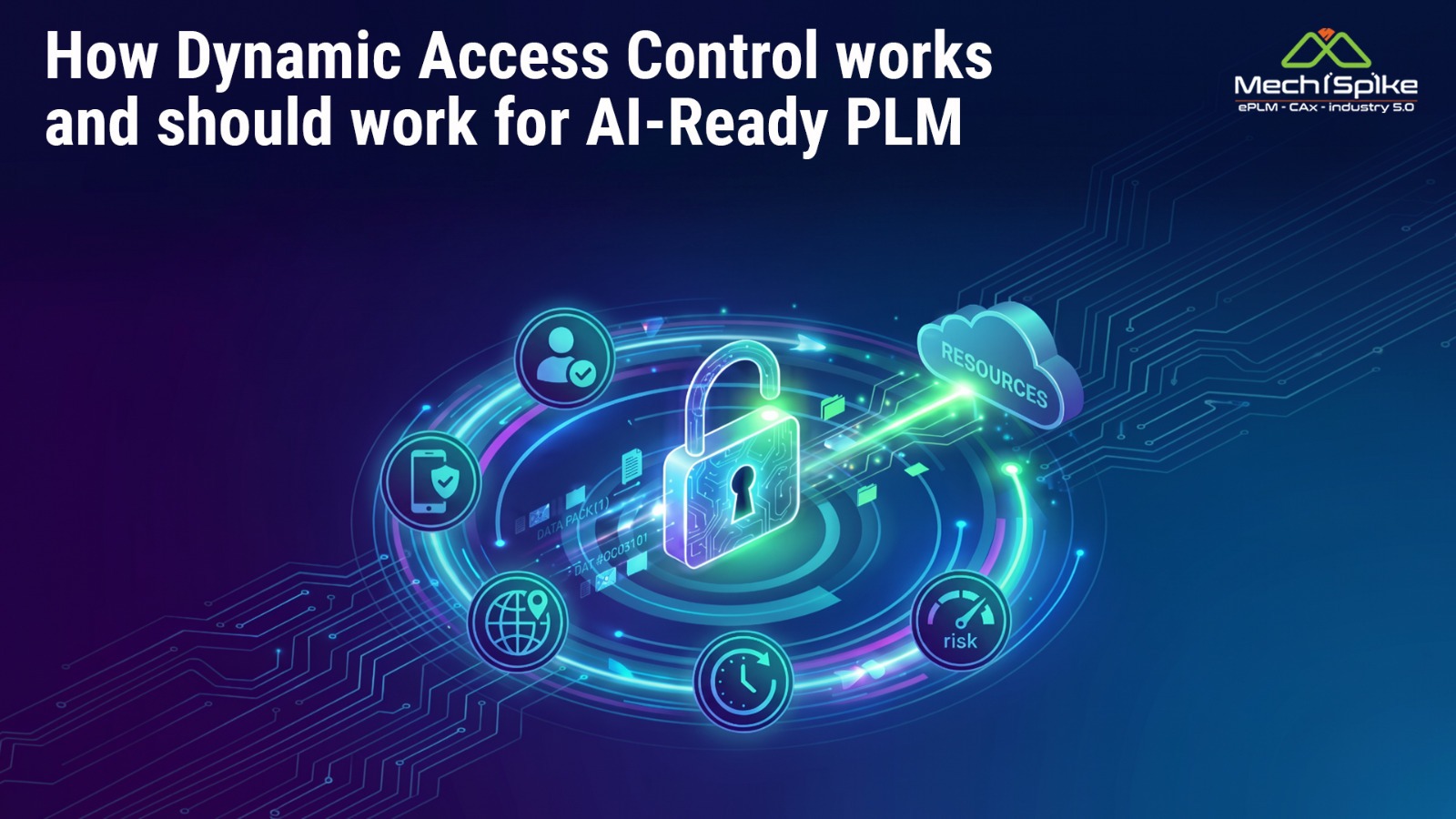
How Dynamic Access Control works and should work for AI-Ready PLM

In this article, let’s explore how dynamic access control is transforming PLM security by calculating permissions at runtime based on roles, groups, projects, ownership and business context. Learn why AI Agents create new PLM security challenges and how manufacturers can govern agent identity, least-privilege access, delegated authority and autonomous actions in AI-ready PLM environments.
How Dynamic Access Control works and should work for AI-Ready PLM
Product Lifecycle Management systems contain some of the most valuable intellectual property inside a manufacturing organisation.
CAD models. Product structures. Bills of Materials. Requirements. Simulation results. Supplier information. Cost data. Manufacturing processes. Engineering changes. Future product designs.
The fundamental security question has therefore always been:
Who should be allowed to do what with which product information—and when?
Historically, organizations often approached this through relatively static permissions and role-based access.
But modern product development is becoming far more dynamic.
Engineers participate in multiple projects. Suppliers collaborate temporarily. Global teams work across organizational boundaries. Products move through different lifecycle states. And increasingly, AI assistants and autonomous agents need access to PLM information.
This requires a more sophisticated approach: Dynamic Access Control.
Managing permissions ensures that the right people have access to the right data at the right time—protecting intellectual property, enabling collaboration and keeping processes secure.
Smart access control is therefore not merely an IT security feature. It is the foundation of a successful PLM strategy.
Why Static Access Is No Longer Enough
Consider a design engineer working on Project Alpha.
The engineer may require:
- Modify access to Project Alpha designs,
- Read access to standard components,
- No access to Project Beta,
- Restricted access to cost information,
- Temporary access to supplier documentation.
Six months later, the engineer moves to another program. Should all those permissions remain? Obviously not.
The problem becomes even more complex when product lifecycle states are considered.
A designer might be allowed to modify a component while it is in Work in Progress, but once it becomes Released, modification may require an Engineering Change process.
Access therefore depends on context.
Not simply:
Who are you?
But also:
What are you trying to access?
What are you trying to do?
Which project are you working on?
What role are you performing?
Who owns the object?
What is its lifecycle state?
That is why modern PLM security increasingly needs to be calculated dynamically.
How Dynamic Access Control Works
Instead of permanently attaching every permission to every PLM object, a modern authorization engine can evaluate access when an operation is requested.
Suppose an engineer attempts to modify a CAD-related object.
The PLM system first gathers the user’s security context.
This might include:
- user identity,
- organization,
- group,
- role,
- project membership,
- ownership,
- geographic or organizational context.
The system then identifies the relevant access-control policy and rules applicable to the requested object and operation.
Conceptually, the process becomes:
User / Agent
↓
Requested Object
↓
Requested Operation
↓
Security Context
↓
Applicable Access Rules
↓
Grant/Deny Resolution
↓
Allow or Reject
The system maps the user’s context against conditions such as:
- Group membership,
- Assigned role,
- Project participation,
- Ownership,
- Object type,
- Lifecycle state,
- Other organizational rules.
Applicable grant and deny rules are resolved.
The operation is then either allowed or rejected.
The important difference is:
Security is calculated at runtime rather than simply stored as static permissions on individual objects.
This provides enormous flexibility.
A Simple Manufacturing Example
Consider a new electric motor being developed.
During early development:
Design Engineers may create and modify CAD models.
Manufacturing Engineers may review manufacturability information.
Procurement may see approved supplier information.
Finance may access cost information.
External Suppliers may access only specifically shared drawings.
Once the design is released, however, the rules change.
Design engineers may no longer directly modify the released definition.
A formal Engineering Change Request may first be required.
The product hasn’t necessarily moved somewhere else.
The user’s identity hasn’t changed. But the business context has changed, so the authorization decision changes. That is the power of dynamic access control.
Designing Access Logic at Organization Level
Before configuring PLM permissions, organizations should avoid starting with individual users.
Start with business logic.
A useful framework is: WHO + WHAT + ACTION + CONTEXT + TIME
WHO?
Identify major communities:
- Design Engineering
- Manufacturing Engineering
- Quality
- Procurement
- Service
- PLM Administration
- Suppliers
- Customers
- Partners
- AI Agents
WHAT?
Classify information:
- CAD
- BOMs
- Requirements
- Changes
- Manufacturing information
- Supplier data
- Cost information
- Compliance documents
ACTION?
Define permitted operations:
- View
- Create
- Modify
- Approve
- Release
- Download
- Export
- Delete
CONTEXT?
Consider:
- Project,
- Role,
- Ownership,
- Lifecycle state,
- Product program,
- Geography,
- Confidentiality level.
TIME?
Some access should be temporary.
Supplier access, contractor access and project-specific access should expire when the business requirement disappears.
This prevents permissions from accumulating indefinitely.
The New Complication: AI Agents
Now introduce Agentic AI.
Imagine an Engineering Change Agent tasked with analyzing the impact of replacing a component.
The agent may need to:
- Read the component.
- Perform where-used analysis.
- Examine affected BOMs.
- Retrieve historical changes.
- inspect supplier information.
- Generate an impact assessment.
- Draft an Engineering Change Request.
Suddenly the question becomes:
What permissions should an AI agent have?
Giving an AI agent unrestricted PLM access simply because it needs broad context would be extremely dangerous.
An AI agent is effectively becoming another participant in the PLM security architecture.
But unlike a human user, it may perform thousands of operations rapidly.
That changes the risk profile dramatically.
Advantages of Dynamic Access for AI Agents
Context-Specific Permissions
Agents can receive access appropriate to a particular task rather than permanent broad access.
Least-Privilege Operation
A BOM-analysis agent may receive read access without modify or release privileges.
Scalable Governance
Organizations can govern many agents using centralized policies.
Temporary Authorization
An agent can receive additional access only for the duration of an approved workflow.
Better Automation
Agents can operate across engineering processes without requiring manually configured permissions for every object.
The Risks
Dynamic access also introduces significant challenges.
Policy Complexity
Too many overlapping rules can become extremely difficult to understand.
Incorrect Rule Configuration
A badly designed rule could accidentally expose sensitive product information.
Agent Speed
A human with excessive access might view several sensitive objects.
An autonomous agent could potentially access thousands before the problem is detected.
Cascading Actions
One agent may invoke another agent, API or enterprise system, creating complicated authorization chains.
Auditability
Organizations must understand not only:
Who accessed the information?
but increasingly:
Which agent accessed it, for what purpose, under whose authority, and what did it do next?
Special Care Required for AI Agents
Manufacturers should therefore avoid treating AI agents exactly like human users.
Every enterprise AI agent should have a clearly defined identity.
Do not allow multiple agents to operate through generic administrator credentials.
Second, define the agent’s purpose.
A Part Search Agent should not automatically receive Engineering Change approval rights.
Third, apply least privilege.
Give the agent only the permissions required to perform its defined task.
Fourth, separate:
Read → Recommend → Modify → Approve → Release
These represent dramatically different risk levels.
An AI agent might be allowed to read BOMs and recommend a change while a human remains responsible for approval.
This reflects an important Industry 5.0 principle:
Autonomy should increase gradually with trust, evidence and governance.
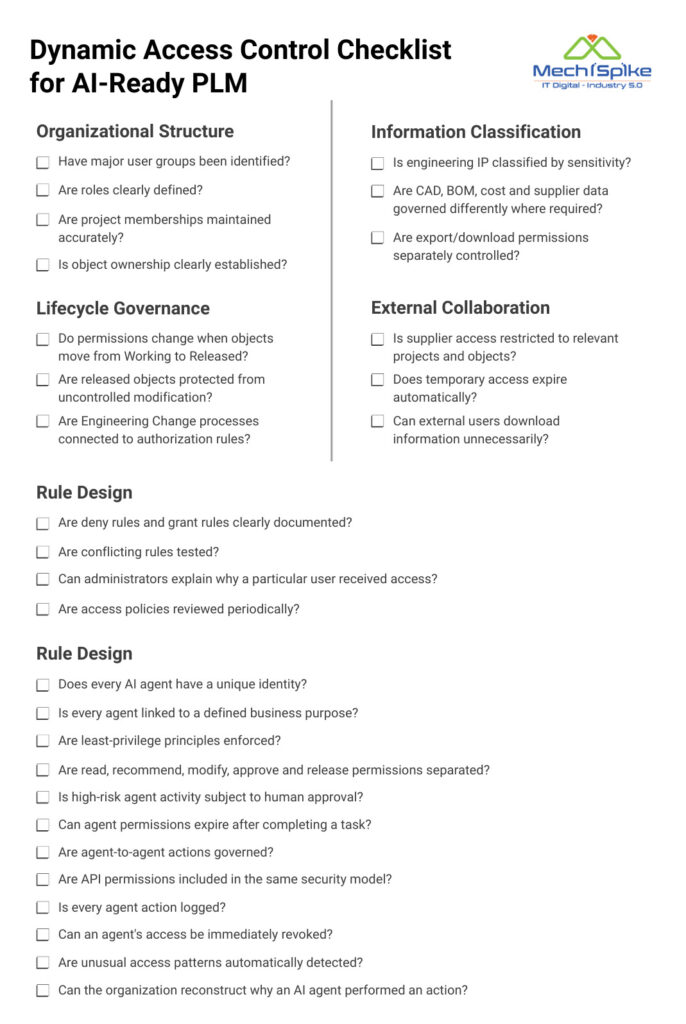
Dynamic Access Control Checklist for AI-Ready PLM
Before implementing access-control logic, organizations should ask:
Dynamic Security Must Not Become Dynamic Chaos
There is an important warning.
More sophisticated access control does not automatically mean better security.
If organizations create thousands of poorly understood rules, dynamic authorization can become almost impossible to govern.
The objective should therefore be:
Minimum complexity required for maximum control.
Organizations should standardize common access patterns, minimize exceptions, periodically remove obsolete rules and continuously test authorization logic.
AI itself could eventually assist here.
AI may analyze access patterns and identify:
- excessive privileges,
- unusual behavior,
- obsolete permissions,
- conflicting policies,
- and potential security risks.
So AI will not only create new access-control challenges.
It may also become part of the solution.
From Role-Based Access to Context-Aware PLM
The deeper transition is therefore not simply from static permissions to dynamic permissions.
PLM security is becoming increasingly context aware.
Access decisions may depend simultaneously on:
Identity + Role + Group + Project + Ownership + Product + Lifecycle State + Requested Action + Business Rule
And soon:
Agent Identity + Agent Purpose + Delegated Authority + Risk Level.
This will become increasingly important as PLM evolves from systems used primarily by humans into platforms accessed continuously by humans, copilots, applications and autonomous agents.
Conclusion
Managing access to product information has always been fundamental to PLM.
Manufacturers need to protect intellectual property without preventing the collaboration required to design and manufacture products efficiently.
Dynamic access control provides a powerful way forward by calculating authorization based on the user’s current security context, applicable policies, roles, groups, projects, ownership and business rules rather than relying exclusively on static object permissions.
AI agents make this capability even more important—and considerably more challenging.
As agents begin searching product information, analyzing BOMs, preparing engineering changes and eventually executing selected actions, manufacturers must treat AI identities and permissions with the same seriousness as human access—potentially even greater seriousness because of the speed and scale at which agents operate.
The future PLM security question will therefore move beyond:
“Who is allowed to access this?”
toward:
“Who—or what—is requesting access, for what purpose, under which context, with what authority, and for how long?”
Getting that answer right will be fundamental to building secure, collaborative and truly AI-ready PLM environments.
MechiSpike can be of great help here to take your organization to the future of Design & Manufacturing with our focus on AI & Industry 5.0 using our prowess in PLM, Engineering and IT Digital.
Click here to know more about us.
For Corporates :
MechiSpike can be of great help to your organization to help you improve your PLM ROI and 30% Savings, be it the hiring cost in staffing or setting up an ODC.
We do this with efficient planning, organizing and controlling Product Master data with seamless data exchange among Engineering, Manufacturing and Enterprise systems.
With our well established niche expertise in PLM, we are now serving more than 15 Global Clients. They are now looking at us as a ‘Go To’ partner for Engineering, IT and PLM. With this confidence, we are expanding our scope of services beyond PLM to Industry 5.0 Digital Transformation i.e. PLM, ERP, CAD, Cloud, AI and DevOps.
Why MechiSpike :

RightSourcing is ‘Better Outsourcing’, given to ‘NICHE EXPERTS’.

Click here to know how we can actually help you with our Proven Methodologies.
For PLM Careers :
Learn More | Earn More | Grow More
Interactive UI : Every Application will get a response with a recruiter contact details and the applicant will get a notification at each phase until the applicant is positioned well with our 15+ global clients in India, USA & Germany.
Candidate Referral Program : Refer a candidate and earn INR 25,000.
Mechispike Solutions Pvt Ltd is a PLM focused company, having all kinds of PLM projects to enable employee career growth and add value to clients. We can position you better with our 15+ global clients in India, USA & Germany.
We believe in “Grow Together” and “Employee First” culture.
Dream more than a Job. Grow your PLM Career to the Fullest with MechiSpike
Click Here to explore our Job Openings.
Subscribe Now :
Our mission : To equip you with the knowledge and tools you need to drive value, streamline operations, and maximize return on investment from your PLM initiatives.
PLM ROI Newsletter will guide you through a comprehensive roadmap to help you unlock the full potential of your PLM investment.
We are committed to be your trusted source of knowledge and support throughout your PLM journey. Our team of experts and thought leaders will bring you actionable insights, best practices, case studies, and the latest trends in PLM.
Subscribe Now to get this weekly series delivered into your Inbox directly, as and when we publish it.
To your PLM success!
Warm regards,
Visit Us: www.mechispike.com
For PLM Services : Click Here to Schedule a Call with us.