Software License Optimization Guide for the new AI Era

In this article, let’s explore Software License Optimization – how it is changing due to AI, Common License Optimization Problems and a Step-by-Step License Optimization Checklist.
Software License Optimization (SLO) Guide for the new AI Era
For decades, software licensing was viewed primarily as a procurement or IT administration activity.
Organizations purchased licenses for:
- PLM systems,
- ERP platforms,
- CAD applications,
- Manufacturing Execution Systems (MES),
- Quality Management Systems,
- Collaboration tools.
Once the contracts were signed, attention shifted toward implementation and operations.
Unfortunately, many enterprises rarely revisited a critical question: Are we actually utilizing what we are paying for?
Today, that question has become more important than ever.
The emergence of AI, Agentic Systems, and Industry 5.0 is fundamentally changing how enterprise software is consumed.
Traditional role-based licensing models are gradually evolving toward rule-based and usage-based consumption patterns, creating both opportunities and risks for product manufacturers.
As AI agents begin interacting with enterprise systems, organizations must rethink how they measure, govern, and optimize software license utilization.
The concepts described in the transition from human role-based access to AI-driven rule-based access are already beginning to reshape enterprise software economics.
License Cost Was Always Important
Software licenses have historically represented one of the largest recurring expenses within engineering and manufacturing organizations.
Large manufacturers routinely spend millions annually on:
- PLM licenses,
- ERP licenses,
- CAD licenses,
- Simulation tools,
- Analytics platforms,
- Cloud subscriptions.
Yet many organizations discover:
- Inactive users,
- Duplicate capabilities,
- Excessive license tiers,
- Underutilized modules,
- Poorly aligned user assignments.
In some enterprises, low utilization rates are not uncommon. The challenge was always significant. The difference now is that AI introduces an entirely new cost dimension.
The Shift from Roles to Rules
Traditional enterprise systems were designed around people.
A Design Engineer received a Design Engineer license.
A Manufacturing Engineer received a Manufacturing Engineer license.
A Project Manager received a Manager license.
Access rights were tied to job roles.
However, AI is introducing a new operating model.
Instead of asking: “Which user should perform this task?”, Organizations are increasingly asking: “Which agent, workflow, or automated process should perform this task?”
This transition is moving enterprises from: Role-Based Access toward Rule-Based Access and Autonomous Actions.
AI agents can:
- Analyze BOM structures,
- Perform change impact analysis,
- Validate compliance,
- Generate reports,
- Trigger workflows,
- Coordinate between PLM and ERP systems.
The result is that software consumption is no longer driven exclusively by human users.
Why This Changes License Economics
Traditional licensing models typically rely on:
- Named Users
- Concurrent Users
- Functional Roles
AI introduces questions that many software vendors are still trying to answer:
- Is an AI agent considered a user?
- How should autonomous workflows be licensed?
- Should organizations pay per action?
- Per API call?
- Per transaction?
- Per outcome?
As organizations adopt Agentic AI, software utilization may increase dramatically even when headcount remains constant.
This creates a new optimization challenge.
Understanding License Utilization
License utilization simply means measuring how effectively purchased software licenses are actually being used.
A well-managed environment seeks to maximize:
- Business Value Obtaining measurable outcomes from licenses.
- Utilization Ensuring licenses are actively used.
- Cost Efficiency Avoiding waste and redundancy.
Optimization does not mean buying fewer licenses. It means buying the right licenses for the right users, workflows, and future operating models.
Common License Optimization Problems
Most manufacturers face one or more of these challenges:
- Over-Licensing: Purchasing more licenses than required.
- Under-Licensing: Insufficient licenses causing operational bottlenecks.
- Role Inflation: Users over empowered with expensive licenses despite limited functionality needs.
- Shelfware: Purchased modules that are never adopted.
- Legacy Contract Structures: Contracts negotiated years ago that no longer align with current usage patterns.
- AI Readiness Blind Spots: Licensing models that fail to account for future AI and agent-based consumption.
Why Product Manufacturers Face a Bigger Challenge
Product manufacturers operate highly interconnected environments involving:
- PLM
- ERP
- MES
- CAD
- SCM
- Quality Systems
- Digital Twins
- AI Platforms
Each system may have:
- Separate licensing models,
- Different usage metrics,
- Varying user classifications.
When AI agents begin interacting across these systems, software utilization becomes significantly more complex.
For example:
An engineering change request may involve:
- PLM workflows,
- ERP validation,
- Supplier collaboration,
- Compliance checking,
- AI-driven impact analysis.
One process can touch multiple licensed systems simultaneously. Without governance, costs can escalate rapidly.
Lack of Independent Consulting
One of the least discussed challenges in software license optimization is the lack of truly independent expertise.
Many enterprises depend heavily on guidance from:
- Software vendors
- System integrators
- Implementation partners
These organizations often possess deep product knowledge.
However, they may also have commercial incentives tied to:
- License growth,
- Cloud consumption,
- Module expansion,
- Platform adoption.
This does not automatically imply bad advice.
But it can create a bias.
At the same time, some independent consultants struggle to stay current with:
- AI licensing models,
- Cloud economics,
- Agentic AI architectures,
- Usage-based pricing,
- Evolving vendor contracts.
As a result, enterprises frequently receive either: Vendor-biased recommendations, or Outdated recommendations. Neither supports long-term optimization.
Building the Right License Optimization Team
The solution begins with governance.
Organizations should establish a cross-functional Software Economics Team comprising:
PLM Experts : Understanding engineering workflows.
ERP Experts : Understanding enterprise operations.
Enterprise Architects : Evaluating technical implications.
Procurement Specialists : Managing commercial negotiations.
AI and Automation Experts : Assessing future agent-based consumption.
Finance Representatives : Measuring ROI and cost impact.
Independent Consultants : Unbiased as well as Latest Technology Expertise.
Most importantly:
This team must have the freedom to challenge existing assumptions, legacy contracts, and vendor recommendations.
Their objective should be: Maximize business value, not software consumption.
A Step-by-Step License Optimization Checklist
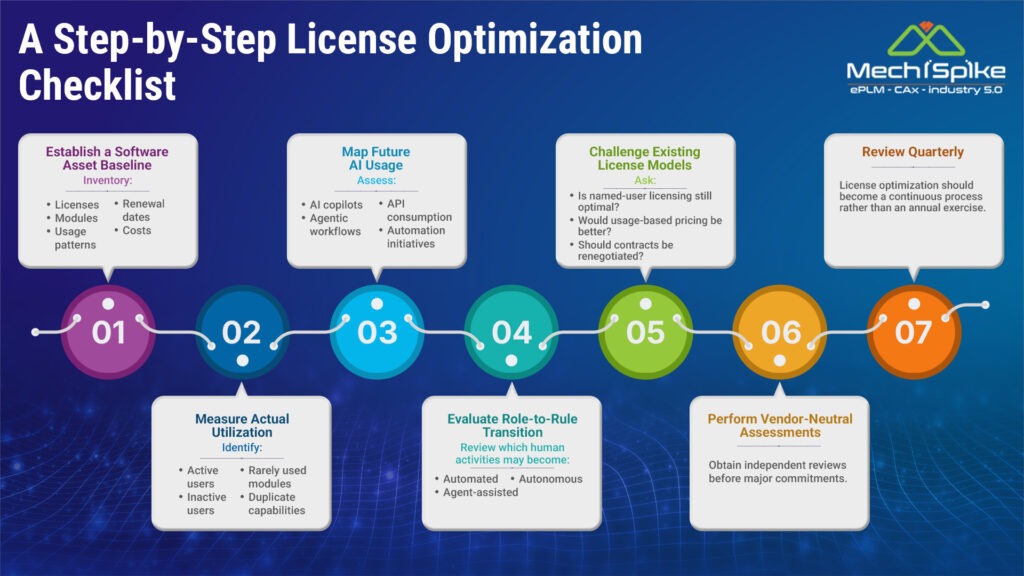
Step 1: Establish a Software Asset Baseline
Inventory:
- Licenses,
- Modules,
- Usage patterns,
- Renewal dates &
- Costs.
Step 2: Measure Actual Utilization
Identify:
- Active users,
- Inactive users,
- Rarely used modules,
- Duplicate capabilities.
Step 3: Map Future AI Usage
Assess:
- AI copilots,
- Agentic workflows,
- API consumption,
- Automation initiatives.
Step 4: Evaluate Role-to-Rule Transition
Review which human activities may become:
- Automated,
- Agent-assisted,
- Autonomous.
Step 5: Challenge Existing License Models
Ask:
- Is named-user licensing still optimal?
- Would usage-based pricing be better?
- Should contracts be renegotiated?
Step 6: Perform Vendor-Neutral Assessments
Obtain independent reviews before major commitments.
Step 7: Review Quarterly
License optimization should become a continuous process rather than an annual exercise.
Best Practices for the Future
Successful manufacturers increasingly follow these principles:
- Treat Licenses as Strategic Assets : Not administrative overhead.
- Monitor Utilization Continuously : Not just before renewals.
- Align Licensing with Business Processes : Not organizational hierarchy.
- Plan for AI Consumption Models : Before large-scale deployment.
- Build Independent Decision-Making Capability : Avoid excessive dependency on any single vendor or consultant.
Recommended Governance Cadence
Monthly
- License utilization review
- User activity analysis
- AI consumption review
Quarterly
- Contract optimization assessment
- Vendor performance review
- Role-to-rule transition analysis
Biannually
- Independent licensing audit
- Future architecture review
Annually
- Strategic licensing roadmap refresh
Conclusion
Software license utilization has always been important. However, in the emerging world of AI, Agentic Systems, and Industry 5.0, it is becoming a critical boardroom discussion.
As enterprises move from role-based access toward rule-based and AI-driven execution models, traditional licensing assumptions are being rewritten.
Traditional licensing assumptions will be challenged, and organizations that continue managing licenses as a procurement activity may struggle to control costs.
Organizations must now optimize not only user licenses, but also future AI consumption patterns, automation workflows, and agent-driven system interactions.
For product manufacturers managing expensive PLM, ERP, CAD, and digital engineering ecosystems, the path forward requires independent thinking, disciplined governance, continuous measurement, and vendor-neutral decision making.
The future belongs to organizations that understand a simple truth:
The objective is not to buy more licenses. The objective is to maximize value from every license, every workflow, and eventually, every AI-driven action.
MechiSpike can be of great help here to take your organization to the future of License Optimization with our focus on AI & Industry 5.0 using our prowess in PLM, Engineering and IT Digital.
Click here to know more about us.
For Corporates :
MechiSpike can be of great help to your organization to help you improve your PLM ROI and 30% Savings, be it the hiring cost in staffing or setting up an ODC.
We do this with efficient planning, organizing and controlling Product Master data with seamless data exchange among Engineering, Manufacturing and Enterprise systems.
With our well established niche expertise in PLM, we are now serving more than 15 Global Clients. They are now looking at us as a ‘Go To’ partner for Engineering, IT and PLM. With this confidence, we are expanding our scope of services beyond PLM to Industry 5.0 Digital Transformation i.e. PLM, ERP, CAD, Cloud, AI and DevOps.
Why MechiSpike :

RightSourcing is ‘Better Outsourcing’, given to ‘NICHE EXPERTS’.

Click here to know how we can actually help you with our Proven Methodologies.
For PLM Careers :
Learn More | Earn More | Grow More
Interactive UI : Every Application will get a response with a recruiter contact details and the applicant will get a notification at each phase until the applicant is positioned well with our 15+ global clients in India, USA & Germany.
Candidate Referral Program : Refer a candidate and earn INR 25,000.
Mechispike Solutions Pvt Ltd is a PLM focused company, having all kinds of PLM projects to enable employee career growth and add value to clients. We can position you better with our 15+ global clients in India, USA & Germany.
We believe in “Grow Together” and “Employee First” culture.
Dream more than a Job. Grow your PLM Career to the Fullest with MechiSpike
Click Here to explore our Job Openings.
Subscribe Now :
Our mission : To equip you with the knowledge and tools you need to drive value, streamline operations, and maximize return on investment from your PLM initiatives.
PLM ROI Newsletter will guide you through a comprehensive roadmap to help you unlock the full potential of your PLM investment.
We are committed to be your trusted source of knowledge and support throughout your PLM journey. Our team of experts and thought leaders will bring you actionable insights, best practices, case studies, and the latest trends in PLM.
Subscribe Now to get this weekly series delivered into your Inbox directly, as and when we publish it.
To your PLM success!
Warm regards,
Visit Us: www.mechispike.com
For PLM Services : Click Here to Schedule a Call with us.