
Digital Twins Vs Virtual Twins: The Difference and How to Leverage both

In this article, let’s look at Digital Twins Vs Virtual Twins. What they are, how do they differ from each other and how to leverage both in Product Design as well as Manufacturing.
Digital Twins Vs Virtual Twins: The Difference and How to Leverage both
For more than a decade, Digital Twins have been positioned as a cornerstone of smart manufacturing and Industry 4.0.
By mirroring physical assets with sensor-driven digital replicas, companies gained visibility into performance, health, and efficiency. But as products become more complex, supply chains more volatile, and sustainability pressures more intense, Digital Twins alone are no longer sufficient.
A new paradigm is emerging—Virtual Twins.
While often used interchangeably in casual conversation, Digital Twins and Virtual Twins represent fundamentally different approaches to how engineering products are designed, validated, manufactured, and evolved.
This distinction is becoming critical as AI, generative models, and autonomous agents reshape industrial decision-making.
This article explores that shift in depth, explains why engineering-driven products benefit most, outlines the KPI changes required, and provides a practical checklist for manufacturers preparing for this transformation.
Understanding the Difference: Digital Twin vs Virtual Twin
Digital Twin: Optimizing What Exists
A Digital Twin is a digital representation of a physical asset that mirrors its current or historical state using real-world data.
In engineering and manufacturing, Digital Twins are typically used for:
- Equipment health monitoring
- Predictive maintenance
- Performance tracking
- Failure diagnostics
Example: A Digital Twin of an industrial compressor monitors vibration, pressure, and temperature to predict bearing failure before it happens.
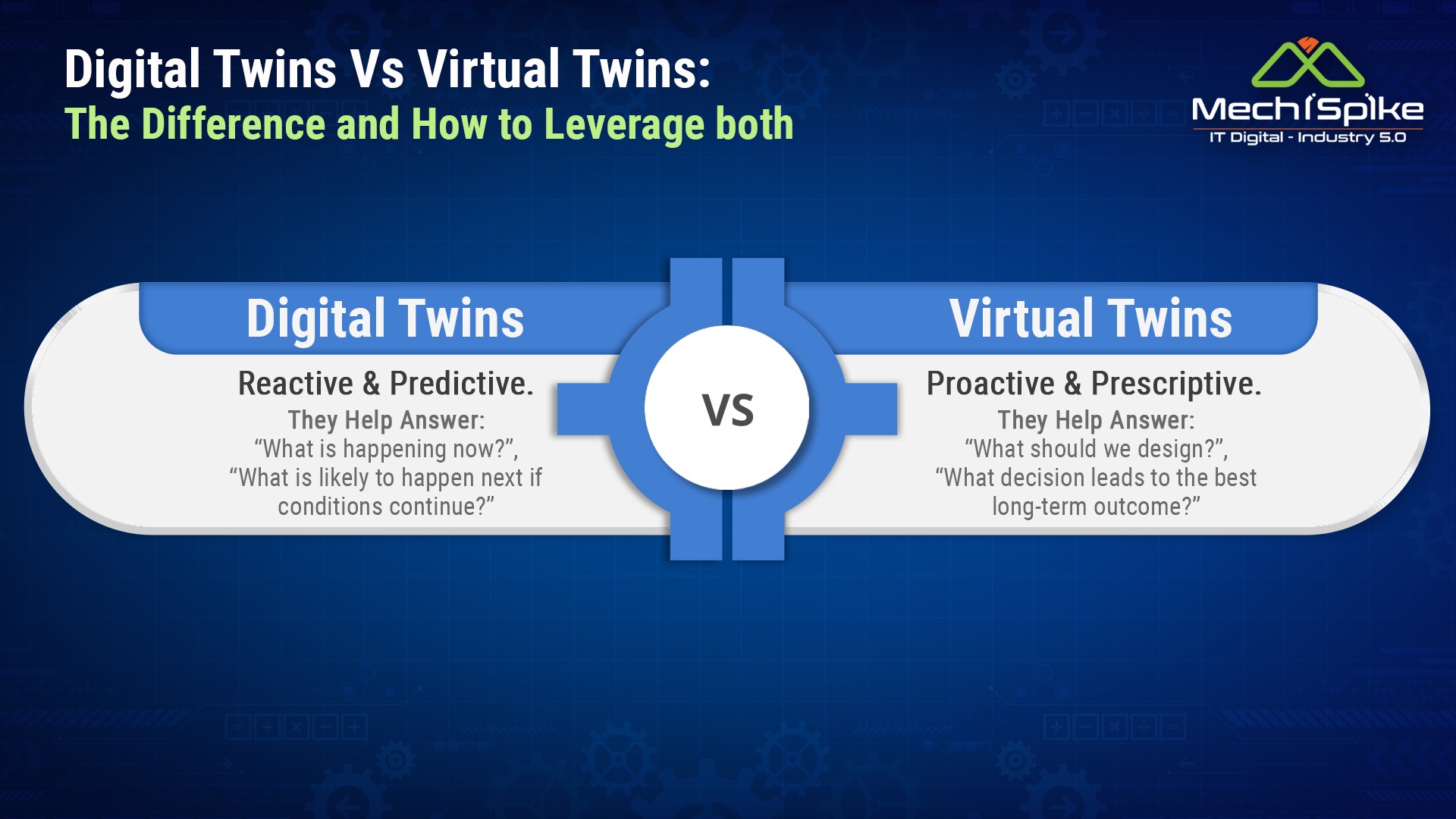
Digital Twins are reactive & predictive. They help answer: “What is happening now?” “What is likely to happen next if conditions continue?”
They excel at operational optimization, but they remain constrained by the reality that already exists.
Virtual Twin: Designing and Deciding Before Reality Exists
A Virtual Twin, by contrast, is virtual-first and AI-powered. It can exist before a physical product, factory, or system is built, and it continues to evolve after deployment.
A Virtual Twin combines:
- Physics-based engineering models
- System behavior and constraints
- AI-driven reasoning and prediction
- Scenario simulation across the lifecycle
Example: A Virtual Twin of a new electric drivetrain simulates performance across different climates, supplier material variations, manufacturing tolerances, and end-of-life recycling scenarios—before a prototype is built.
Virtual Twins are proactive & prescriptive. They help answer: “What should we design?” “What decision leads to the best long-term outcome?”
Why Engineering Products Are at the Center of This Shift
Engineering-driven products—automotive platforms, aerospace systems, industrial machinery, medical devices—are ideal candidates for Virtual Twins.
Mainly because they share key characteristics:
- Long development cycles
- High cost of late-stage changes
- Strong coupling between design, manufacturing, and service
- Strict regulatory and safety requirements
- Growing sustainability expectations
In these environments, physical trial-and-error is expensive and risky. Virtual Twins shift learning upstream, where mistakes are cheap and insights are scalable.
How Digital Twins and Virtual Twins Work Together
This is not a replacement—it is an evolution.
- Virtual Twin → used to design, validate, and decide
- Digital Twin → used to monitor, measure, and learn
- Operational data from Digital Twins feeds back into Virtual Twins
- AI learns from reality and improves future designs
This creates a closed-loop intelligence system across the entire product lifecycle.
Digital Twin = truth of reality Virtual Twin = intelligence for future decisions
Impact on Product Design
1. Expanded Design Space Exploration
Virtual Twins allow engineers to explore thousands of design variants using AI and simulation—far beyond what traditional methods allow.
Example: Instead of testing three design options, an AI-powered Virtual Twin evaluates hundreds of structural geometries and highlights the top 5 based on performance, cost, and sustainability trade-offs.
2. Predictive Design Decisions
Design choices are no longer based solely on experience and assumptions. Virtual Twins predict how products will behave over time and under extreme conditions.
This reduces:
- Late engineering changes
- Warranty risks
- Field failures
3. Continuous Design Evolution
As products operate in the field, Digital Twin data updates the Virtual Twin, allowing future product generations to improve continuously.
Design becomes adaptive, not static.
Impact on Manufacturing and Production
1. Virtual Factories Before Physical Ones
Manufacturing systems can be designed and optimized entirely in virtual space.
Example: A production line layout is simulated with AI agents testing throughput, ergonomics, energy use, and bottlenecks before any equipment is installed.
2. Adaptive Manufacturing Operations
Digital Twins mirror real-time operations, while Virtual Twins simulate alternate futures.
AI can:
- Predict disruptions
- Suggest schedule or routing changes
- Optimize quality, cost, and delivery simultaneously
Manufacturing becomes resilient and adaptive, not just automated.
3. Human–AI Collaboration
Engineers and operators interact with Virtual Twins through immersive and conversational interfaces.
Humans provide:
- Judgment
- Ethics
- Creativity
AI provides:
- Memory
- Prediction
- Optimization
This aligns directly with Industry 5.0’s human-centric vision.
KPI Changes Required for the Virtual Twin Era
Traditional KPIs focus on execution efficiency. Virtual Twins demand intelligence-driven KPIs.
Old KPIs (Still Necessary, But Not Sufficient)
- Cycle time
- Cost per unit
- Utilization
- Downtime
New KPI Categories
1. Design Intelligence KPIs
- Design Space Coverage – number of viable alternatives explored
- Design Confidence Index – predicted vs actual performance alignment
- Rework Avoidance Rate
2. Manufacturing Adaptability KPIs
- Mean Time to Adapt (MTTA) to disruptions
- Virtual-to-Physical Iteration Ratio
- First-Time-Right via Virtual Validation
3. Lifecycle & Sustainability KPIs
- Lifecycle Carbon per Product
- Circularity Index
- Failure Prediction Accuracy
4. Human–AI Collaboration KPIs
- Decision Latency Reduction
- Human–AI Productivity Index
- Exception Resolution Speed
These KPIs reward foresight, learning, and resilience, not just output.
Checklist: How Product Manufacturers Can Prepare
Strategy & Mindset
- ☐ Shift from physical-first to virtual-first thinking
- ☐ Treat Virtual Twins as strategic decision assets
Data & Architecture
- ☐ Build a unified digital thread across lifecycle stages
- ☐ Ensure clean, connected engineering and manufacturing data
- ☐ Enable AI access to contextual, cross-domain information
Technology
- ☐ Invest in multi-physics simulation and system modeling
- ☐ Layer AI for reasoning, prediction, and orchestration
- ☐ Integrate Digital Twins, Virtual Twins, and IoT
Organization & Process
- ☐ Redesign workflows to validate decisions virtually first
- ☐ Establish human-in-the-loop governance
- ☐ Pilot in high-impact engineering and manufacturing areas
People & Skills
- ☐ Develop AI literacy among engineers and managers
- ☐ Strengthen systems thinking and lifecycle awareness
- ☐ Encourage collaboration between domain experts and data specialists
Challenges to Anticipate
- Over-reliance on models without human judgment
- Poor data quality undermining AI predictions
- Cultural resistance to virtual-first decision-making
Success depends as much on people and governance as on technology.
Conclusion: From Optimizing Reality to Designing the Future
Digital Twins helped industries optimize what already exists. Virtual Twins enable industries to design what should exist.
For engineering-driven products, this shift represents a structural transformation—moving intelligence upstream, reducing physical trial-and-error, and enabling responsible, resilient innovation.
The future of industrial systems will not be designed primarily in factories or labs. They will be designed in AI-powered virtual environments, validated before reality is touched.
Manufacturers that embrace this transition—by evolving KPIs, upskilling people, and rethinking decision workflows—will lead the next era of engineering and manufacturing.
The future is not just digital. It is virtual, intelligent, and profoundly human-centric.
MechiSpike can be of great help here to take your organization to the future of Product Design as well as Manufacturing with our focus on Industry 5.0 using our prowess in PLM, Engineering and IT Digital.
Click here to know more about us.
For Corporates :
MechiSpike can be of great help to your organization to help you improve your PLM ROI and 30% Savings, be it the hiring cost in staffing or setting up an ODC.
We do this with efficient planning, organizing and controlling Product Master data with seamless data exchange among Engineering, Manufacturing and Enterprise systems.
With our well established niche expertise in PLM, we are now serving more than 15 Global Clients. They are now looking at us as a ‘Go To’ partner for Engineering, IT and PLM. With this confidence, we are expanding our scope of services beyond PLM to Industry 5.0 Digital Transformation i.e. PLM, ERP, CAD, Cloud, AI and DevOps.
Why MechiSpike :

RightSourcing is ‘Better Outsourcing’, given to ‘NICHE EXPERTS’.

Learn More | Earn More | Grow More
Interactive UI : Every Application will get a response with a recruiter contact details and the applicant will get a notification at each phase until the applicant is positioned well with our 15+ global clients in India, USA & Germany.
Candidate Referral Program :
Mechispike Solutions Pvt Ltd is a PLM focused company, having all kinds of PLM projects to enable employee career growth and add value to clients. We can position you better with our 15+ global clients in India, USA & Germany.
We believe in “Grow Together” and “Employee First” culture.
Dream more than a Job. Grow your PLM Career to the Fullest with MechiSpike
Click Here to explore our Job Openings.
Subscribe Now :
Our mission : To equip you with the knowledge and tools you need to drive value, streamline operations, and maximize return on investment from your PLM initiatives.
PLM ROI Newsletter will guide you through a comprehensive roadmap to help you unlock the full potential of your PLM investment.
We are committed to be your trusted source of knowledge and support throughout your PLM journey. Our team of experts and thought leaders will bring you actionable insights, best practices, case studies, and the latest trends in PLM.
Subscribe Now to get this weekly series delivered into your Inbox directly, as and when we publish it.
To your PLM success!
Warm regards,
Visit Us: www.mechispike.com
If you want to Grow your PLM Career to the Fullest, Click Here to explore our Job Openings.
For PLM Services : Click Here to Schedule a Call with us.